Comparison · 6 min read
AI Voiceover for Instagram Reels: ElevenLabs vs Gemini vs OpenAI

You have a reel cut together and it needs a voice. You do not want to record yourself, or you want the same clean voice on every video, so you are looking at ElevenLabs, Google's Gemini text-to-speech and OpenAI. Good news first: the voiceover is the cheapest part of an AI reel by a long way.
Short answer, on prices read on 19 November 2026: a 30-second voiceover costs a few cents or less on any of the three. So do not pick on price. Pick on which voice sounds right for your brand, whether it speaks your audience's languages, and whether your plan lets you use it commercially. Prices move, so check before you build a habit on one.
How long should the script be?
Voiceover work commonly plans on about 150 words a minute. That is a rule of thumb from production, not a measured standard, but it gets you close. A 30-second reel holds roughly 75 words, which is around 450 characters with spaces.
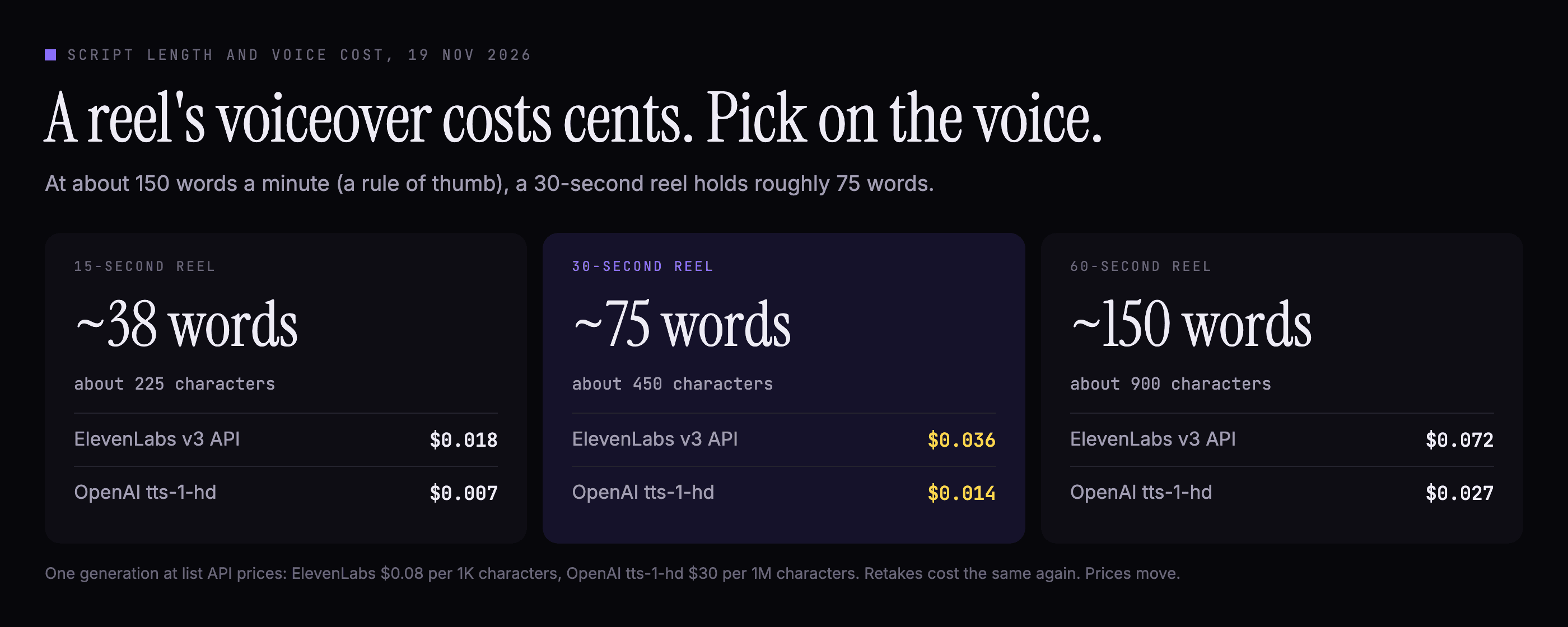
Seventy-five words is less than most people write on a first try. If your draft runs to 120 words, the voice will either rush or run past the end of the video. Cut it before you generate, because every retake is billed.
Read the script aloud with a timer once. AI voices vary in pace, and some read faster or slower than the rule of thumb.
What does one reel's voiceover cost?
Here is what each vendor charged on 19 November 2026, read from their own pricing pages.
| Vendor and model | How it is priced | 30-second reel (about 450 characters) |
|---|---|---|
| ElevenLabs eleven_v3, multilingual_v2, v4 (API) | $0.08 per 1K characters | About $0.036 |
| ElevenLabs Flash/Turbo-class (API) | About $0.04 per 1K characters | About $0.018 |
| OpenAI tts-1 | $15 per 1M characters | About $0.007 |
| OpenAI tts-1-hd | $30 per 1M characters | About $0.014 |
| OpenAI gpt-4o-mini-tts | $0.60 per 1M text tokens in, $12 per 1M audio tokens out | Token priced, not converted here |
| Google gemini-3.8-flash-tts | $0.50 per 1M text tokens in, $9.00 per 1M audio tokens out | Token priced, not converted here |
| Google Flash-Lite TTS | $0.50 in, $6.00 out per 1M tokens | Token priced, not converted here |
For the token-priced models, the bill depends on how many audio tokens the vendor counts per second of speech, and we did not have a figure we could cite for that. Run one test reel and read the usage line; it will be small.
If you would rather not touch an API, ElevenLabs also sells monthly plans: Free ($0, 10,000 credits), Starter ($6, 30,000), Creator ($22, 121,000), Pro ($99, 600,000), and larger Scale ($299) and Business ($990) tiers. Check how many credits a character costs on the model you choose before assuming how many reels a plan covers.
Whichever you pick, the voice is a small line next to the video itself. Our comparison of AI video models for reels shows 15 seconds of footage running from about $1 to $7, and what an AI Instagram post costs puts all the pieces on one bill.
If price is not the decision, what is?
Does the voice sound like your brand?
This is the part no pricing page can answer. Generate the same 75-word script on each vendor you are considering and listen on a phone speaker, which is how most people will hear it. A voice that sounds rich on studio headphones can turn thin and tinny there.
Listen for the words that matter to you: your brand name, your product names, any local place names. Mispronunciations are the fastest way for a voiceover to sound fake. If one keeps coming out wrong, try respelling it phonetically in the script.
Does it speak your audience's languages?
Google lists 30 curated voices and over 130 languages for its Flash TTS model, with output as 24 kHz mono WAV. ElevenLabs offers multilingual models (eleven_multilingual_v2 among them). If you post in Spanish or Hindi as well as English, test each language with a native speaker before you publish. A voice that is excellent in English can sound flat or oddly accented in another language.
Can you use it commercially?
This is the one that catches people. ElevenLabs' terms, updated 9 October 2026, say free users "may only use the Services for non-commercial purposes." A reel on a business account that promotes your product is commercial use. Paid ElevenLabs plans allow commercial use, and Starter was $6 a month.
We did not verify the commercial terms for Google's or OpenAI's speech output for this post. Read each vendor's terms yourself before a voice goes into an ad, a sponsored post or anything you sell.
So which one should you try first?
It depends on which of those three questions is hardest for you.
You post in several languages. Start with Gemini Flash TTS, since Google lists over 130 languages for it. Test your second language first, not your English, because that is where a voice is most likely to let you down.
You want a monthly plan and an app, not an API. ElevenLabs Starter at $6 a month is the cheapest ElevenLabs plan that allows commercial use. Make your first few reels there and see whether the credits last the month.
You voice a lot of English clips through code. OpenAI's tts-1 had the lowest per-character price in the table, at $15 per million characters. Try tts-1-hd as well before settling, since it costs twice as much and you should hear whether the difference is worth it on a phone.
Is Gemini about to get more expensive?
Yes. Google's pricing page lists gemini-3.8-flash-tts at $0.50 per million text input tokens and $9.00 per million audio output tokens today, rising to $1.00 and $18.00 on 1 January 2027. Flash-Lite TTS goes from $0.50 and $6.00 to $1.00 and $12.00 on the same day.
For a few reels a month, that change is still pocket money. It matters if you are building a workflow that voices hundreds of clips, because the price you test with in December will not be the price you pay in January.
Do you have to label an AI voice?
Probably, if it sounds real. Meta says it requires people to use its AI disclosure tool when they post organic content with "photorealistic video or realistic-sounding audio that was digitally created or altered," and that it may apply penalties if they do not. A natural AI voiceover plausibly counts as realistic-sounding audio, so the safe move is to add the label.
Our guide to Instagram's AI label rules covers what triggers the label and when Instagram adds it by itself.
Before you generate the first take
Checklist
For the script itself, our post on the last five seconds of a reel script covers how to end on something viewers act on.
We are building this into PostEngage; it is not out yet.
Questions people ask
How many words fit in a 30-second reel voiceover?
About 75. Voiceover work commonly plans on roughly 150 words a minute, which is a rule of thumb rather than a measured standard. Read your script aloud with a timer before you generate it, because a fast or slow voice shifts the count.
Can I use the ElevenLabs free plan for my business account?
No. ElevenLabs' terms, updated 9 October 2026, say free users may only use the services for non-commercial purposes. Paid plans allow commercial use, and the cheapest one, Starter, was $6 a month when we checked on 19 November 2026.
Is Gemini text-to-speech getting more expensive?
Yes. Google's pricing page lists gemini-3.8-flash-tts at $0.50 per million text input tokens and $9.00 per million audio output tokens, rising to $1.00 and $18.00 on 1 January 2027. Flash-Lite TTS moves from $0.50 and $6.00 to $1.00 and $12.00 on the same date.
Do I have to label an AI voiceover on Instagram?
Meta requires its AI disclosure tool for organic posts with realistic-sounding audio that was digitally created or altered, and says it may apply penalties if people skip it. A natural-sounding AI voice plausibly falls inside that wording, so the safe choice is to add the label.