Playbooks · 5 min read
The Last Five Seconds of a Reel Script Are the Trigger

We do not write video scripts. No hook generator, no shot list, no B-roll suggestions, no AI that turns a topic into forty-five seconds of talking. We do not edit, caption, publish or schedule Reels either. This product replies to comments, and everything upstream of the comment is yours.
There is exactly one place where a script and an automation touch, and it is the last thing you say. When a Reel ends with comment RECIPE and I'll send it, that sentence has stopped being a call to action and become a technical specification. The word you said out loud has to survive being heard, remembered, and typed by somebody holding a phone in one hand. Most scripts treat that sentence as an afterthought and it is the only line in the script that a machine reads.
Spoken words arrive damaged
Written CTAs and spoken CTAs fail differently, and the difference is the whole post.
A caption CTA is copied. A spoken CTA is transcribed by a human ear, in a noisy room, possibly at speed, sometimes with the sound off entirely. What arrives in your comments is not the word you said. It is an approximation of it.
Whatever you say at the end of a Reel, somebody will type a version of it that you did not plan for. Plan for the version, not the word.
The specific ways it degrades:
- Homophones and near-homophones.
SITEandSIGHT.GUIDEandGUIDED. Anything that sounds like a common word will be typed as the common word by a chunk of your audience. - Spelling by ear across languages. If you say a Hindi word in an otherwise English sentence, the transliteration is genuinely uncertain.
nuskhaarrives asnushka,nuska,nuskha. Three strings, one word. - Sound-off viewing. A large share of Reels are watched muted. Anybody who did not hear the CTA is relying entirely on what is on screen and in the caption.
- The plural and the article. You say RECIPE, they type
recipes,the recipe,recipe pls. An any-of list containingrecipecatches all of them, because matching looks for the word inside the comment rather than matching the whole thing.
The fix is not a cleverer word. It is redundancy: say it, show it on screen, and put it in the caption. Three channels, one word, and the trigger list carries the two or three spellings you actually receive.
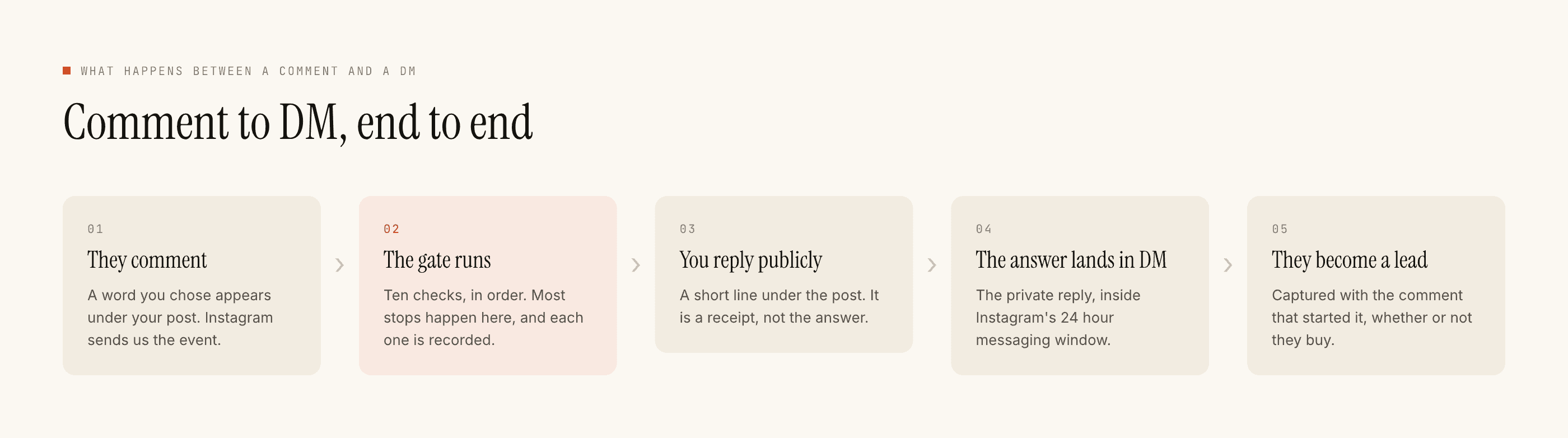
Choosing a word that survives audio
A written trigger word can be anything. A spoken one has constraints, and they are worth applying while you are still drafting.
Short beats long, because people remember two syllables and paraphrase four. Concrete beats abstract, because a person who half-heard SYSTEM has nothing to reconstruct from, while a person who half-heard MENU under a restaurant Reel can guess. And a word that is already the subject of the video is the safest of all — if the Reel is about a sizing problem, SIZE is a word the viewer has heard six times before you asked for it.
Avoid words that also appear in ordinary comments under your posts. LINK and INFO are typed by people who are not responding to your CTA at all, and if your automation is not scoped to that specific Reel, those comments get a confident answer to a question nobody asked.
Reels bring strangers, and strangers behave differently
The reason this matters more for Reels than for a carousel is distribution. Carousels are mostly seen by people who follow you. Reels travel.
That has three consequences on the response side.
The comment volume is spikier. A Reel that travels produces comments in a burst rather than a trickle, and a burst is where quiet hours and the rate budget become visible. Replies get held and paced rather than sent all at once. That is the system working, but it is worth having seen it before it happens during your best Reel.
The commenters have no context. A follower who comments RECIPE knows who you are. A stranger who saw one Reel does not, and a private reply that assumes familiarity reads oddly. Write the Reel's private reply as though the person has never seen your account, because most of them have not.
Some of them will comment on the Reel weeks later. Reels resurface. A comment is answerable for seven days from when it lands, not from when you posted, so a Reel that gets rediscovered in month two still produces live conversations — as long as the automation is still on.
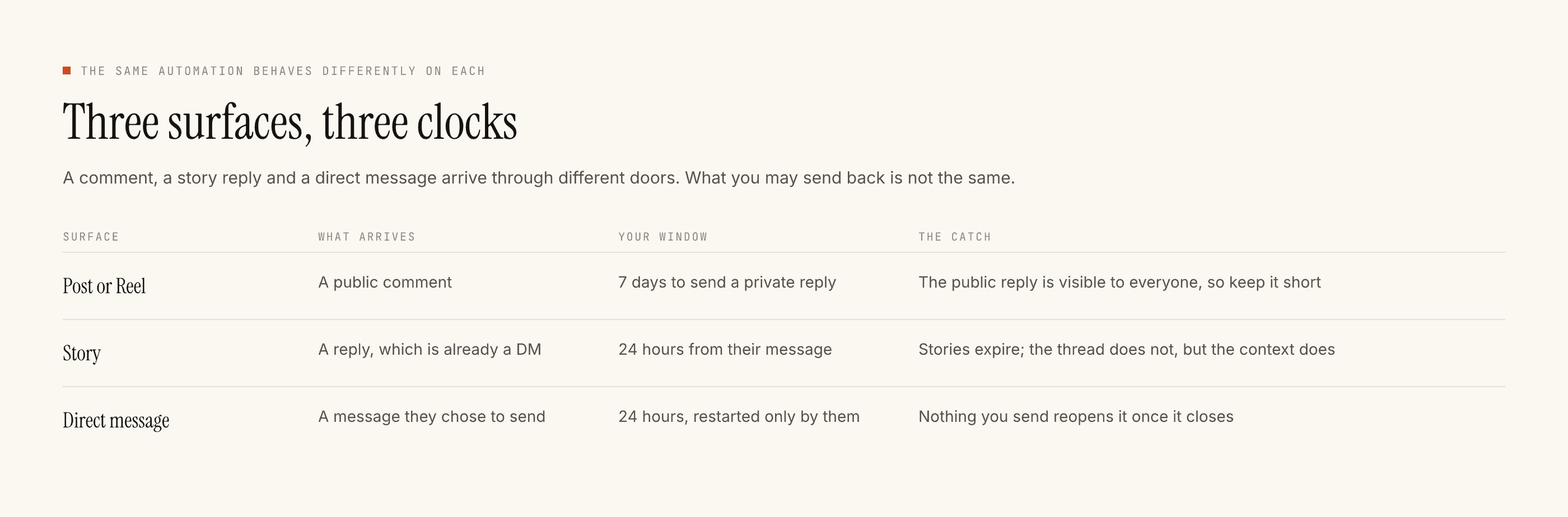
What we will not claim about your script
We have no view on your hook, your pacing, your first three seconds, or whether talking-head beats voiceover. We have no data on any of it and will not invent some.
What we can say is narrow and true: the value of a Reel that gets attention is capped by what happens when that attention tries to speak to you. A Reel with two hundred comments asking the same question, and no answer to any of them, converted nothing. The last five seconds of the script is the part that decides whether the other forty are worth anything commercially.
If you want the mechanics of the flow the CTA feeds into, the Reels-to-DM post covers it end to end, and the keyword post covers building the trigger list that catches the spellings your audience actually produces.