Voice DNA · 5 min read
Personalized DMs Without a Single Merge Tag or CRM Field

In email, personalisation has a technical meaning. You hold a row per subscriber, the row has columns, and the template pulls from the columns. Hi {first name}, still thinking about the {product category}?
None of that machinery exists here. There are no merge tags. There is no contact database with fields you populate, no custom attributes, no last-purchase column, no way to import a CSV of people and have their details appear in a reply. If you arrived expecting to map fields, there is nothing to map.
What is here is a different definition of the word, and it produces better messages than the field-merge version ever did.
The merge tag was never the personal part
Everybody has received the email that opens Hi , because the field was empty. Everybody has also received the one where the name was correct and the message was still obviously a blast.
The name is not what makes a message feel personal. What makes a message feel personal is evidence that the sender read the specific thing you sent. A reply that names your question, in a register that sounds like a person rather than a department, reads as personal even with no name in it at all.
Nobody has ever felt known because a machine got their first name right.
That is convenient, because on Instagram the name is the one thing you often do have and the least thing it buys you.
Ingredient one: their words
Every conversation here starts with something they typed. That is not a small input. It carries the intent, the phrasing, the language mix and, if you triggered on a specific post, the context of what they were looking at when they wrote it.
A generated reply is tied to a source. It draws on what they said, on the automation you configured, and on what you have told the system is true about your business. It does not invent a fact to fill a gap — when there is nothing to ground an answer on, the reply does not get sent confidently anyway. Grounding has its own post and it is the mechanism underneath everything in this section.
The practical consequence: personalisation improves when the incoming message is richer, which means it improves when your caption asks for something specific. comment SIZE gets you a word. comment your size and city gets you a reply that can name both back.
Ingredient two: your register
The second ingredient is not about them at all. It is about how the reply sounds.
A voice profile is built from replies the account owner actually wrote. Not from a description of your tone, not from a dropdown, not from your website copy. Your own outbox, in the register you genuinely type in. If you write "haan ji available hai, 2-3 din mein bhej denge", that is what the record contains, and that is what generated replies drift towards.
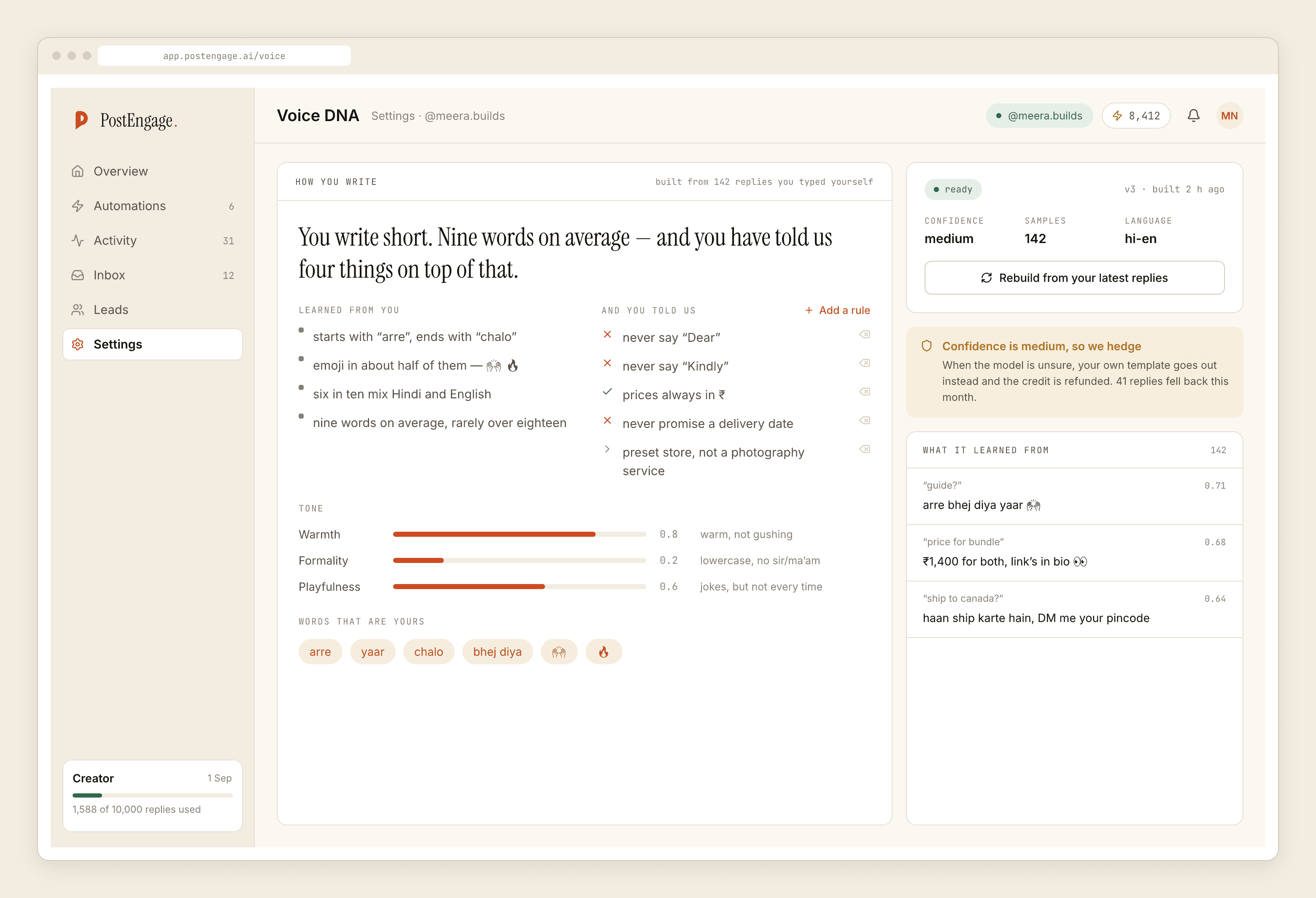
This is the half that most tools skip, and it is the half a customer notices. Two brands can send factually identical answers and one of them reads like a person. The deep dive on what a profile records is specific about what it captures and what stays invisible to it.
What the lead record does and does not do
There is a record per person — stage, tags, a replied flag, interaction counts, notes. It looks like a CRM row and it is worth being exact about what it is for.
It is for you to read. It is not a source of merge fields, and nothing in it is injected into a reply. If you write "asked about EMI in April, husband decides" in the notes, that sentence is there for the human who opens the row before answering, not for a template that will splice it into message two.
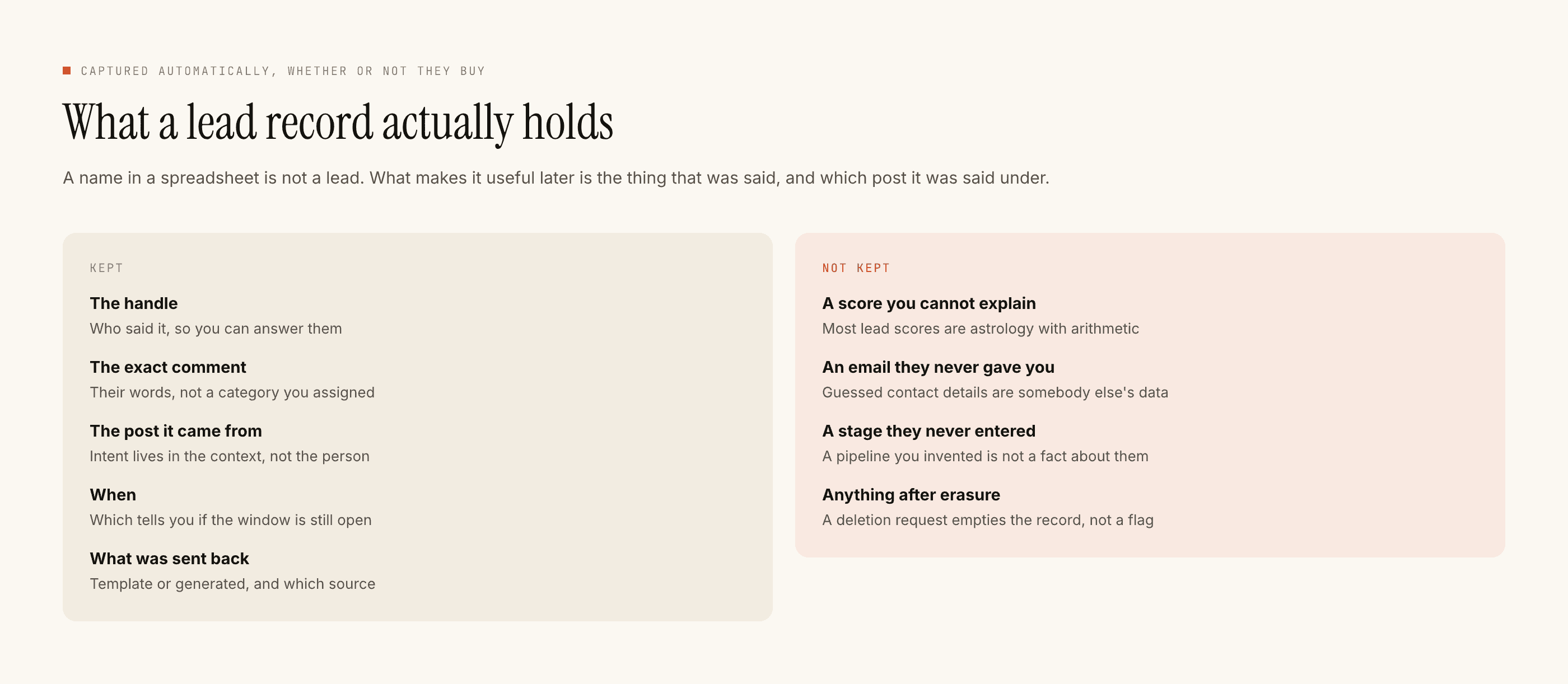
Which sounds like a limitation and is mostly a discipline. The version where software auto-inserts a remembered detail is the version that produces "I see you were interested in our Diwali offer" six months after Diwali. A human glancing at one line of notes never makes that mistake.
The thing that is personal and free
Templated replies are free and unlimited. A credit is spent only when the AI writes a new reply, one credit per reply, and the free tier is 100 credits with no card.
That pricing has a design consequence people miss. Your four most repeated answers should be templates you typed yourself, in your own words, and they will be perfectly in voice forever at no cost. Generated replies are for the messages that genuinely need composing — the ones where the question is unusual enough that no template you wrote covers it.
So the shape of a well-run account is not "AI writes everything". It is: your own sentences handle the common cases, and generation handles the tail.
What personalisation cannot reach
It cannot know a fact nobody wrote down. It cannot know that this particular person is a repeat buyer unless you look at the row. It cannot decide that this enquiry deserves ten minutes and that one deserves a line — that judgement is invisible in finished text and it stays yours.
And it cannot make a reply true. Style and correctness are separate systems. A reply can be flawlessly in your voice and quote a price you changed last month, which is why the facts you ground on are worth more maintenance than the tone is.
Two ingredients, then, and neither of them is a field. What they said, and how you write. Everything else people call personalisation is a database trick that stopped fooling anybody around the time it became common.