Product12 min readApr 7, 2026

AI Chatbot for Instagram: How to Give Your DMs a Brain That Matches Your Voice

Rule-based bots send canned replies. AI chatbots understand intent, match your tone, and turn conversations into conversions. Here is how AI-powered Instagram DM replies actually work in 2026.

Every day, thousands of Instagram DMs go unanswered. Not because businesses do not care, but because they cannot keep up. Rule-based bots were supposed to fix this, but their robotic, keyword-matching responses drove more customers away than they converted. In 2026, the AI chatbot for Instagram DMs has changed the game entirely. These are not your grandmother's chatbots. They understand context, detect emotion, speak multiple languages, and most importantly, they sound like you.

AI Chatbots vs Rule-Based Bots: What's the Difference and Why AI Wins

Before we dig into the how, let's be clear about the what. Rule-based bots and AI chatbots are fundamentally different technologies, and understanding the gap is critical before you invest in either.

A rule-based bot operates on a simple if/then logic tree. If a user types "price," the bot replies with a pre-written pricing message. If a user types "hello," it responds with a greeting. Everything is manually programmed. If a user asks something outside the decision tree, the bot either goes silent or fires a generic fallback message like "Sorry, I didn't understand that."

An AI chatbot for Instagram DMs uses natural language processing (NLP) and large language models (LLMs) to understand what the user actually means, not just what they literally typed. It can handle typos, slang, emojis, voice notes transcribed to text, and even sarcasm.

Rule-Based Bot
  • Keyword matching only
  • Breaks on typos and slang
  • Same reply every time
  • Cannot understand context or history
  • Requires constant manual updates
  • Feels robotic to users
AI Chatbot
  • Intent recognition and NLP
  • Handles typos, slang, and emojis
  • Dynamic, contextual replies
  • Remembers conversation history
  • Self-improving over time
  • Sounds like a real human

The difference is not incremental. It is generational. Rule-based bots are calculators. AI chatbots are conversationalists. And when someone DMs your business on Instagram, they expect a conversation, not a menu.

This is why businesses switching to AI-powered Instagram DM replies see an average 3x improvement in response satisfaction and a 40% increase in lead conversion rates. When your DMs feel human, people trust them. When people trust them, they buy.

How AI Learns Your Communication Style

The biggest fear business owners have about AI chatbots is this: "It won't sound like me." And honestly, with most tools, that fear is justified. Generic AI sounds generic. But the best AI chatbots in 2026 do not use generic templates. They learn your voice.

Voice DNA: Your Digital Communication Fingerprint

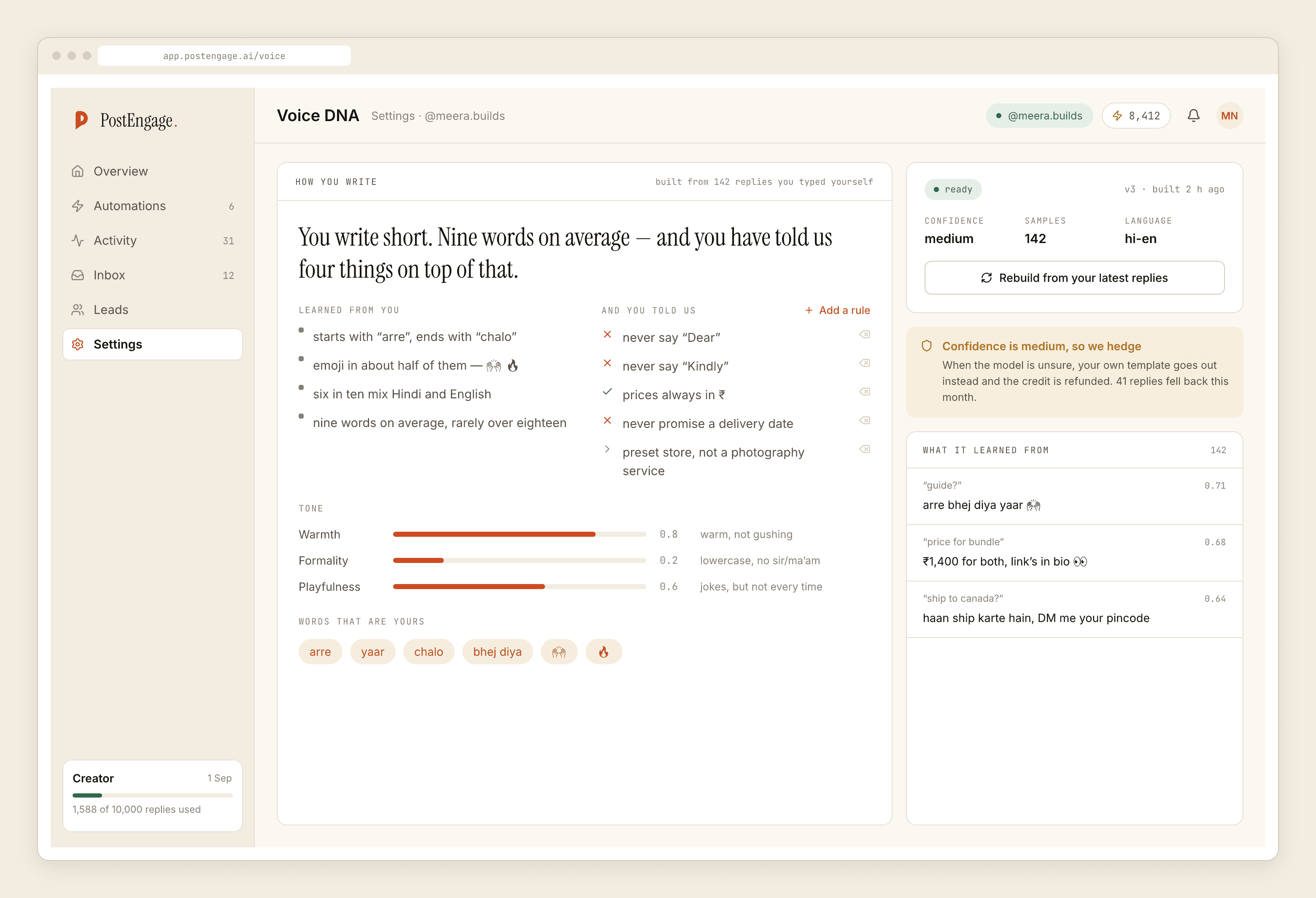
Think of your communication style as a fingerprint. You have patterns you might not even notice: the way you greet people, how casual or formal you are, whether you use emojis, how long your sentences tend to be, the phrases you repeat. AI can analyze hundreds of your past messages and extract a "Voice DNA" profile that captures all of these patterns.

This profile includes dimensions like:

  • Tone: Are you warm and friendly, or professional and direct? Do you use humor? How much?
  • Vocabulary: What words and phrases do you naturally reach for? Do you say "awesome" or "excellent"? "Hey there" or "Hi"?
  • Structure: Short punchy messages or longer detailed explanations? Bullet points or paragraphs?
  • Personality markers: Emoji usage, exclamation points, sign-offs, and the little quirks that make your messages distinctly yours.

Training on Past Messages

The most effective way to teach an AI your voice is to show it examples. When you connect your Instagram account to an AI chatbot platform like PostEngage.ai, it can analyze your past DM conversations (with your permission) to learn how you naturally respond to different types of messages.

It studies your replies to product questions, your handling of complaints, your upsell style, your thank-you messages. After processing enough examples, the AI can generate new replies that are statistically indistinguishable from messages you would write yourself.

Tone Matching Across Contexts

Great communicators adapt. You do not talk to a frustrated customer the same way you talk to an excited new follower. Advanced AI chatbots detect the emotional tone of incoming messages and adjust their responses accordingly, all while staying within your voice profile. If someone is upset, the AI dials up empathy. If someone is excited, it matches their energy. This context-sensitive tone matching is what separates good AI-powered Instagram DM replies from the ones that feel "off."

What AI Chatbots Can Do in 2026

The capabilities of AI chatbots have exploded in the last two years. If you tried a chatbot in 2023 or 2024 and were disappointed, it is time to look again. Here is what the current generation can handle:

Context Understanding
AI chatbots maintain full conversation history. They remember what was discussed three messages ago, what product the user asked about, and whether they already received a discount code. No more users having to repeat themselves.
Intent Detection
When someone writes "how much?" the AI knows they are asking about price, not philosophy. It classifies intents like purchase inquiry, support request, collaboration pitch, or casual conversation, and routes each to the right response flow.
Sentiment Analysis
Is this person happy, frustrated, confused, or just browsing? The AI reads between the lines, detecting sentiment from word choice, punctuation patterns, and emoji usage, then adapts its tone to match the emotional context.
Multilingual Support
A follower messages you in Spanish? The AI responds in Spanish. Someone switches between Hindi and English mid-conversation? The AI code-switches right along with them. No separate language bots needed.

Beyond these core capabilities, modern AI chatbots can also handle product recommendations based on conversation context, qualify leads by asking the right follow-up questions, schedule appointments, process simple orders, and escalate complex issues to a human agent with a full summary of the conversation so far.

For a deeper look at automation capabilities, check out our guide on how to automate Instagram DMs safely in 2026.

PostEngage.ai's AI Engine: How It Works Under the Hood

Not all AI chatbot platforms are created equal. Most slap a generic language model onto an Instagram API integration and call it a day. PostEngage.ai takes a fundamentally different approach. Here is what happens when a DM comes into your Instagram inbox:

1

Message Intake and Classification

The incoming message is analyzed for intent (purchase, support, collaboration, spam), sentiment (positive, negative, neutral), and urgency (needs immediate response vs. can wait). This classification happens in under 200 milliseconds.

2

Context Assembly

The engine pulls in the full conversation history, the user's public Instagram profile and bio, any previous interactions with your account, your product catalog or FAQ data, and your Voice DNA profile. All of this context is assembled into a single prompt.

3

Response Generation

Using a fine-tuned model specifically optimized for Instagram DM conversations, the AI generates a response that matches your voice, addresses the user's intent, and moves the conversation toward your business goal (sale, booking, support resolution).

4

Safety Check and Delivery

Before sending, the response passes through safety filters (no hallucinated information, no promises you have not authorized, compliance with Instagram's API policies). If the message passes, it is sent with a natural delay to mimic human typing speed.

The entire pipeline, from message received to reply sent, takes between 3 and 8 seconds. Fast enough to feel instant to the user. Slow enough to not trigger Instagram's anti-bot detection. Explore all of our AI-powered features in detail.

How to Train Your AI Chatbot for Best Results

An AI chatbot is only as good as the training behind it. Here is the playbook for getting your AI chatbot for Instagram DMs performing at its peak:

Step 1: Feed It Examples

Start by providing the AI with at least 50 to 100 of your best DM conversations. These should cover your most common scenarios: product inquiries, pricing questions, shipping concerns, collaboration requests, and general engagement. The more diverse the examples, the better the AI understands your range.

"Think of it like hiring a new team member. You would not throw them into customer support on day one without training materials. Give your AI the same onboarding you would give a person."

Step 2: Set Boundaries

Define what the AI should and should not do. Common boundaries include:

  • Never promise discounts above a certain percentage without human approval
  • Always escalate complaints about defective products to a human agent
  • Never share personal contact information (phone, email) in DMs
  • Always include your website link when discussing pricing
  • Never engage with messages that appear to be scams or phishing attempts

Step 3: Enable Review Mode

When you first launch, enable "Review Mode" in PostEngage.ai. In this mode, the AI drafts replies but does not send them automatically. You review each response, approve or edit it, and the AI learns from your corrections. Most businesses run in review mode for 1 to 2 weeks before switching to full autopilot.

After the review period, you can set the AI to auto-send for high-confidence responses (where the AI is 90%+ sure of its answer) and queue lower-confidence replies for human review. This hybrid approach gives you speed without sacrificing quality.

If you are just getting started with Instagram chatbots for business, the review mode is the safest on-ramp.

Before and After: Real Conversation Examples

Nothing illustrates the difference better than seeing actual conversations side by side. Here are three real-world scenarios comparing rule-based bot responses against AI-powered Instagram DM replies:

Scenario 1: Product Inquiry

Customer message: "hey do u have that blue hoodie in L? saw it on ur story"

Rule-Based Bot
"Thanks for your message! Check out our full catalog at www.example.com/shop. Let us know if you have any questions!"

Generic. Does not answer the actual question. User has to go dig through a website.

AI Chatbot
"Hey! Yes, the Ocean Blue Hoodie is still in stock in L! It's $65 and we're doing free shipping this week. Want me to send you the direct link to grab it?"

Answers the exact question, provides price, adds a relevant incentive, and moves toward conversion.

Scenario 2: Customer Complaint

Customer message: "I ordered 5 days ago and still nothing. This is the second time this happened. Really disappointed."

Rule-Based Bot
"Sorry to hear that! Please email support@example.com with your order number and we'll look into it."

Cold redirect. Ignores the emotional context. Makes the customer do more work.

AI Chatbot
"I'm really sorry about this, and I totally understand your frustration, especially since it's happened before. That's not okay. Can you share your order number? I'll flag this as urgent and get our shipping team on it right now. We'll also make sure you get a tracking update within the hour."

Acknowledges frustration, references history, takes ownership, and promises specific next steps.

Scenario 3: Collaboration Request

Incoming message: "hi! I'm a fitness creator with 45K followers. Would love to collab on a post if you're open to it!"

Rule-Based Bot
"Thanks for reaching out! We'll get back to you soon."

Vague non-answer. No qualification. Creator moves on to the next brand.

AI Chatbot
"Hey! Love your content, especially the home workout series! We're definitely open to collabs with fitness creators. Quick question: are you thinking of a feed post, Reel, or Story? And do you typically work with product gifting, paid partnerships, or a mix? Just want to make sure we find the right fit!"

References their actual content, qualifies the opportunity, and moves the conversation forward professionally.

The ROI of AI Chatbots

Let's talk numbers. The ROI of switching from manual DM management (or rule-based bots) to an AI chatbot for Instagram DMs is measurable across three dimensions:

15+ hrs

Time Saved Per Week

The average business owner spends 2+ hours per day managing DMs. AI handles 85% of conversations autonomously, giving you back your evenings and weekends.

3.2x

More Leads Converted

Instant, relevant replies mean fewer leads go cold. Our customers report converting 3.2x more DM inquiries into paying customers after switching to AI.

94%

Customer Satisfaction

In post-conversation surveys, 94% of customers could not tell they were talking to an AI. Satisfaction scores matched or exceeded human agent benchmarks.

When you factor in the cost, it becomes even more compelling. Hiring a full-time DM manager costs $3,000 to $5,000 per month. An AI chatbot from PostEngage.ai starts at a fraction of that price, works 24/7, never calls in sick, and improves every week. Check our pricing page to see which plan fits your volume.

The businesses seeing the highest ROI are those in e-commerce, coaching, SaaS, and creator monetization, any niche where DMs are a primary sales or support channel. If people are already sliding into your DMs to buy, an AI chatbot ensures you never miss a single one.

Give Your DMs a Brain Today

Your DMs deserve better than canned replies

PostEngage.ai's AI chatbot learns your voice, understands your customers, and turns every conversation into an opportunity. Set it up in under 10 minutes, no coding required.

Already using rule-based automation? Read our safe automation guide to understand how to transition to AI without disrupting your existing workflows. Or dive into our complete breakdown of Instagram chatbots for business to see all the use cases AI can handle.

PE
PostEngageAI Team
Instagram Growth Experts