Playbooks · 5 min read
A Narrow Niche Is the Best Predictor of Automation Working

We do not do niche research. No competitor analysis, no gap finding, no audience segmentation, no suggestions about which corner of a market to occupy. We have no content features of any kind — this product replies to comments and nothing else.
But there is a single variable that predicts whether comment automation will be useful to an account better than follower count, posting frequency, category, or budget, and it is how narrow the account is. Not narrow in audience. Narrow in the set of questions the audience asks. This post is about why that variable matters mechanically, and what it actually costs when it goes the other way.
Question width, not audience width
A niche is usually described in terms of who you are talking to. For our purposes the useful description is different: how many distinct things do people ask you?
An account selling one category of handmade silver jewellery gets asked about price, materials, sizing, and shipping. Four things, in rotation, forever. An account posting general lifestyle content with occasional products gets asked about the jewellery, the shirt, the location, the song, the camera, the recipe, and where the shelf is from.
Same follower count, same effort, completely different inbox. The first one is four templates. The second one is a job.
Narrowness is not about who follows you. It is about how few distinct answers cover most of what you are asked.
Why this shows up on your bill
The mechanical reason is worth being explicit about, because it is the part that has a number attached.
A templated reply is free and unlimited. You write it once, it sends as many times as it needs to, and it never costs anything. A credit is spent only when the AI writes a new reply — one credit, one reply.
That pricing is not arbitrary. It reflects what is actually happening: a repeated question with a fixed answer requires no thinking, and a novel question does.
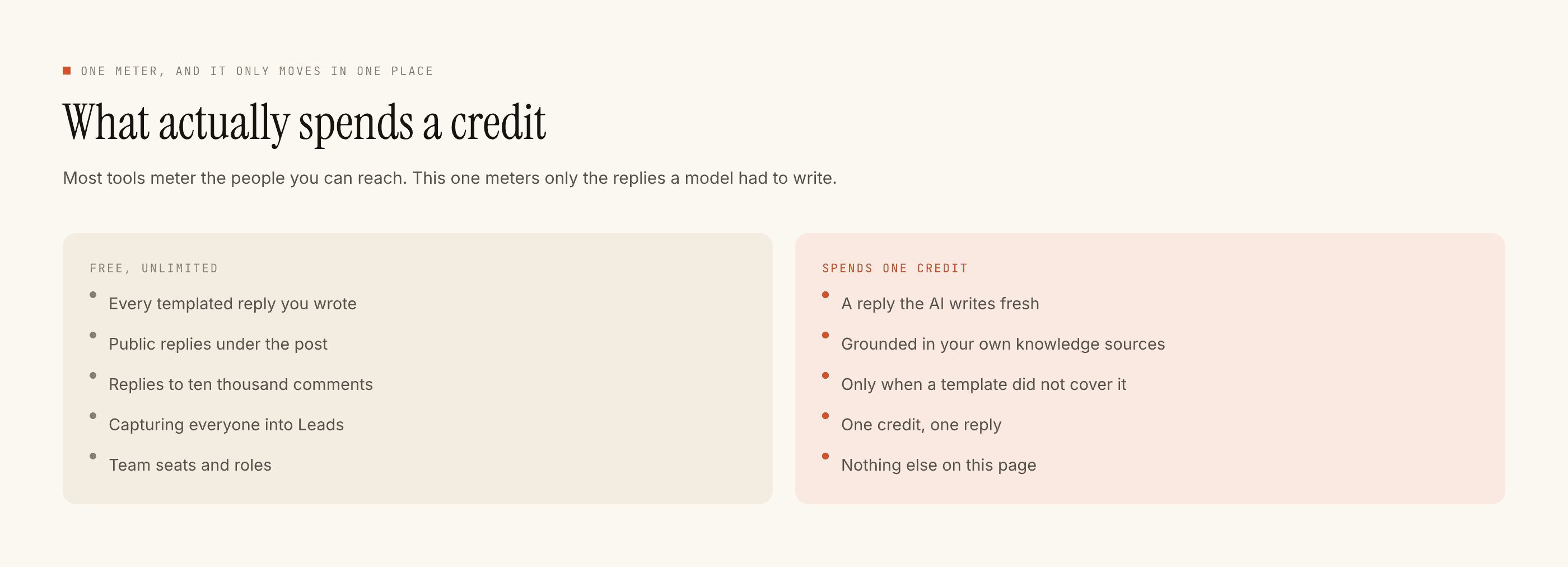
Follow it through. A narrow account with four recurring intents can cover most of its inbox with four templates, spending credits only on the unusual ones. A broad account has no four templates that cover anything, so nearly every reply is a new reply, and the cost scales with volume rather than flattening out.
The free tier is 100 credits with no card, and packs start at ₹499. For a narrow account those hundred credits last a surprisingly long time, because the bulk of the traffic is not touching them. For a broad account they are a sample, and that is a genuine signal about fit rather than a pricing gripe.
The second advantage: your voice holds still
The other thing narrowness buys you is consistency of register, which is harder to notice and easier to lose.
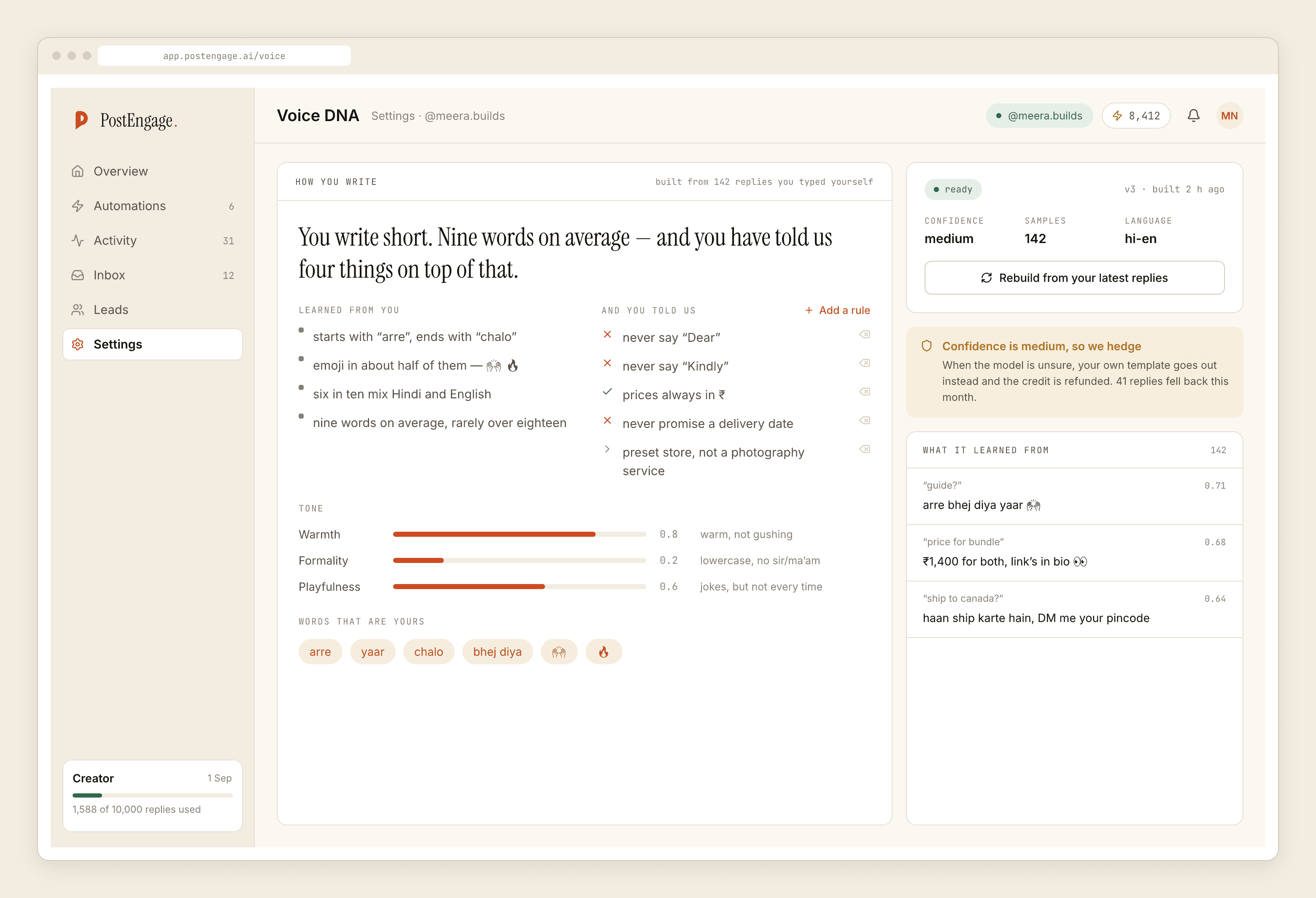
Voice DNA is built from replies you actually wrote. If your account covers one subject, the replies you have written are all in the same mode — same vocabulary, same formality, same amount of Hinglish, same length. The profile that comes out of that is sharp, because the source material agrees with itself.
An account that swings between a product voice and a personal voice gives the profile contradictory examples. The generated replies land somewhere in the middle, which is nobody's voice in particular. That is not a limitation of the model so much as an averaging problem, and the fix is upstream.
When a narrow niche still has a wide inbox
This is the exception worth checking before you assume you are safe.
Some genuinely narrow niches produce enormous question variety. A travel account focused on one region gets asked about visas, weather in a specific month, budgets, safety, transport, and where a particular photo was taken. Extremely niche. Almost nothing repeats, because every asker's situation is different.
Consulting, legal, medical and education accounts have the same shape. The subject is narrow, and the questions are all my specific case. Those inboxes are not automatable in the answering sense and should not be forced.
What still works there is narrower and honestly stated: catching the intent, sending an acknowledgement in your own words, and capturing the person to Leads so somebody follows up properly. That is a triage function, not a replacement, and it is worth having for the reason that acknowledgement inside a minute is better than a real answer in two days.
Narrowing the automation instead of the account
You do not have to niche down your content to get a narrow question set. You can narrow the automation instead, and for most accounts this is the better move.
- Scope triggers to specific posts. Under Advanced. A
pricetrigger restricted to your three product posts is narrow even if your account is not, because under those posts the word can only mean one thing. - Do not run account-wide automations for ambiguous words.
link,infoanddetailsmean something different under every post. Account-wide, they will produce confident wrong answers, which are worse than silence. - Let the broad content run unautomated. The lifestyle post, the personal one, the behind-the-scenes — leave them alone. Nothing bad happens to a post with no automation on it.
That gives you a narrow inbox where it counts without flattening the account into a catalogue.
The honest summary
If you sell a small number of things to a specific audience, comment automation will do a lot for you, mostly for free, and it will sound like you because your voice has one mode.
If your account is wide, expect it to cover less, cost more per conversation, and need scoping to individual posts before it is trustworthy. Both are workable. Only one of them is what the marketing usually implies.
For the upstream half of this — how what you publish shapes what you get asked — the content strategy post covers it. For working out where your own account sits, the audit method is an hour with your own comments and it answers the question definitively.