Playbooks · 5 min read
Restaurant DM Automation: The Questions It Must Not Answer
Most of a restaurant's Instagram inbox is genuinely easy. Are you open on Monday. Do you have parking. Kitna time lagta hai delivery mein. Do you do private parties. Where exactly are you, because the map pin is wrong.
All of that is fixed information, asked constantly, and answerable by a template at three in the morning at no cost. That part of this post writes itself.
The part worth your attention is the two kinds of message hiding in the same inbox that an automation should not go anywhere near.
Never let it answer a question about allergies
"Is the paneer tikka egg-free?" "Does the soup have gluten?" "Ye Jain hai kya?" "Any nuts in the dessert?"
These look like menu questions. They are not menu questions. They are safety questions, and the correct behaviour for an automated system is to refuse to answer and get a human involved.
The reasons are not abstract. Your kitchen's ingredients change with suppliers. A dish that had no nuts in March gets a garnish in June. Cross-contamination is a property of the kitchen at that moment, not of the menu PDF the AI was trained on. And a generated answer will be fluent and confident regardless, because fluency is what it does — it has no way to represent "I am not sure and the consequence of being wrong is somebody in hospital."
Note that this cuts against the instinct to make the bot more helpful. Dietary questions are high-volume and they feel like exactly the thing worth automating. They are the thing worth refusing.
An automated menu answer is a promise made by software about what is currently in a pan it has never seen.
Never let it answer someone who is upset
The second category. A photograph of a cold biryani, three angry lines, sent at 10:40pm.
An automated reply here does not fail neutrally, it fails visibly. "Thanks for reaching out! Here is our menu link" underneath a complaint is the kind of screenshot that travels, and it converts one annoyed customer into a public story about a restaurant that runs a bot instead of caring.
The controls that handle it:
- Negative keywords for complaint vocabulary. Cold, stale, refund, worst, food poisoning,
paisa wapas, and the ones you can only learn by reading your own inbox for a week. - First-time senders only, switched off for these. A complaint often comes from a regular. You want it reaching a person, not being filtered by whether they have written before.
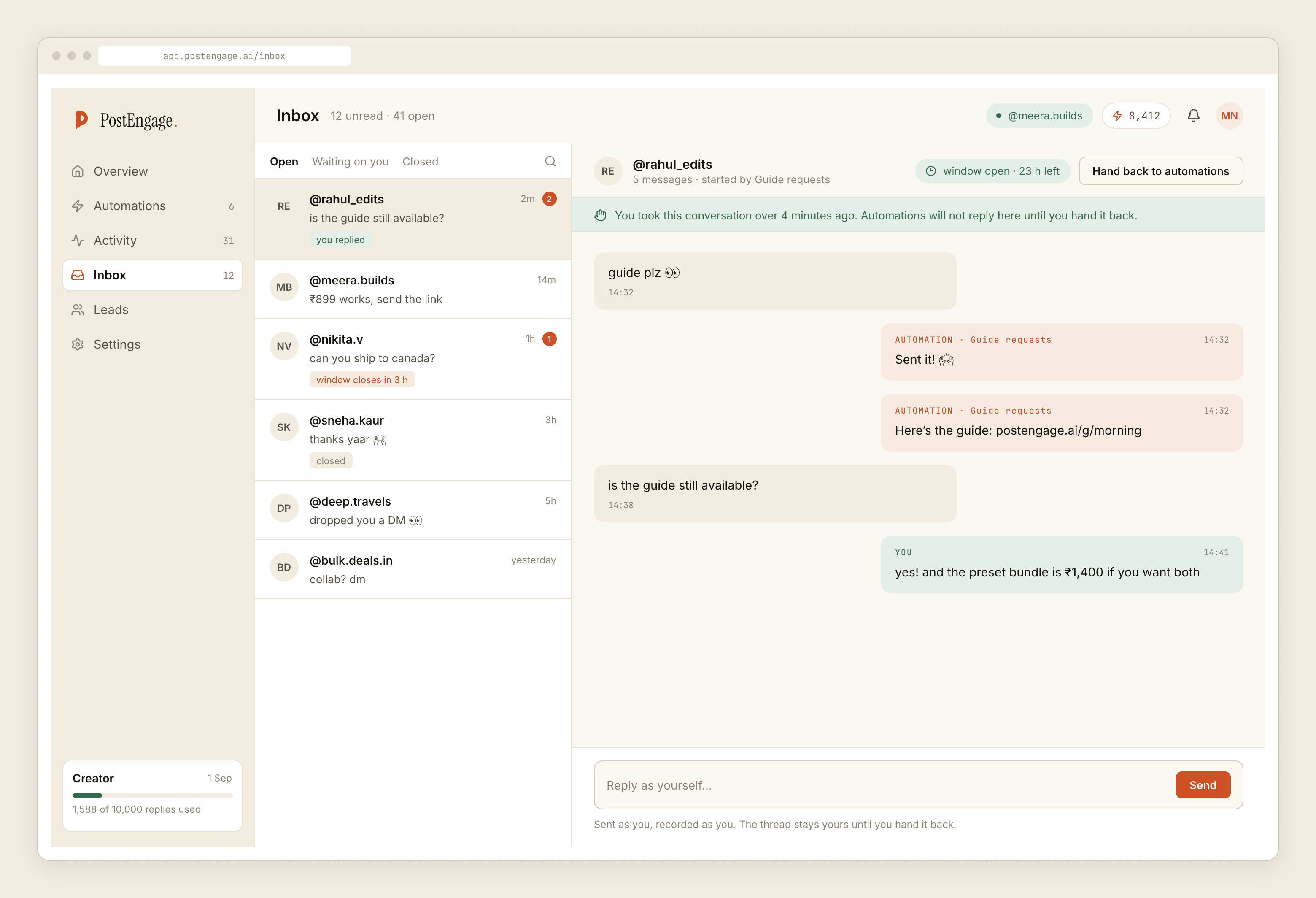
- Takeover. The moment anyone on your team replies by hand, automation is out of that thread for good. No cheerful template landing under a manager's apology.
Today's special is a trap in template form
The third restaurant-specific problem is smaller and catches everyone once.
You write an automation for the Sunday brunch post. The template says "brunch is on today, 12 to 4, walk-ins welcome." It is perfect on Sunday and it is wrong from Sunday evening until you remember it exists.
Anything with a day, a date, or a price in it ages. Restaurants have more of that content than almost any other business — daily specials, festival menus, happy hour, a limited-run dessert. The rule that works is simple: if the sentence would be false next week, it goes in a temporary automation with a switch-off date, not in your evergreen set.
Prices deserve the same caution. Menu prices move, and a template quoting a figure will keep quoting it long after the printed menu changed. "Sending you the current menu" survives a price revision. A number does not.
What is left is genuinely worth automating
After you have carved out allergies, complaints and anything dated, what remains is most of the volume: hours, location, parking, whether you take walk-ins, delivery platforms you are on, party bookings, whether the terrace is open when it rains.
All fixed. All templates. Templated replies are free and unlimited — a credit is spent only when the AI writes a new reply — which means the enormous repetitive tail of a restaurant inbox costs nothing whatever your footfall. The free tier is 100 credits with no card, and packs start at ₹499. Most single-outlet restaurants running the setup above spend credits on very little.
One more thing worth setting: a rate budget. A reel of a cheese-pull travels in a way a salon post never will, and an uncapped automation answering two thousand comments in an hour is how an ordinary good night starts looking like spam to Meta. The cap turns the spike into a queue.
What it will not do
It cannot see your table availability, so it should never confirm a booking — route reservation requests to whoever holds the diary, exactly as you would a phone call.
It cannot take an order or a payment. It cannot message people who have not messaged you first. It does not do WhatsApp.
And it runs on the official Instagram Graph API, which means a comment stays answerable for seven days and a DM thread for twenty-four hours. For a restaurant the DM clock is the one that hurts: a Friday-night question answered on Monday is a table you lost on Friday night, which is the real argument for letting a free template answer it at 11pm.
Build the allergy refusal first, then the four boring templates, then read what got blocked in the first week. If comments are where your volume actually lives, the comment-to-DM flow is the one to build after that.