Playbooks · 6 min read
A Giveaway Is the One Volume Spike You Plan in Advance

Almost every volume spike an Instagram account experiences arrives without warning. A Reel leaves your audience overnight, and by the time you know it happened, the automation has already done whatever it was going to do.
A giveaway is the exception. It is the single biggest surge most accounts create deliberately, and you choose the day, the hour it opens and the hour it closes. That means every piece of preparation that a viral night denies you is available here, and skipping it is a choice rather than bad luck.
This post is the pre-flight. The separate problem of what giveaway comments look like as text — tag spam, hashtags that collide with your keyword — is covered here, and it is worth reading first because a rule that fires wrongly at volume is worse than one that fires wrongly at ten comments an hour.
What the spike actually does
Comments arrive faster than replies can leave. That is by design: every reply passes through a fixed sequence of checks, and the rate budget caps how many go out per hour. Once the allowance is used, the remaining matches are held.
So a successful giveaway produces a long queue and a long list of blocked rows, and both are correct. The alternative — a few thousand messages leaving as fast as the API accepts them — is how an account acquires a delivery problem that outlasts the campaign by a long way.
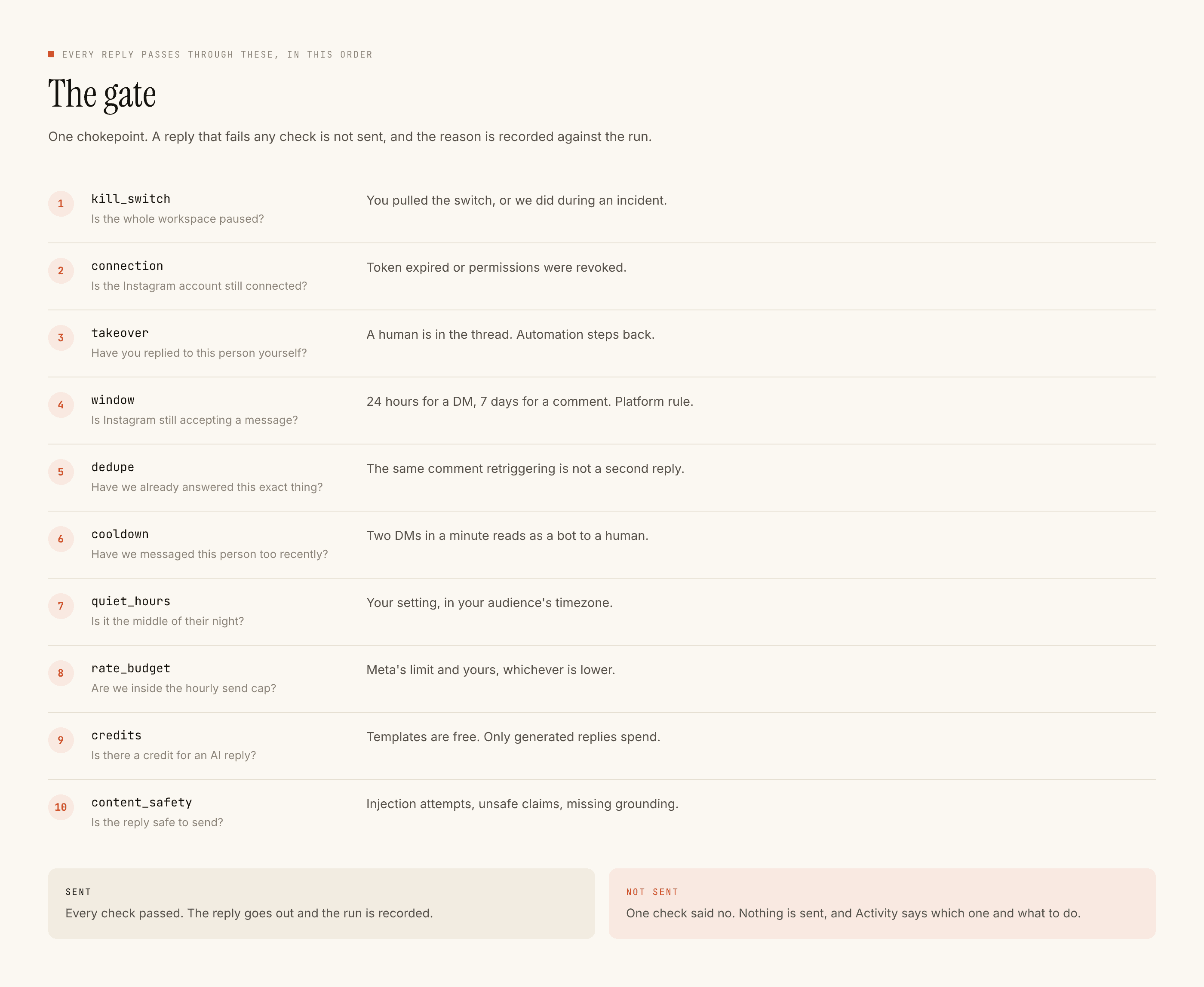
The queue draining slowly is not a problem, because the comment window is seven days per comment, counted from each individual comment. Somebody who entered at 11pm and receives their acknowledgement at 9am is inside their window with days to spare. The spike threatens the account's standing, not your deadline.
The pre-flight
Do all of this the day before, not on the night.
- Set the rate budget deliberately. This is the one number that decides whether the evening is a queue or an incident. Pick it, look at it, and leave it alone once the thing starts.
- Resolve the quiet hours conflict now. Giveaways close at midnight because that is a clean deadline, and quiet hours exist because nobody wants a business messaging them at 1am. Both are right and they collide. Decide which wins before the night rather than in the middle of it, and know the consequence: replies held until morning have spent those hours out of a window they still have to fit inside.
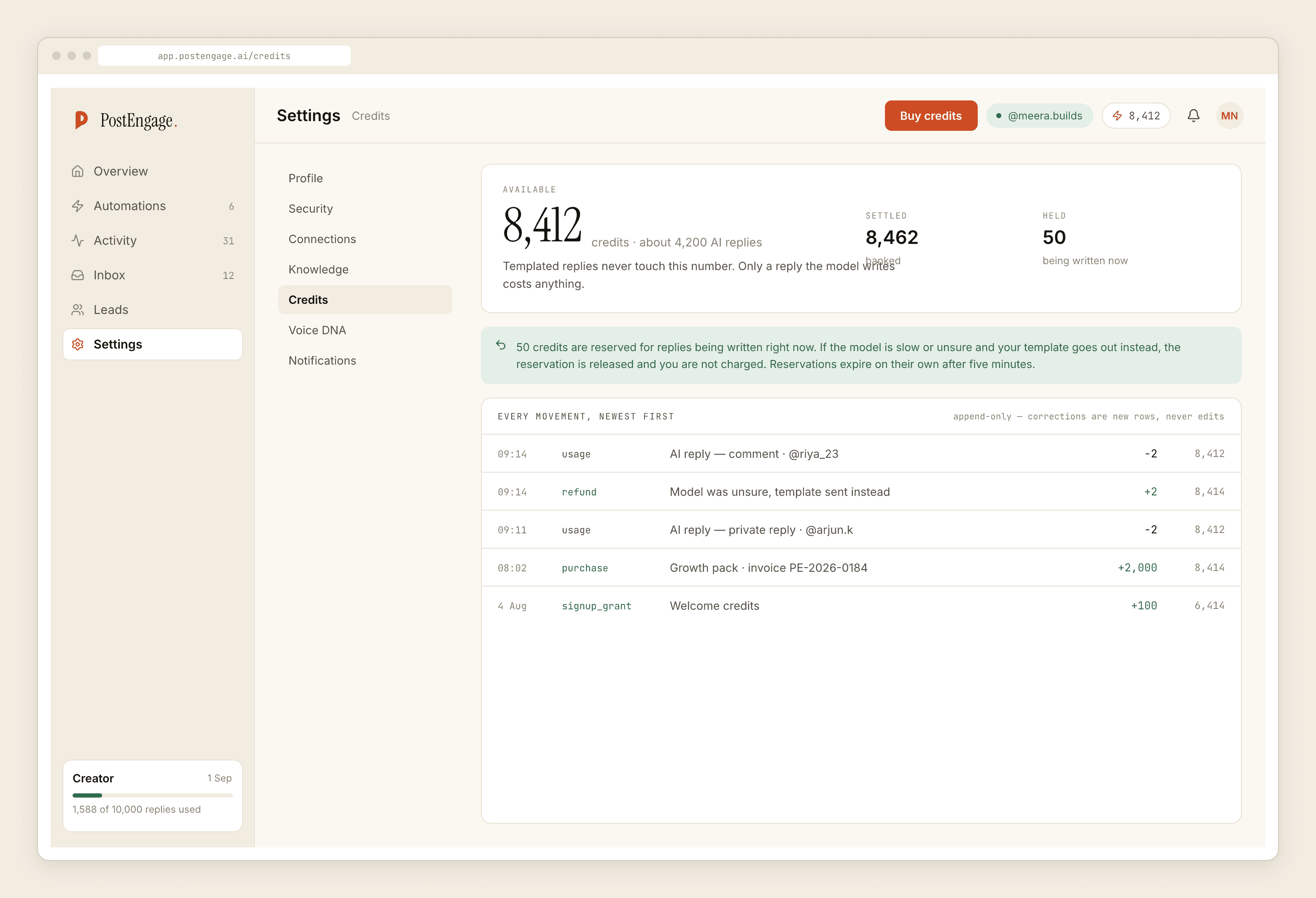
- Check your credit balance against the expected volume. Credits sit ninth in the gate, so running out reads as a wall of blocked rows rather than an obvious error.
- Template the entry reply. Templated replies are free and unlimited; a credit is spent only when the AI writes a new reply, one credit per reply. The entry acknowledgement is the same sentence for everybody, so there is no reason for it to be generated, and templating it removes the credit question from the biggest volume of the night entirely.
- Find the kill switch. It is first in the gate and it stops everything instantly. Locate it on a calm afternoon so that locating it is not what you are doing at 10pm.
- Run Test on myself. It puts a real reply through the real pipeline into your own account. Read it on a phone. A rule that matches nothing shows up as a test that never fires, which is a much better way to learn that than a quiet comment section.
The timing decisions that actually matter
When it opens. A giveaway that opens at 9pm produces its heaviest hour inside your quiet hours. Opening in the morning spreads the same volume across a day when replies can go out as they arrive.
When it closes. The last hour is always the heaviest, because that is how deadlines work. If the close lands late, the final surge queues overnight. That is survivable — seven days per comment — but the entrants who wrote at 11:58pm and hear nothing until morning are the ones most likely to think the entry did not register.
How long it runs. A longer window flattens the curve, which makes everything above easier and makes the campaign feel less urgent. That is a marketing trade-off rather than a technical one, and it is worth making consciously instead of by default.
You cannot choose when a Reel travels. You can choose when a giveaway closes, which means every capacity problem it causes is one you signed up for.
During, and the morning after
During: stay out of it. The instinct to intervene manually while a queue is draining is the wrong one, and it has a specific cost — takeover means the moment you answer a thread by hand, the automation stands down for that conversation permanently. That is exactly right for a real question and a waste on an entry acknowledgement.
The morning after, read Activity before anything else. Rate budget, cooldown and dedupe rows are expected: the cap working, repeat entrants getting one reply instead of eleven, and Instagram redelivering the same event. A connection row is the only genuine emergency, because it means nothing went out at all. A large negative-keyword count means the comment section had a shape you did not anticipate, which is information for the next one.
Then read what the automation actually sent, not the summary of it. Ten replies at random, on a phone. That is the check nobody runs and it is the only one that catches a reply that was technically perfect and read badly.
After the volume goes away
The unglamorous part. A giveaway produces a large list quickly and the list is mostly people who wanted a free thing, which is a different audience from people who wanted your thing.
The leads you captured export as a CSV file — there are no one-click integrations here, and no automatic nurture, no sequences and no broadcasts, so nothing happens to that list unless you do something with it. That is worth knowing before you build a plan around it.
What makes the list worth having is what the entry mechanic asked for. An entry that is three handles tells you nothing. An entry that names a product, a size or a city gives every row a fact in it, and a fact is the difference between a list you can use and a number you can quote.
Then leave the automation on the post afterwards. The giveaway ends; the post keeps circulating, and each new comment on it opens its own seven days. Turning rules off for tidiness is the most common way accounts throw away the tail of something they spent a month planning. If you are working out which posts deserve a rule at all, that question has its own answer.