Comparison · 4 min read
PostEngage vs Wati: A Comparison We Cannot Honestly Make
You came here for a comparison, so here is the useful half of one straight away: we do not ship WhatsApp. Wati does. On the thing this page's title promises to compare, there is nothing on our side of the table.
That makes the honest version of this post short on the head-to-head and long on the part that actually helps — how to evaluate a WhatsApp tool, including against the one we would build.
What we will not do
Rank a competitor's product on features we have not used at the scale you would. Quote their prices, which change and which we would get wrong. Suggest they are unsafe or non-compliant — Wati operates on Meta's Business API and there is no reason to imply otherwise.
Comparisons of this genre are usually written by whoever is not the market leader, scoring on the axes where they win. You can spot one in about ten seconds and it should cost the vendor your trust, including when the vendor is us.
Compare on what is metered
The single most consequential difference between tools in this category is not a feature. It is the unit on the meter, because that decides how your bill behaves on a good month rather than a bad one.
Metered by contacts or conversations
Metered by work performed
WhatsApp adds a wrinkle Instagram does not have: Meta itself charges for certain message categories, and that charge is upstream of whatever the vendor adds on top. So there are two meters, and a tool's pricing page usually describes only its own.
Ask any vendor to show you the total for a hypothetical month — a specific number of conversations, of a specific kind — rather than a per-unit rate. Per-unit rates are comparable only when both parties count the same unit, and in this category they do not.
Compare on what it refuses
Sending is the easy half. Every tool sends.
The questions worth asking are about the other half, and they are the same ones we would want asked of us:
- What happens when the model is unsure? Does it send something plausible, or hold it for a person? A product with no answer to this sends confidently and is wrong in public under your name.
- What happens when a human replies by hand? The automation should stand down for that thread immediately and stay down, with no switch to remember.
- Can you see what was not sent, and why? A tool that only records successes cannot be debugged. A named reason per refusal is the difference between a system and a black box.
- What is on the never-send list, and can you edit it? Refunds, complaints, anything about a payment that has already moved. If those are not stoppable, volume will eventually put a template on top of a furious customer.
Compare on the exit
The least-asked question and one of the most important. Can you get your data out, in a format something else can read, without asking permission?
For us the answer is a CSV of leads and nothing more — there are no one-click integrations here, and that is a limitation rather than a virtue. But the export exists and it is not gated. Ask whoever you are evaluating the same question before you have three years of conversation history inside them.
What we can honestly claim
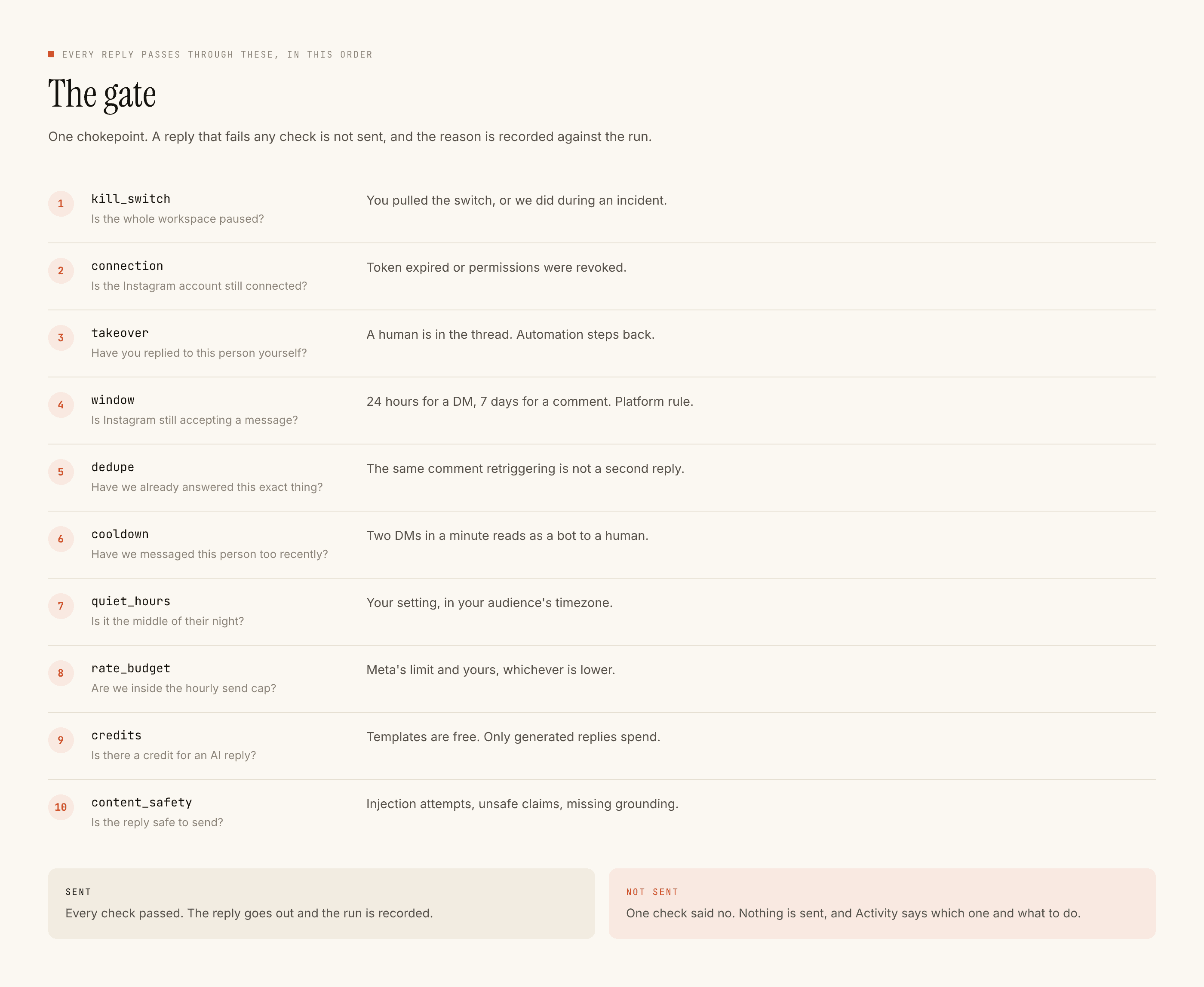
One channel, done carefully. PostEngage answers Instagram comments and DMs: a public reply and a private one, inside Meta's seven-day comment window and twenty-four-hour messaging window, with ten named checks before every send and a recorded reason for every refusal. Templated replies are free and unlimited; a credit is spent only when the model writes something new. The free tier is 100 credits with no card, and packs start at ₹499.
That is the whole product. If your revenue arrives on WhatsApp, none of it helps you today, and the useful thing this page can do is say so plainly and give you better questions for the vendors who can.
If Instagram is also part of the picture, the honest self-review is here — it leads with what we are bad at. And if you are weighing running both channels at once, that argument is here.