Playbooks · 5 min read
Your Inbox Changes Before Your Follower Count Does
On this page
- Shift one: first-time senders become the majority
- Shift two: the people commenting do not follow you
- Shift three: hostility arrives, and it contains your trigger word
- Shift four: brand messages change shape
- Shift five: the same person writes three times
- Shift six: the questions arrive in more languages
- What this does to cost, honestly
- What does not change

The follower count is a lagging indicator and everybody treats it as the main one.
The inbox moves first. Weeks before the number does anything interesting, the composition of who is writing to you changes — different people, different assumptions, different tone — and an automation that was well built for the old population starts quietly misfiring on the new one. Nobody tells you. There is no alert for it, and there is no analytics product here that would flag it.
You find out by reading. Here is what you are reading for.
Shift one: first-time senders become the majority
On a small account most people who message you have messaged before, or at least have been following long enough to know how you talk. On a growing one that flips, and it flips fast.
The tell is in your own reading of the inbox: you stop recognising usernames. When that happens, the first-time senders only toggle under Advanced changes meaning. On a small account it was a nicety. Now it is the difference between a template greeting a stranger, which is correct, and a template greeting somebody you have been talking to for two years, which is not.
Shift two: the people commenting do not follow you
This is the one that breaks templates rather than settings.
Reach beyond the follower base means comments from people who have never seen anything else you have made. They have no idea what "the usual link" refers to, who your co-host is, or that the thing you say at the end of every reel is a joke. A reply that assumed shared context now reads as either confusing or smug.
A template written for people who know you stops working the week strangers outnumber them, and it fails silently.
Go and read your private replies as somebody who arrived from the explore page. Every inside reference either gets explained in four words or gets cut.
Shift three: hostility arrives, and it contains your trigger word
Small accounts get almost none. Growing accounts get some, and it is not the abuse that causes the problem — it is the sarcasm. "Wow amazing, PRICE for this?" fires a trigger word perfectly and gets a cheerful rate card.
This is when the negative keyword list stops being a formality. Add the ordinary ones — not interested, stop, spam, fake, scam — and add whatever your niche attracts. Matching folds case and punctuation, so PRICE? and price are the same word; it matches whole words, so scam will not catch scammer; and it does not fold Indic vowel signs, so Devanagari entries are exact spellings rather than families.
Shift four: brand messages change shape
The sequence is consistent enough to use as a milestone.
First, barter: free product for a reel, frequently mass-sent, never naming anything you have posted. Then rate-card requests with no brief. Then agencies wanting you on a roster. Then, eventually, actual briefs — a deliverable, a timeline, a usage period, sometimes a number.
The moment the fourth kind starts appearing, your rate template is doing a different job. At the barter stage it was a filter. Now it is the first document in a negotiation, and the things it does not say — usage duration, exclusivity, revisions, what you will not do — are the things you will be arguing about in six weeks.
Everything past that first reply stays yours. Negotiation, exclusivity, whitelisting, deliverable counts, payment terms. A keyword matcher has no idea what it is agreeing to, and being wrong there costs you money rather than time.
Shift five: the same person writes three times
Volume brings repetition, and repetition brings a set of checks you never noticed before.
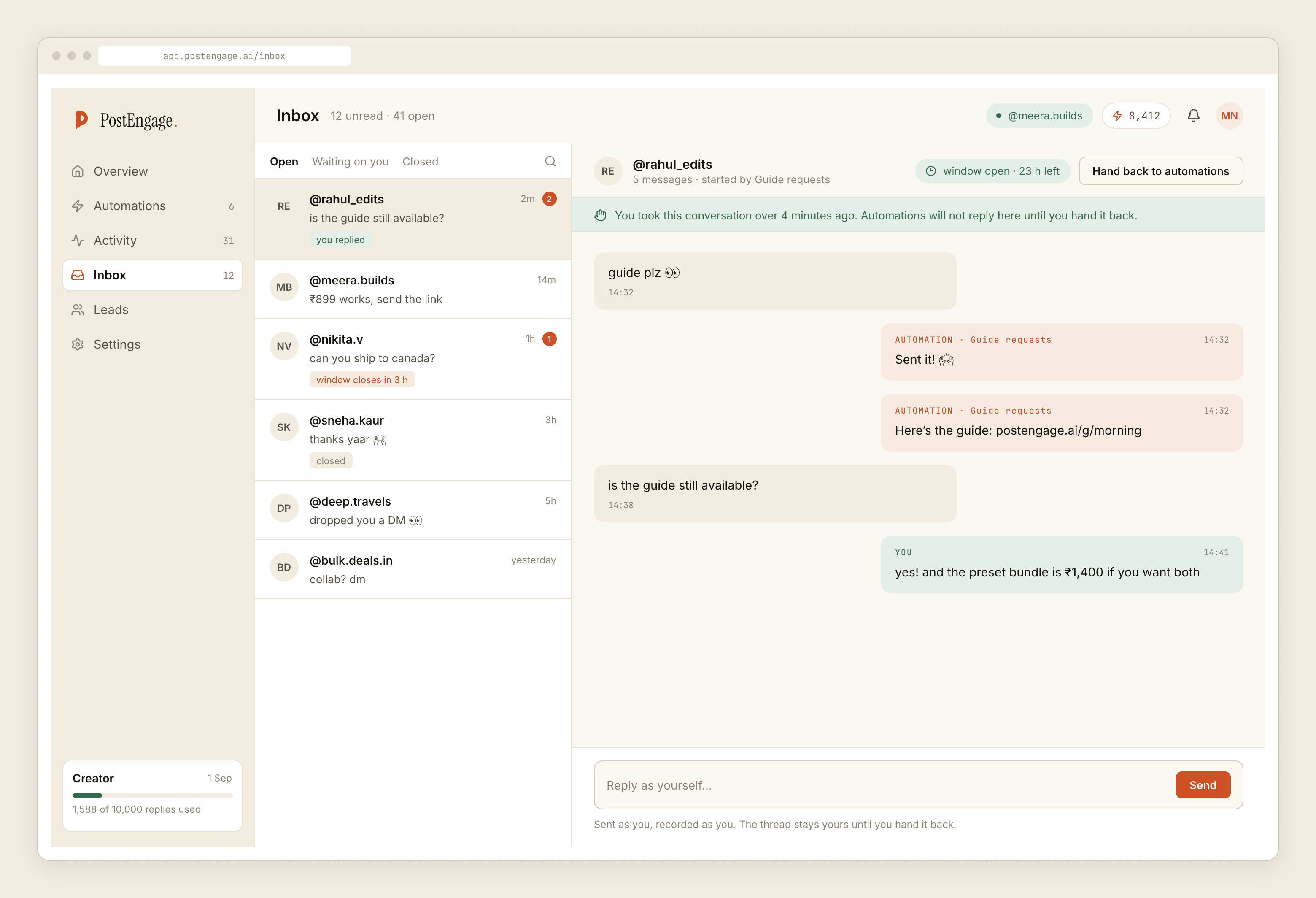
Dedupe stops the same comment producing two replies. Cooldown stops one enthusiastic person receiving four messages in ten minutes. Rate budget paces sending when a post is moving quickly. All three run before every send, in a fixed order, and a blocked reply is recorded with its reason in Activity.
On a small account you will never see any of them fire. On a growing one, Activity fills up, and the important skill is reading it correctly: most of what appears there is the system behaving, not the system failing.
Shift six: the questions arrive in more languages
A wider audience writes in more scripts and more registers. The same question — where is the link — turns up in English, in Roman Hinglish, in Devanagari, in whatever else your reach picks up.
Your triggers have to widen with it, and this is where the matching rules matter. Since it does not fold Indic vowel signs, each spelling you want to catch has to be listed. Since it matches whole words, link alone will not catch linkk, which people type. Widen the trigger list on purpose, and widen the negative list at the same time, because a broader trigger catches more of everything.
What this does to cost, honestly
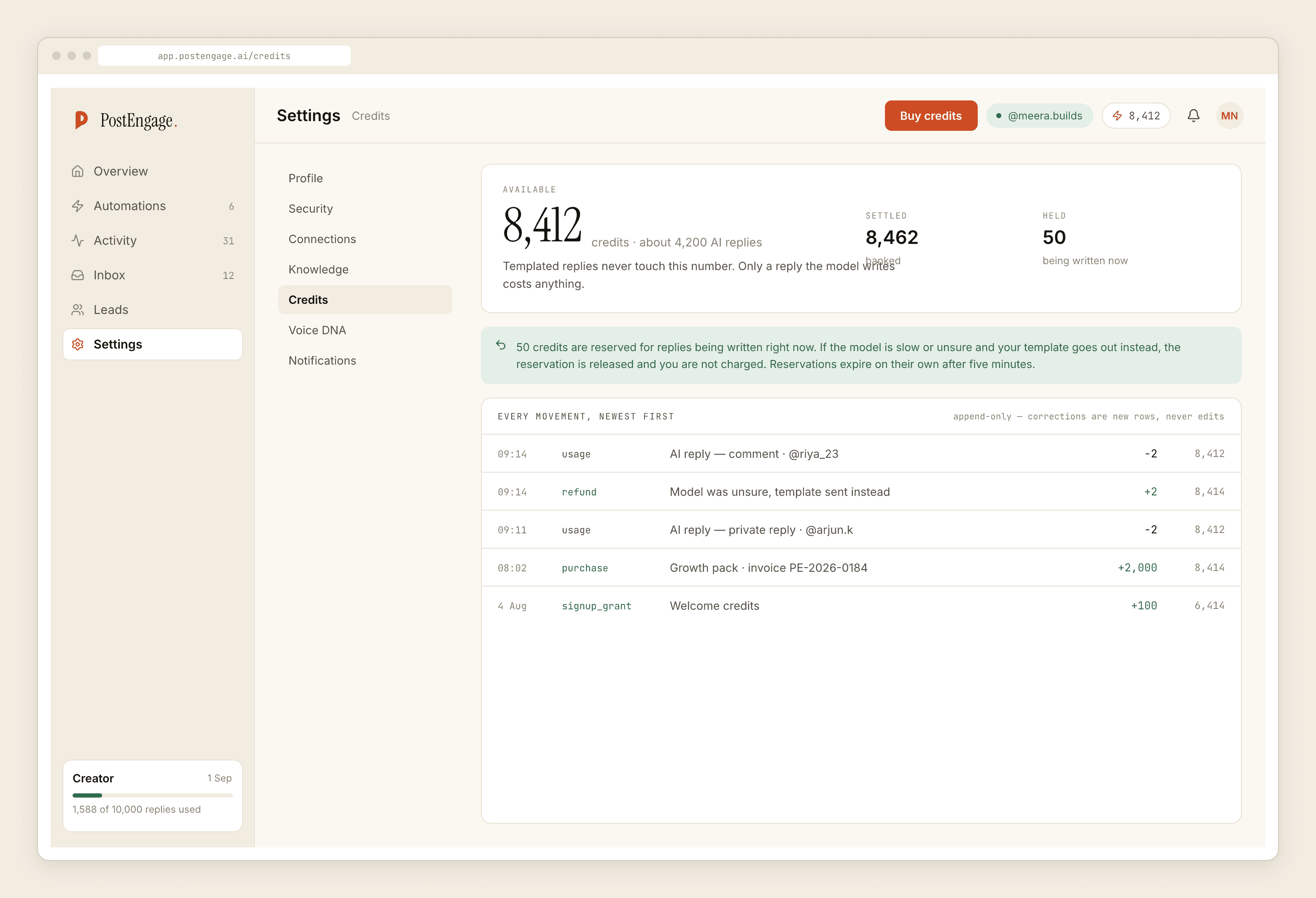
Templated replies are free and unlimited, and they stay free at any volume. That does not change.
What changes is the share of your inbox that a template can cover. New audiences ask things your five templates do not answer, and if the AI is writing those replies, a credit is spent each time — one credit, one reply. The free tier is 100 credits with no card and packs start at ₹499, so this is not expensive; it is just the first month where the number is not zero.
The cheaper response is usually not more credits. It is reading twenty of the new questions and turning the three that repeat into templates.
What does not change
Takeover: the moment you reply by hand, the automation stands down in that thread permanently. That is true at any size and it is why you can keep the thing on while the account is moving.
The clocks do not change either. Seven days per comment, counted from the comment. Twenty-four hours inside a DM thread, restarted only by their message, never by yours. Nobody can message a person who has not written first.
And nothing here grows the account. There is no follower-growth feature, no scheduling, no captions, no hashtags, no analytics. Growth comes from the work; this only decides what happens underneath it.
If you want the routine that keeps two automations honest week to week, that is the operations post. If the inbox itself is the thing that has become unpleasant, the burnout post is more relevant than any setting.