Comparison · 5 min read
Threads Is a Different App and We Do Not Automate It
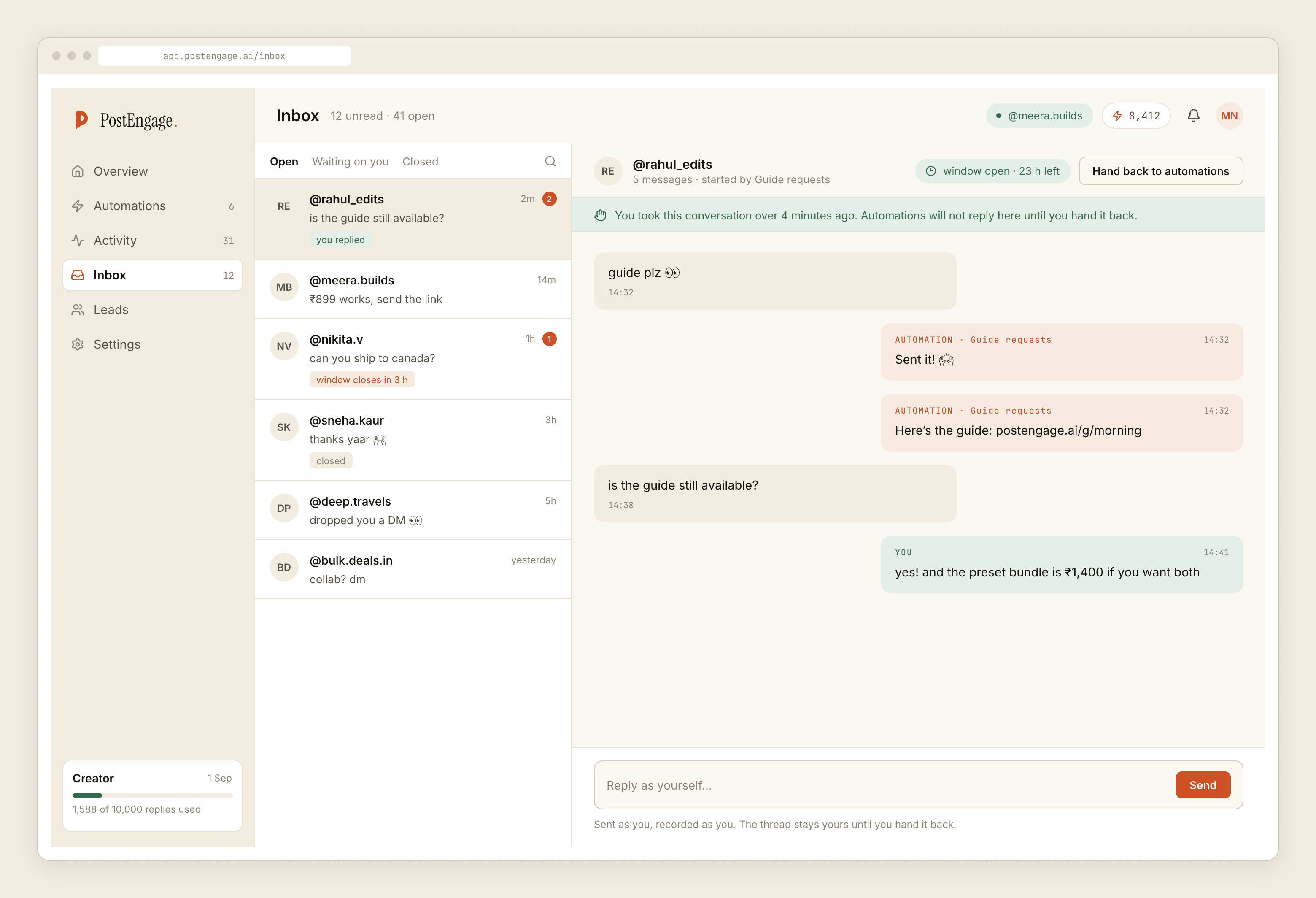
We do not support Threads. Connecting your Instagram account here gives us nothing on Threads — we cannot read replies there, cannot post there, cannot trigger on anything that happens there, and there is no setting that changes that.
That is worth stating in the first paragraph because Threads shares a login with Instagram, and shared login makes people assume shared plumbing. It is a separate app with a separate feed and separate mechanics, and an Instagram automation is as connected to it as it is to your email.
So this is not a product post. It is an honest note on what a person who has built an Instagram practice should expect when they spend time on Threads, written by people who spend their days on the other app.
What carries over
The discipline of one ask. A post that wants four things gets none of them. That is true of a Reel, a story frame, a Note, and a text post, and it is the single most transferable habit in social marketing.
Knowing the words your audience types. On Instagram this shows up as a keyword list. On Threads there is no keyword list, but the underlying knowledge is the same asset: you know that your people write daam and kitne and misspell price in a specific way. That knowledge tells you how to write anywhere.
The instinct to keep the conversation on the surface it started on. Sending somebody out to a browser costs you a share of them and returns nothing you can follow up. That instinct is not Instagram-specific.
Writing like a person. The thing that makes an automated reply survive contact with a real audience — short, specific, unbothered — is the same thing that makes a text post readable.
What does not carry over
The automation. All of it. Different app, and we do not connect to it.
The windows. Seven days from each comment and twenty-four hours from each direct message are Instagram messaging rules. They describe permission on the Instagram Graph API and they have no bearing on a different product.
The comment-to-DM shape. The move that makes Instagram work is that a public comment creates permission for a private message. Whether an equivalent exists on Threads is not something I am going to assert either way, and I would not design around a mechanism I cannot verify.
Your posting rhythm. Instagram rewards a small number of well-made things. Text platforms reward volume and conversation. People who port their Instagram cadence across tend to post three times a week into silence and conclude the app does not work.
The one honest bridge
There is a real connection between the two apps and it is manual.
Threads is a text surface where a conversation can be had at length. Instagram is where your ask lives, on a post with an automation behind it. So the bridge is: have the conversation on Threads, and when it reaches the point where somebody wants the specific thing, point them at the Instagram post.
Nothing about that is automated and nothing about it can be. It is you, typing, in an app we have no access to. But it works, because the two surfaces genuinely do different jobs — one is where people argue and think out loud, the other is where they look at what you make.
Two apps, one login, and no wiring between them. Anyone selling you the wiring should be asked to describe it.
What to actually do on Threads
Given all of the above, the sensible posture is unromantic.
- Treat it as a place to be interesting, not a place to convert. No funnel, no keyword, no ask on every post. The conversion surface is elsewhere and it already works.
- Reply more than you post. Text platforms run on replies. This is the opposite of the Instagram habit, where your own grid does the work.
- Keep the offer out of most of it. If every post routes to a purchase, the app stops being a place people talk to you, which is the only thing it is good for.
- Move the specific questions to Instagram DMs. Not because we handle those — because that is where you already have a repeatable answer, a lead record and a window you understand.
Where the effort compounds
The reason to be careful with a second app is that attention is the scarce input and it is not additive. An hour on Threads is an hour not spent reading your own Instagram comments, which is where the actual work of improving an automation happens — harvesting the words people type, spotting the questions your private reply does not answer, noticing the negative keyword you should have added last month.
If you have limited hours and an Instagram audience that already writes to you, the higher-return activity is almost always tightening what happens when they do. A keyword list built from fifty real comments beats a month of posting into a new app, and it is an afternoon of work rather than a habit.
The scope, stated plainly
What we do: reply to Instagram comments and Instagram direct messages, through the official Instagram Graph API, inside the windows it allows, with a gate that refuses anything unsafe and records why.
What we do not do: Threads, Notes, WhatsApp, Messenger, Telegram, scheduling, publishing, analytics, follower growth, or one-click integrations. Leads leave as a CSV file.
That list is shorter than most tools advertise and it has the advantage of being true. If you want the full picture of what is inside the boundary, the getting started guide walks it, and the safety argument explains why the boundary is where it is.