Playbooks · 5 min read
Instagram Notes: We Do Not Automate Them, and Why

We do not automate Instagram Notes. There is no API for them, so there is nothing to post to, nothing to read from, and no event to fire a rule on. If you came here looking for a tool that writes or schedules Notes, this is not it and I am not aware of an honest one.
That could be a two-line post. It is worth a few hundred words more, because Notes do connect to automation — just not in the way the phrase "Notes automation" implies.
What a Note is
A short line of text that sits at the top of your followers' inbox list, above their conversations. One sentence at most. It expires on its own. It is a status, in the oldest sense of the word — a small signal that you exist today.
Its whole value comes from position. It appears in the place people go to talk to each other, at a moment when their attention is already on messaging rather than on scrolling. Nothing else you post lands there.
Why there is nothing to automate
Three separate reasons, any one of which would be enough.
No write access. We cannot post a Note on your behalf. There is no publishing capability in this product at all — not for Notes, not for posts, not for stories, not for Reels. We reply to people who wrote to you. That is the entire scope.
No read access. We cannot see your Notes, other people's Notes, or who looked at one.
No event. A Note being seen is not a message. Nothing arrives, nothing fires, nothing gets recorded. In this respect it sits with story views, poll votes and link taps — things a person did rather than things a person sent.
The genuine connection: a Note can carry the ask
Here is the part that is actually useful.
A Note cannot trigger anything, but it can be the reason somebody sends you a message, and a message is a thing you can answer. That makes a Note a placement for the ask rather than a thing to be automated.
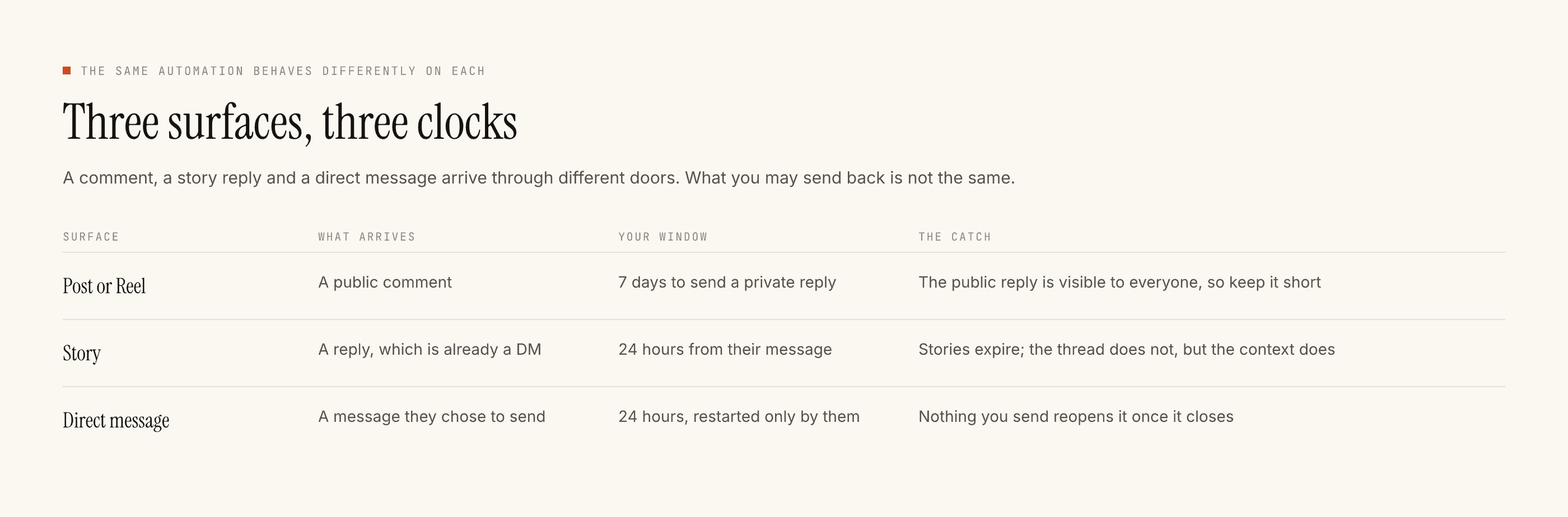
Two shapes work. Point at a post: new drop up, comment SIZE under it and I will send the chart. The Note carries the instruction; the comment on the post produces the event; the automation you already built does the rest, with seven days per comment to work in.
Or invite a reply directly: asking prices today, reply KIT. Now the Note is the top of a DM funnel with no public step at all, which is the story funnel shape arriving through a different door.
What happens when someone replies to a Note
It becomes a direct message thread. From your side it is an ordinary DM on the ordinary clock: twenty-four hours from their message, restarted only by their next one, and nothing you send extends it.
Whether a reply to a Note is distinguishable from any other DM once it reaches us is not something I would build on. Treat it as a plain DM, trigger on the words in it, and you will be right regardless.
That has a practical consequence for the ask. If your Note says "reply KIT" and your DM automation has kit in its keyword list, the reply is answered by the rule you already have. If the Note says something charming and unspecific, you get "hey" and a rule that does nothing with it — which is the same failure as a vague keyword anywhere else.
The Note is not the automation. The Note is the sentence that makes someone type the word the automation is waiting for.
Writing one that produces messages
Short is not optional; the field forces it. So the constraint does the editing and what is left is the choice of what to include.
Name the thing. "New stock" is a mood, "sizes back in stock" is an object. Name the action. "DM me" is weaker than a specific word to type, because a word to type is smaller and it tells the person what will happen. And put one thing in it — a Note asking people to reply, follow and check the link achieves none of the three.
The honest expectation is modest. Notes reach a limited audience and produce a trickle of conversations, not a pipeline. Their advantage is intent: someone who replies to a status has chosen to write to you while looking at their inbox, which is a different quality of contact from a stranger who typed a word under a Reel that reached them by accident.
Where the effort is better spent
If your goal is volume, the answer is not a status feature. It is comment automation on posts that travel, where each comment carries its own seven-day window and strangers arrive in bursts.
If your goal is quality, the answer is asks placed where people are already writing — stories and Notes and the DM surface generally, which produce fewer conversations and better ones.
Either way the automation itself is the same small set of pieces: a trigger, a keyword list built from what people actually type, a private reply that answers and asks one closed question, negative keywords for everything you should never automate, and the ten checks between the match and the send. The reference for that is here.
And if you have been sold a Notes scheduler, it is worth asking the seller which API it uses, then checking the answer. That question sorts most social tooling into two piles quickly, and why the distinction matters is its own argument.