Lead generation · 5 min read
Why the Email Address Is Worth Asking For in the First Place
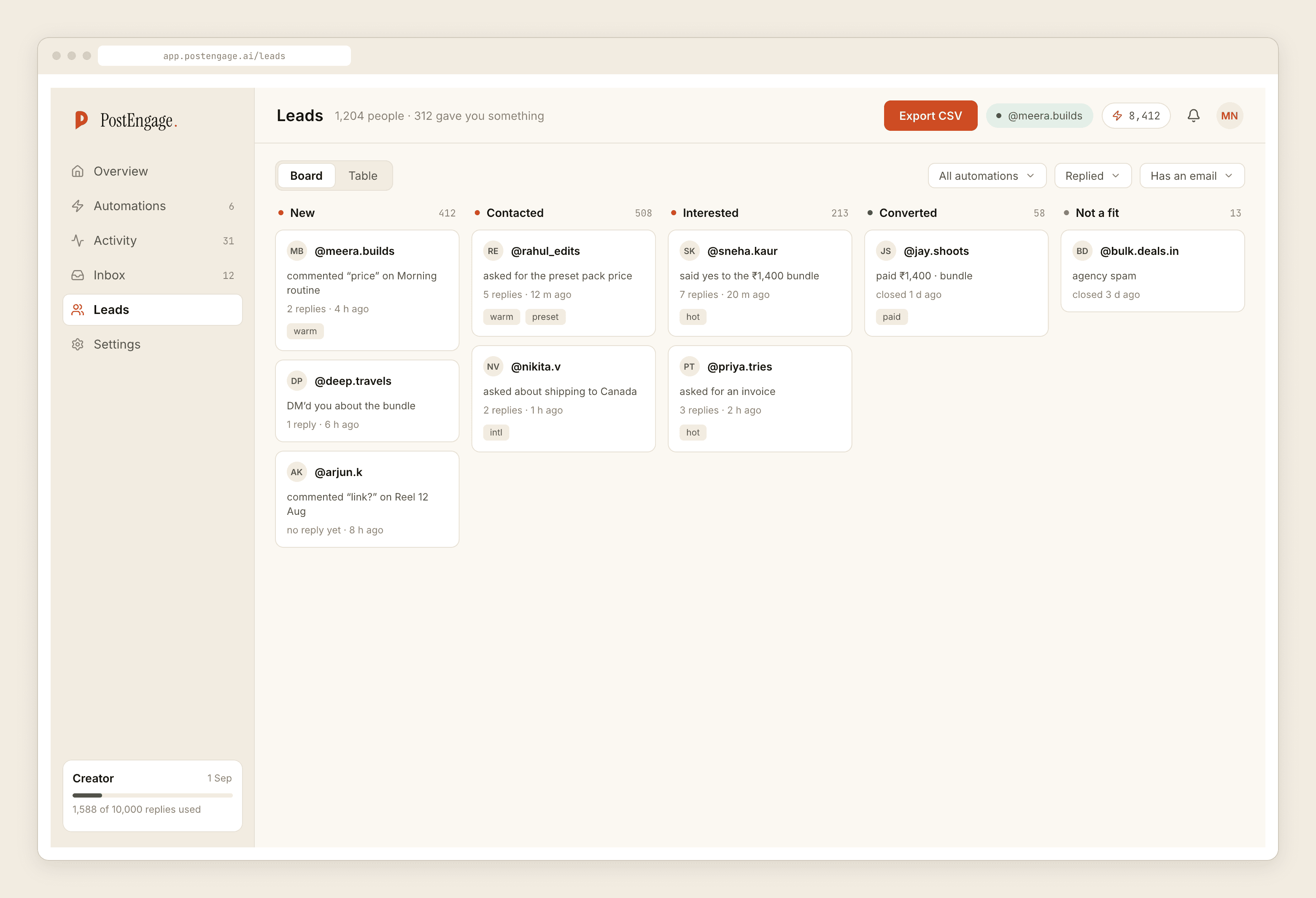
How the address actually gets from a DM into a file is covered elsewhere, in detail, including the two ways of asking and the order that matters more than either. This post is the argument underneath it, because plenty of people set the capture up without ever deciding why they want it, and then never use the file.
The reason is not that email converts better. It might not. The reason is structural, and it survives being asked for a source.
Count what you actually hold
Take an account with forty thousand followers and try to send all of them a message. There is no button. There has never been a button, and no tool on the official API can build one, because the permission does not exist.
So the follower number is not a list. It is an audience you can broadcast to by posting, and address individually only when they speak first.
Then look at the individual conversations, which is where it gets sharper:
- Seven days to reply to a comment, counted per comment. Generous, and it still runs out.
- Twenty-four hours to reply inside a DM thread, counted from their most recent message and restarted only by their next one. Nothing you send extends it.
- Nothing outside those. A person who messaged you last month is not contactable by any route, at any price, from any tool.
Every relationship you have on Instagram is a lease renewed in one-day increments by the tenant. That is not a complaint about the platform — it is the rule that keeps the inbox worth opening — but it is a fact about what you own, which is nothing.
A follower count measures reach. It does not measure a single person you are allowed to contact.
And the account itself is held on the same terms
The second half of the argument is the one nobody enjoys. The audience lives inside an account you do not control the continuity of. A restriction, a compromised login, a policy change, a mistaken enforcement — any of them removes access to the whole thing at once, and there is no export. You cannot download your followers. There is no file.
Whatever else an email list is, it is a file. That is the entire difference and it is a big one.
The honest counter-argument, which is real
Email is also rented. You do not own deliverability. A provider can close your account, a spam complaint rate can put you in the promotions tab or the junk folder, and a domain reputation takes months to build and an afternoon to ruin. Anybody telling you email is an owned channel and Instagram is a rented one has simplified it.
The difference is not ownership in the absolute. It is portability. An email list moves between providers in an afternoon. A follower graph does not move anywhere, ever.
The longer comparison of the two channels treats them as doing different jobs, which is the right framing. This post is only arguing that one of them is worth converting into the other.
What we do and do not do with the address
We capture what somebody typed to you and nothing else. Nothing is inferred from a profile or a bio; if they did not send it, it does not exist. The value is stored with the message that produced it, so months later "why do we have this" has an answer, and it is deletable on the record.
Then it leaves as a CSV. There is no Mailchimp sync, no Zapier, no webhook, no CRM integration — the export is the whole handoff, and you import it wherever your email actually gets sent from. Weekly is enough for most accounts and has the side effect of making you look at the list.
Which addresses are actually worth having
Not all of them, and this is where list-building goes wrong more often than at the capture step.
An address collected in exchange for a giveaway entry belongs to somebody who wanted the giveaway. An address collected in exchange for a size chart belongs to somebody who was choosing between two sizes of a thing you sell. Both are real; only one is a customer list, and the difference was decided upstream by what you asked people to comment for.
So filter before you export. A lead who never replied and volunteered nothing is a username with a timestamp. Importing those in bulk is how accounts end up with a large list, a poor reputation, and a conclusion that email does not work for them.
The list you want is small, attached to questions people actually asked, and portable. That is the thing Instagram cannot give you, and it is the only reason to be asking at all.