Playbooks · 6 min read
One Collab Post, Two Accounts, and Nothing Shares a Dedupe

A collab post is a single piece of content that appears on two profiles. Both accounts show it. Both audiences see it. The comments people leave under it are the same comments wherever you look at them from.
That is a genuinely good reach mechanic and it is also the one post type where two independently configured automations can end up pointed at the same people without either party noticing.
The guard rails are per account
Here is the thing worth understanding before you build anything.
Dedupe stops the same person receiving the same reply twice for the same trigger. It works on your account, on your automations, against what your account has already sent. It has no idea what the other brand's tool did thirty seconds earlier.
The same is true of everything else in the chain. Your cooldown, your rate budget, your quiet hours, your takeover — all of them describe your account's behaviour. Two accounts connect separately, through separate authorisations, holding separate tokens.
Two brands, two automations, one comment section. The only thing preventing a person getting two DMs is an agreement neither tool can enforce.
So the first decision on a collab is not a keyword. It is who is answering.
Three ways to split it, and one of them is bad
One brand answers, the other stands down. The cleanest option. Usually the brand whose product the post is actually about, or whose audience the collab was for. The other partner switches off any account-wide automation for the duration, or scopes it so the collab post is excluded.
Both answer, on different words. Workable and better than it sounds. You take SHADE, they take SIZE, and the caption tells people which word gets which thing. Nobody gets two replies because nobody typed both. It requires the caption to be written jointly, which is worth doing anyway.
Both answer, on the same word. This is the bad one. Somebody comments LINK and receives two DMs, from two brands, within a minute, saying slightly different things. It reads as spam because at the receiving end it is indistinguishable from spam.
Scope the automation to the post, always
Under Advanced there is a setting restricting a trigger to specific posts. On a collab it stops being an optimisation and becomes the thing holding the arrangement together.
An account-wide LINK automation will fire on a collab post because a collab post is a post on your account. It will fire even if you never thought about the collab, using a template written for your own audience, sent to somebody who arrived through a partner. That is how a brand ends up answering questions about a product it does not sell.
- Decide who answers, in writing, before the post goes up. One message in the group chat. It is the whole coordination and it takes a minute.
- Exclude the collab post from every account-wide automation, or scope those automations to specific posts in the first place. The second is better practice generally.
- Build one automation for the collab, restricted to that post. Fresh trigger word, fresh template, written for an audience that may not know you.
- Write the public reply for strangers. Half the people reading that comment section have never seen your account. A reply full of in-jokes and shorthand from your regular content lands badly in front of an audience that arrived twenty minutes ago.
- Cap it. A collab reaches an audience you have not reached before, which means the comment volume does not resemble your usual grid. A rate budget turns a spike into a queue, and a comment stays answerable for seven days counted from each comment, so the queue drains comfortably.
- Give it a switch-off date. A collab post lives on both grids indefinitely and keeps getting found. The automation attached to a campaign that ended in March should not still be running in September.
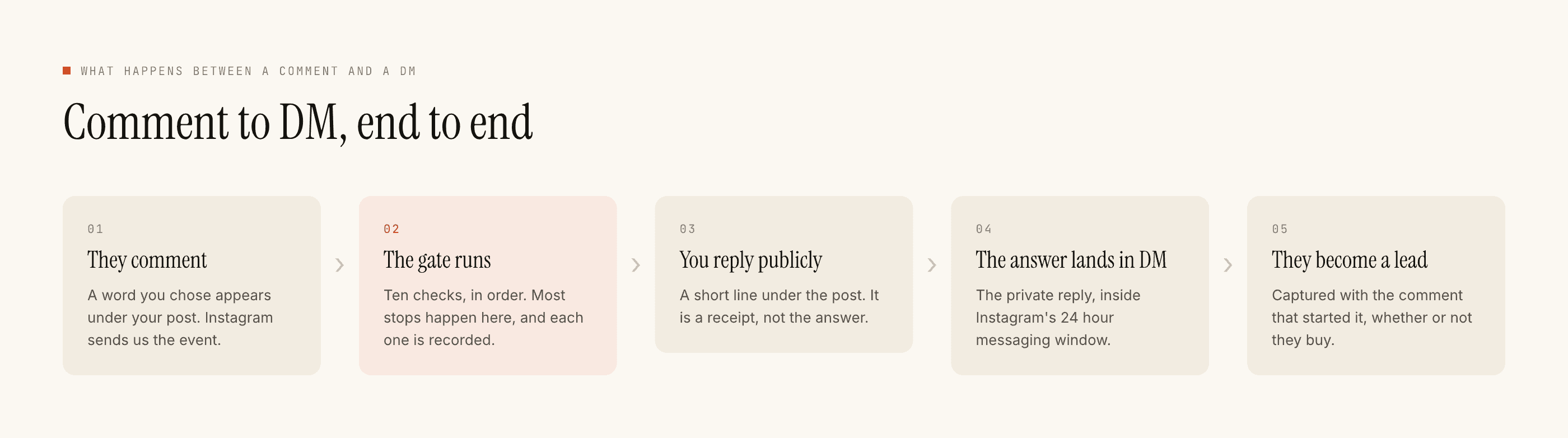
Whose lead is it
The unglamorous question that causes arguments afterwards.
Captured leads belong to the account whose automation ran. If one brand answered, one brand has the list. There is no shared view, no split, no way for the other party to see any of it, and no merge — leads leave as a CSV from whichever account collected them.
Which means the sharing arrangement, if there is one, is a spreadsheet somebody emails, and it needs agreeing at the same moment you agree who answers. Doing it afterwards is how a good collaboration turns into a bad conversation.
There is a data point worth mentioning to your partner too: the record holds the source post, so every row from the collab is identifiable as a collab row. That is the most honest reporting either of you will get out of it, because there is no analytics product here — no reach numbers, no follower attribution, no chart of what the collab did.
Takeover only knows about your side
Worth stating because it surprises people.
If the partner's team replies by hand to somebody in their own inbox, your automation does not know and does not stand down. Takeover watches your account's threads. Two brands replying to the same person in two separate DM threads is not a conflict either system can see.
In practice this is another argument for the one-brand-answers arrangement. It has one owner, one voice, and one place where a human can step in cleanly.
Cost, and the limits
Templated replies are free and unlimited, so a collab automation sending a fixed link to a large new audience costs nothing at any volume. A credit is spent only when the AI writes a new reply, one credit per reply. Free tier is 100 credits with no card; packs start at ₹499.
Official Graph API only. Seven days to answer a comment, counted per comment; twenty-four hours inside a DM thread, restarted only by their next message. Nothing here publishes, schedules or captions anything, so the collab post and its caption are yours to make. It cannot message anyone who has not written to you first. No CRM sync, no WhatsApp, no analytics.
If the partnership side is what you are working out, the brand partnerships post covers the arrangement rather than the wiring, and choosing a trigger word matters more here than usual, because two accounts have to agree on it.