Playbooks · 5 min read
Never Build an Automation That Slows Down a Cancellation

Every business gets questions. A subscription box gets a category nobody else has to think about: people asking to stop paying.
It arrives in the DMs because that is where the brand is. "Hey, I want to cancel." "How do I pause for a month?" "Please stop the December box." Sometimes politely, sometimes not, and almost always at the point where the customer has already decided.
There is a strong and entirely understandable instinct to build an automation for that moment. Retention flows exist. Offers exist. Somebody will suggest a discount template.
Do not build it.
Why deflection is the wrong thing to automate
Three reasons, and they get worse in order.
The first is that it does not work in the way people imagine. Somebody who has typed "cancel" in a DM has usually been thinking about it for a fortnight. A cheerful automated offer does not reopen the decision; it confirms the impression that got them there.
The second is that the friction is visible. An automated reply that answers a cancellation request with anything other than how to cancel is a screenshot. It reads as a brand making it hard on purpose, because that is what it is.
The third is the one that has consequences beyond marketing. In many places there are rules about how a subscription may be cancelled and how easy that has to be. What those rules are, whether they apply to you, and what a cancellation request received on social media obliges you to do vary by jurisdiction and by the kind of business you run.
The one message you should be fastest and plainest about is the one asking you to stop taking money.
What the automation should do with a cancellation
The honest version is short and it is genuinely better for the business, because a clean exit is a customer who might come back and who will not tell six people about the fight.
- Route it, do not answer it. Cancellation vocabulary goes on the negative-keyword list, which stops the automation entirely and leaves the thread for a person:
cancel,cancellation,stop,pause,unsubscribe,refund,charge,charged,billing,chargeback,band karo. Matching folds case, punctuation and Latin accents, and it matches whole words, socancelwill not catchcancelled— write both. - If you do send anything automatically, send the route. One line, the actual link to the account page where it can be done, no offer attached. That is a template you can be proud of.
- Leave first-time-senders-only switched off. A cancellation always comes from an existing customer. Filtering by whether someone has written before gets this exactly backwards.
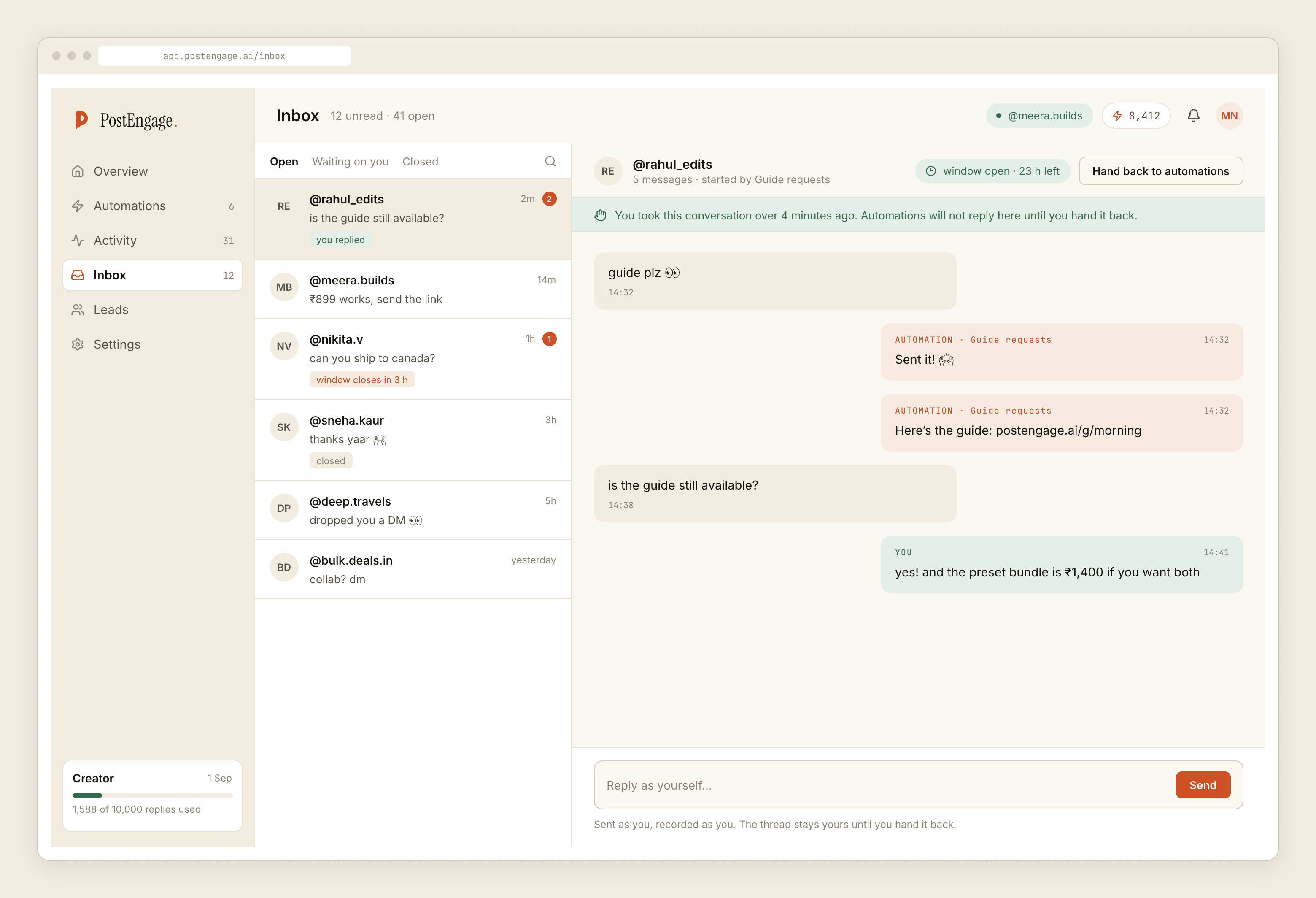
- Let takeover work. The moment a person replies by hand, automation is out of that thread permanently. No retention template landing underneath an apology someone wrote carefully.
- Read the blocked rows. Every stopped reply is recorded with its reason. The cancellation stops are the most valuable rows in the whole log, because they are a weekly list of who is leaving and, in their own words, why.
That last point is the actual retention feature here, and it is not automated. It is somebody reading what people typed.
We cannot see your billing, your orders or your boxes
Worth being blunt, because a lot of subscription questions assume otherwise.
There is no billing integration. No order lookup, no shipment tracking, no payments, no shop or catalogue connection, no way to pause, skip or change anything. Nothing here knows whether this month's box shipped, which variant somebody chose, or when their card is next charged.
So "where is my box" cannot be answered automatically, and an automated reply that sounds like it checked has lied about the one thing the customer wants. It routes. It does not guess.
What is genuinely worth automating
Plenty, and it is the boring half, which is exactly right.
What is in this month's box, once it is public. How the subscription cycle works — the shape of it, not a specific date. How gifting works. Whether you ship to a particular country. What happens if the theme does not suit someone. Where the account page is. How referral works if you run one.
All fixed. All templates. Templated replies are free and unlimited, so the repetitive tail costs nothing however many subscribers you have.
The dated content is the exception and it needs the same discipline as any perishable post. A festive box, a limited collaboration, a waitlist opening — each gets its own automation with a switch-off date decided the day it is built. The habit that saves you: point rather than state. "This month's contents are always on the box page" is true forever. "December's box has the ceramic mug" is wrong in January and keeps saying so.
Unboxings are the other half of the inbox
Subscription boxes generate more customer content than almost any other category, which is the pleasant part of this business.
A tag is not permission, though, and an automated ask has requirements. The consent post covers what a request actually has to say — where the photo will appear, for how long, and whether paid advertising is included, which is a materially different ask that a lot of people would answer differently.
The one thing worth repeating here: the consent request belongs in a fixed template rather than a generated reply. A generated reply phrases the ask slightly differently for every person, which means forty subscribers agreed to forty subtly different things.
Cost, and the clocks
Templated replies are free and unlimited. A credit is spent only when the AI writes a new reply, one credit per reply. Free tier is 100 credits, no card; packs start at ₹499.
Official Graph API only. Comments stay answerable for seven days, counted from each comment. A DM thread stays open for twenty-four hours from the subscriber's last message and only their next message restarts it — which for a billing question is tight, and is the strongest argument for a free template holding the door open at 9pm on a Sunday.
No CRM sync; leads export as CSV. No WhatsApp, no analytics, no sequences and no broadcasts.
If churn is the thing you are actually trying to solve, the churn post is the more useful read, and what a subscription business can honestly do on this channel covers the wider shape.