Playbooks · 5 min read
Nothing Here Grows a Podcast. Here Is What It Actually Does

Say the unhelpful thing first, because a post with "growth" in its URL owes you that.
There is no growth feature here. Nothing follows accounts for you, nothing likes or comments on other people's posts, nothing finds listeners, nothing messages your followers, nothing posts, schedules or captions, and there is no analytics product to tell you whether any of it worked. There is no YouTube integration of any kind. We reply to people who write to you, on Instagram, through the official Graph API. That is the entire product.
So if the question is "will this make my show bigger", the honest answer is no, not directly, and anything that promises otherwise is either describing a different tool or describing a terms violation.
The useful question is a different one, and it is worth asking properly.
Growth is a content problem. Leakage is not.
Whether people discover your show is decided by the work, the guests, the clips and whatever luck the feed hands you. None of that is an inbox question.
But some proportion of the people who did discover you, who did like the clip enough to type something, get nothing back. That is not a growth problem. That is a leak, and it is the only part of this that an automation touches.
The leak is small on any given day, which is exactly why nobody fixes it. Four comments here, a story reply there, a DM asking where to listen that gets seen on Sunday. Individually trivial. The reason it adds up is the second half of this post.
You cannot automate discovery. You can stop losing the people discovery already sent you.
An episode never stops producing messages
Every other kind of Instagram content decays. A sale post is dead in a week. A launch reel is finished in nine days. A restaurant's menu carousel is a rolling present tense that nobody visits twice.
A podcast episode is a library item. Somebody finds it in 2028 because a guest got quoted somewhere, listens on a commute, comes back to the grid, and types a question under a post you made years earlier. That is not an edge case. For a show with any back catalogue at all, it is the normal behaviour of the archive.
Two consequences follow, and the second one is the point of this post.
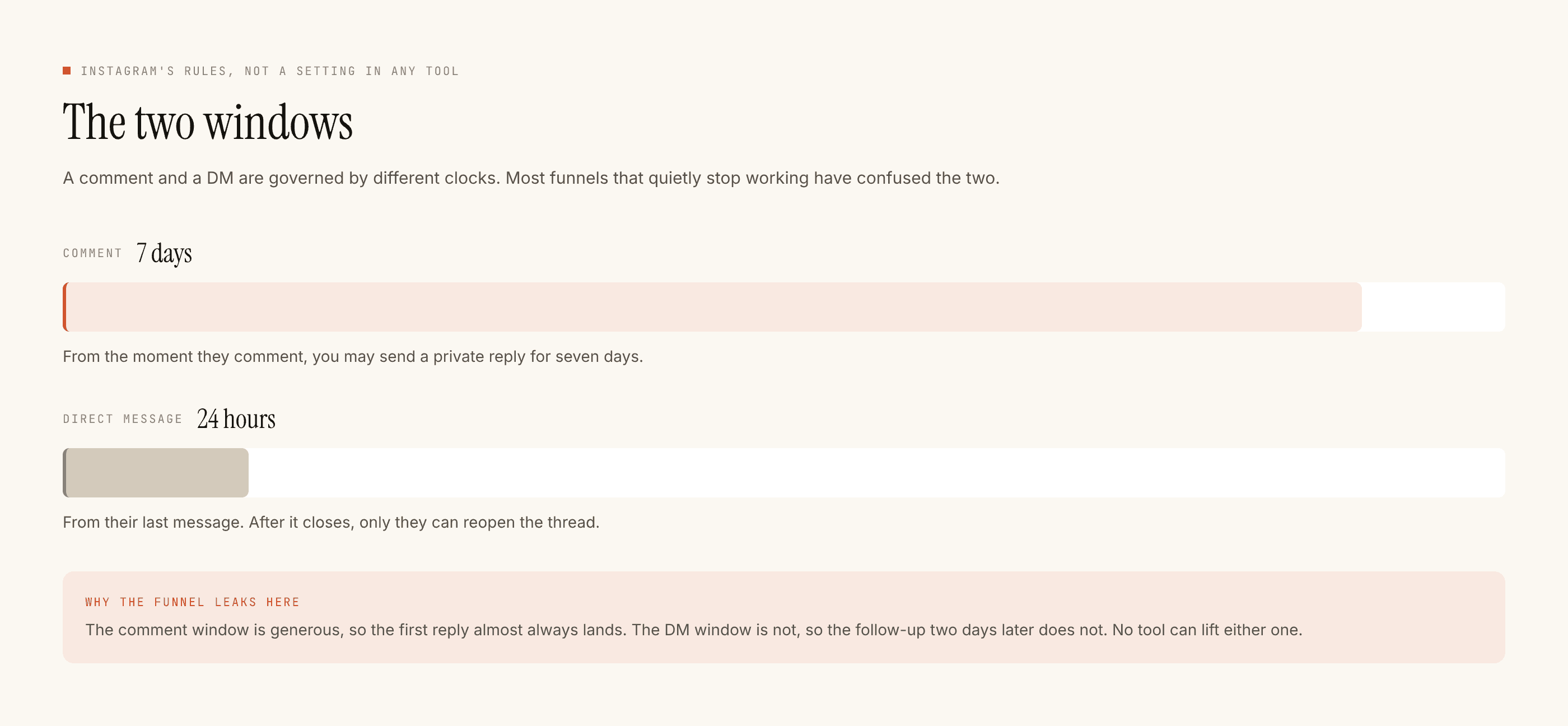
The first is mechanical: the seven-day reply window is counted from the comment, not from the post. A comment left today on a post from eighteen months ago is answerable today, for a week. The mechanics of building for that have their own writeup.
The second is about attention. Your attention goes to the newest post. That is not laziness, it is how the notification list is ordered and how everybody works. Which means the archive — the part that produces messages forever — is precisely the part no human is watching.
The leak audit, which takes an afternoon
Before building anything, go and look. This is the least glamorous instruction on this blog and the one that changes the most.
- Open your twenty best-performing episode posts. Not the newest twenty. The ones that keep getting found.
- Read the comments from the last three months. Count how many were never answered. Most shows are unpleasantly surprised here.
- Note what they actually asked. It is usually four things: where to listen, is there a transcript, which episode was the one about X, and is the guest on socials.
- Note which ones are past seven days. Those are gone. Not recoverable, not worth mourning, but worth counting once so the number is real to you.
- Add the ask line to those twenty captions, by hand. "Comment EP34 and I'll send it." Nothing here edits captions. This is you, in the Instagram app, twenty times.
That last step is the one people skip and it is the one that does the work. An automation with no invitation in the caption sits there matching a word nobody has been told to type.
Four templates cover most of it
The audit almost always produces the same four answers, which is convenient, because four fixed templates cost nothing at all to run.
Where to listen. Whether there is a transcript. Which episode covered a particular thing. Whether the guest is on socials. Write them once, well, in your own voice — a show's whole appeal is often that you seem reachable, and a reply in polished corporate English breaks that in one line.
What the numbers will not tell you
There is no analytics here. No dashboard showing listens, no attribution from a comment to a download, no chart of anything.
That is worth stating clearly because the instinct after building this is to look for the graph that proves it worked, and it does not exist. The honest measure is the one from the audit: go back in three months, open the same twenty posts, and count the unanswered comments again. If the number went down, the leak closed. That is the whole evaluation and it is more truthful than most dashboards.
What it costs
Templated replies are free and unlimited. Four fixed answers running across an entire back catalogue spend nothing, ever, however many people find episode 34. A credit is spent only when the AI writes a new reply, one credit per reply — the genuinely unusual messages, which for a show is a small pile. Free tier is 100 credits with no card; packs start at ₹499.
Takeover stands the automation down in any thread the moment you reply by hand, which for a podcaster is often, and should be.
If the sorting problem is what you actually have — listeners, publicists and sponsors sharing one thread list — that has its own post. If you want the payload right before you build anything, what goes inside the reply is the one to read.