Playbooks · 6 min read
A Follower Is Not a Listener, and You Get One Message
A show with a healthy Instagram following and a thin listener count is not a marketing failure. It is a distance problem.
Instagram is a place people are already in. A podcast app is a place they have to go. Between those two sits one tap that a person makes while distracted, usually on a phone, usually while doing something else — and the only thing you get to influence it with is a single message you cannot follow up.
That constraint is the whole subject of this post. How the back catalogue keeps producing those messages is covered elsewhere, and so is sorting listeners from publicists. What nobody writes about is what should actually be inside the reply.
Why it is one message and not a sequence
The DM window is twenty-four hours from the person's last message to you, and only their next message restarts it. There is no drip, no reminder two days later, no "did you get a chance to listen" on Thursday. Not a feature we have withheld — the platform does not permit the message, so no tool has it.
The comment window is seven days, counted from each comment rather than from the post. That is generous and it is not the same thing as a second attempt. It is one attempt, available for a week.
Everything you would have put in message two has to go into message one, or it does not get sent at all.
Which means the reply is not a conversation opener. It is a delivery. Treat it as one and the whole design gets simpler.
The payload: one link, and it is not the one you think
Here is where most shows lose the tap.
Do not send three links. "Spotify, Apple, or YouTube — whichever you prefer" is a decision handed to somebody who was not planning on making one. A person deciding between three options in a DM is a person who closes the DM. Send one link. If you use a landing page that lists platforms, that is still one link and it is fine, but understand that you have moved the decision one screen further away rather than removing it.
Send the episode, not the show. A link to your show's page drops someone at episode 62 when they asked about episode 34. They will not scroll. An episode-specific link is the single highest-leverage detail in this entire setup and it is the one people skip because it means one automation per episode.
Say what they are getting, in one line. "Ep 34 — the one about hiring your first engineer" costs nothing and turns a bare URL into a thing worth tapping. A link with no label looks like every other link in a DM inbox.
Do not ask for anything in the same message. Not a follow, not a review, not an email address. You are asking for a tap. Adding a second ask halves the first one, and you cannot recover it because there is no second message.
Which surface produces an event, and which does not
This trips up more shows than the payload does, because Instagram presents three things that feel identical and behave nothing alike.
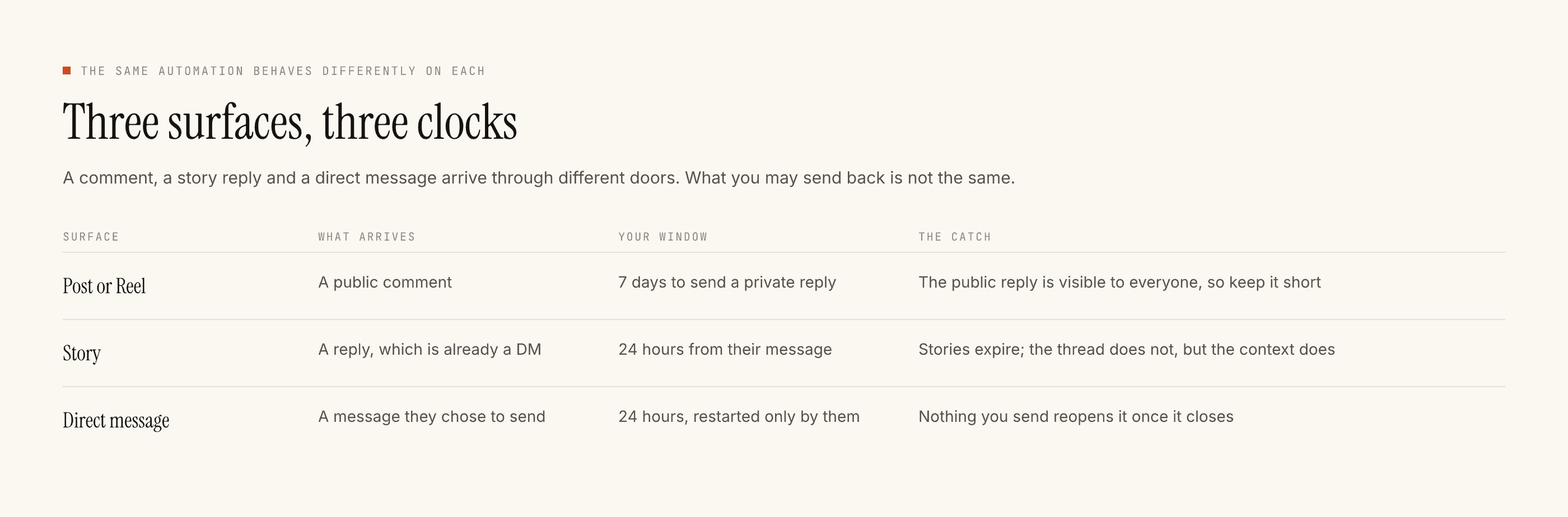
A comment on your episode post is an event. Keyword matches, automation fires, seven days per comment.
A typed reply to your story arrives as a direct message, threaded under the story, and behaves like any other DM. Twenty-four hours.
A story mention where somebody simply tags you and types nothing is not a message. There is no text to match a keyword against and nothing for an automated reply to answer. If you want a reply to be possible, the person has to have typed something — which means the sticker on your story has to invite typing, not tapping.
That last distinction quietly decides how a lot of shows design their release-day story, and most of them design it wrong.
One automation per episode, and the set only grows
Because the trigger is a post plus its keywords, and Advanced restricts it to specific posts, the natural build for a show is a small automation per episode. Three lines each. Added on publish day, never removed.
- Trigger word specific to the episode.
EP34, or the guest's surname. NotLINK, which is already in half your comments and will fire on people who meant something else entirely. - Restrict to that post under Advanced. A show with sixty episode posts and one account-wide trigger is a show that sends the wrong episode.
- Public reply short and varied. Everyone scrolling the comments reads it, and it teaches them the word works. "Sent 📩" forty times in a row reads as a wall.
- Private reply: one labelled link, nothing else. Per the section above.
- Capture to Leads, on. Somebody who typed a word to get an episode is the closest thing a show has to a warm list, and that list leaves as a CSV.
- Test on yourself before going live. The whole pipeline, delivered to your account. It is the only way to catch the copy-paste error where episode 52 sends 51's link, and that error is not hypothetical.
What the reply cannot do, however well you write it
It cannot make somebody listen. There is no attribution here, no analytics, no way to know whether the tap happened. Whether Instagram drove listens is a question for your hosting dashboard, and the honest answer is that the connection is usually blurrier than anyone wants.
It cannot message a follower who has not written to you first, so telling your audience an episode is out is not something automation does. That is a post, a story, and a caption you write.
It does not publish, schedule, read your RSS feed or know your episode numbers. Every episode automation is one somebody made by hand. There is no YouTube here and no WhatsApp. Takeover stands the automation down the moment you reply personally, which for a show is often — and should be.
Cost, briefly
Templated replies are free and unlimited, so sixty episode automations sending sixty fixed links spend nothing, ever, at any volume. A credit is spent only when the AI writes a new reply, one credit per reply, which for a show is the small minority of genuinely unusual messages. Free tier is 100 credits with no card; packs start at ₹499.
Start with your best-performing episode post, add the caption line by hand, build one automation, test it on yourself, and read what got blocked after a week. Choosing the trigger word is the decision the whole thing turns on.