Playbooks · 5 min read
Collab Logistics in the DMs: Start There, Then Leave

Two posts on this site already cover the ends of this. We cannot find creators for you deals with the brand side and what happens once a brand and a creator are talking. The micro-influencer inbox deals with the creator side and which incoming collab DMs deserve your own words.
Neither covers the part in between, which is where collaborations actually go wrong: the fortnight after both sides say yes and before anything is posted. Dates, deliverables, a shipping address, a draft to approve, an invoice. This post is about that, and about the single structural fact that makes it hard.
A collab conversation is slow and the window is not
The DM window is twenty-four hours, and it is restarted only by their message. Nothing you send extends it.
Now look at how a real collaboration moves. Brand messages on Monday. Creator replies Wednesday. Brand needs to check the budget, comes back the following Tuesday. Creator is travelling. Somebody asks for the address on the 20th and the reply comes on the 23rd.
Every one of those gaps closes the window. Which means that for most of a collaboration's life, you cannot message the other side at all. The person who happens to be waiting on a reply is the person who has to send the next message — and if both sides are waiting, the thread is simply over until one of them starts again with a fresh message.
Instagram DMs are a good place to begin a collaboration and a terrible place to run one.
So the goal of the DM is to leave the DM
That is the whole operational insight, and it is not a limitation of this product. It is what the window means.
The first real reply in a collab thread should hand over a channel that has no clock on it. An email address. A phone number. A brief form. Whatever you use. Say it plainly: "Sending the details to email — what's the best address?"
That question does two jobs. It gets you the channel, and because it is a closed question, their answer restarts the twenty-four hours, so you have another turn if you need one.
What is honestly worth automating
Narrow. One thing, mostly.
- The first reply to a collab enquiry. Whichever side you are on, the opening message is predictable enough to template: here is the rate card, or here is the brief form, or here is what we need from you before we can say yes. This one template removes a fortnight of "hi, did you see my message".
- Routing collab words out of your sales automations. Put
collab,collaboration,barter,pr package,paid promo,rate card,media kit,brand deal,sponsorshipin the negative keyword list of every selling automation you run. A collab enquiry that receives your product price list reads as an account nobody is home at. - Nothing after that. Once a real negotiation starts, takeover means the automation stands down for that thread the moment you reply by hand, and that is exactly the behaviour you want.
What must never be automated
Three, and they are all versions of the same rule: an automation must not agree to anything.
A rate. Not the number, not a range presented as an offer, not "we usually do X for this". A quoted rate is a position you now have to argue out of.
A deliverable or a date. "Yes, two reels and three stories by the 15th" is a commitment made by a template that has no idea what your calendar looks like.
An approval. Approving a draft, a caption, or a disclosure label is a judgement call. So is deciding whether something needs a paid-partnership tag, which is a rule about your jurisdiction and your agreement, not about your keywords.
Keeping the thread of it
There is no CRM here, no calendar, no contracts, no invoicing, no shipment tracking, no approval workflow and no creator database. What exists for holding a collaboration together is a lead record: a stage, tags, a replied flag, an interaction count and notes you write yourself.
That is enough to be useful if you actually use it. When a conversation pauses, spend fifteen seconds writing what was agreed and what you are waiting for. "Agreed 1 reel + 2 stories, shipping Tuesday, awaiting address." Three weeks later, when the creator messages out of nowhere, you open the row and reply as somebody who remembers rather than somebody scrolling back through a thread.
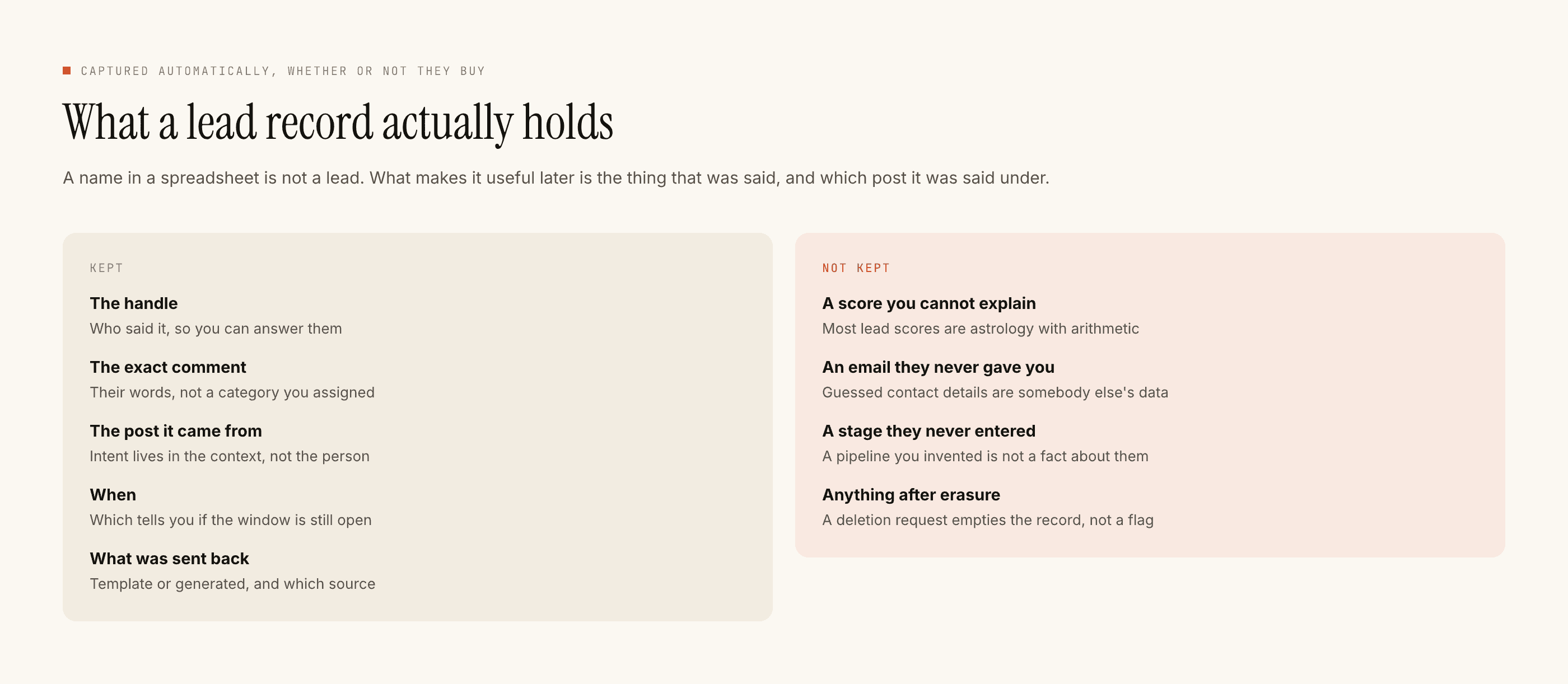
Everything in there leaves as a CSV. There is no sync to a spreadsheet, no integration with a project tool, no export beyond the file.
The seven-day window is your friend here
One genuinely useful asymmetry. The comment window is seven days from the comment, which is far more forgiving than the DM clock.
So if you are a creator and brands find you through your posts, a collab enquiry left as a comment is answerable a week later. If you are a brand seeding to creators, a creator who comments on your product post on Tuesday is still reachable at the weekend. For a workflow this slow, that week is worth more than it sounds.
What this does not do
It does not find creators, score them, check their audience, or tell you what a fair rate is. It does not track collab performance — there is no analytics product, no attribution, no click tracking, so measuring whether a collaboration worked is its own separate and mostly manual problem. It does not send contracts or move money. It does not message anyone who has not messaged you first.
What it does is answer the first collab DM in seconds with the right document attached to it, keep your sales templates off those conversations, and give you somewhere to write down what was agreed. For the awkward middle, that plus an email address is most of what you need.