Playbooks · 5 min read
Graphic Designers: Automate the Intake, Not the Quote
Every designer's inbox contains the same message, arriving several times a week, phrased slightly differently: "how much for a logo".
It is unanswerable. Not because you are being coy about your rates, but because a logo is not a thing with a price. It is three concepts or one, two revision rounds or unlimited, a wordmark or a full identity, files for print or a brand sheet, one-time use or a transfer of rights. The number changes by a lot depending on answers the person has not given you and mostly has not thought about.
So the first rule of automating a design inbox is the one that sounds like a refusal: your automation does not quote.
Why a number in a DM is worse than no number
If your automation replies with a starting figure, that figure is now the anchor for every conversation that follows. The client who wanted a full identity with three rounds has already decided what the job costs, and everything you add afterwards reads as an upsell rather than as scope.
A price sent before the brief is not information. It is the ceiling of your negotiation, set by a machine that had not read the brief either.
There is a version of publishing a starting price that works, and it is the version that carries its scope with it: "single wordmark, two rounds, source files — that is the starting package. Full identity is a different conversation." If you are willing to put that in writing and stand by it, put it in the template. If you are not, the automation should not produce a number at all.
What the automation is actually for
The value is not the reply. It is that the reply arrives while the person is still thinking about you, and that it collects the three facts that decide whether this is a job.
- What, exactly. Logo, packaging, deck, social templates, a wedding invite. One word from them is enough to route it.
- When. A deadline is the most honest qualifier anybody gives you unprompted. "Next month" and "by tomorrow" are different businesses.
- Budget, as a band. Not a number — a band, with your bands named. People answer a multiple-choice question they would dodge as an open one.
Ask those in one private reply, not four. A DM thread is not an interview and you get one good question before people stop typing. If you must pick a single one, pick the deadline.
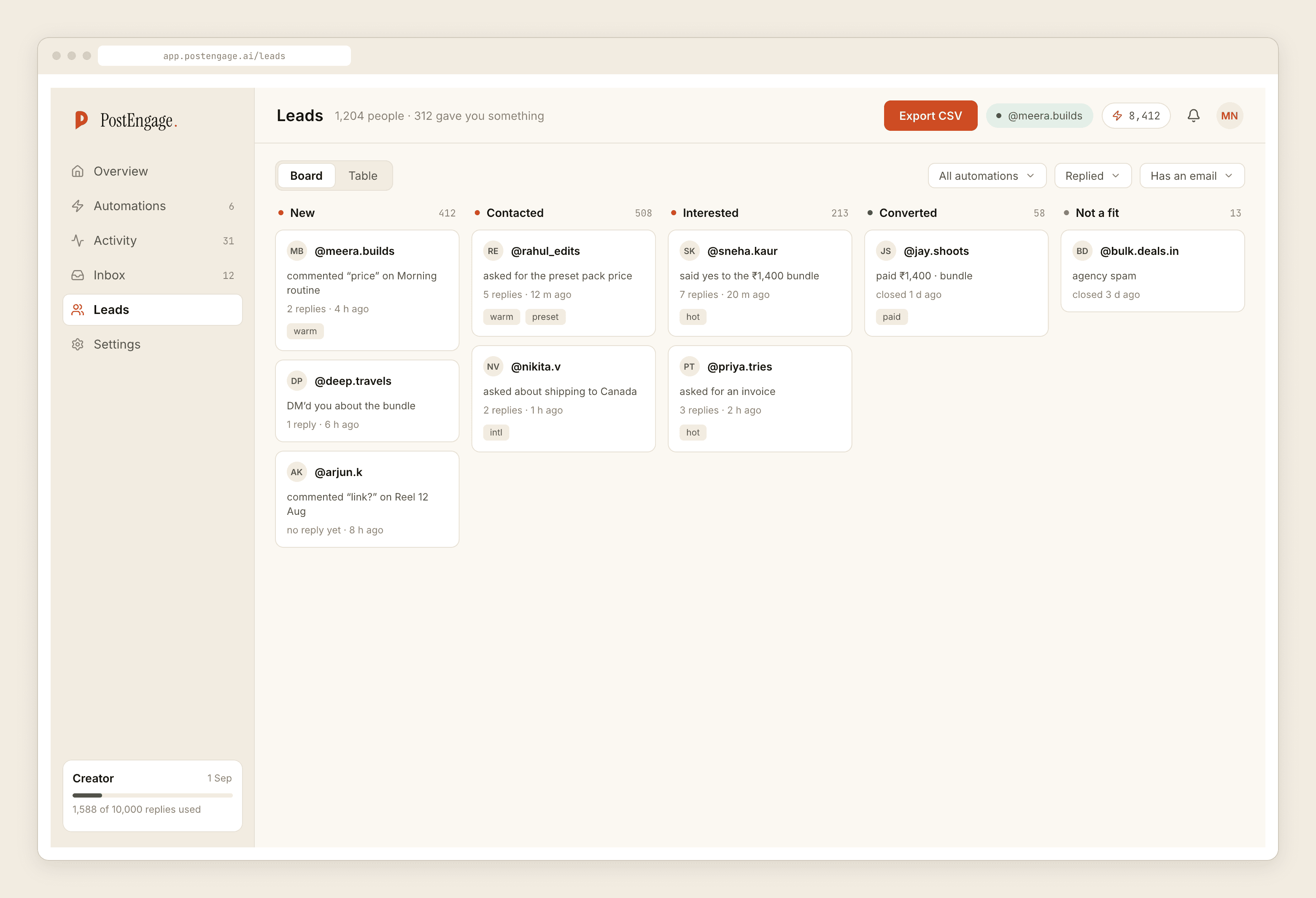
Capture every one of them. There is no CRM sync and no integration; leads leave as a CSV. That is less limiting than it sounds, because what you mostly want from this data is not a pipeline view. It is the pattern: which posts produce enquiries, which service people keep asking for, and which enquiries you kept ignoring.
The three inboxes hiding inside your inbox
Read a month of DMs and they sort into three piles that deserve three different automations.
Real enquiries. Someone with a business and a problem. These get the intake reply above, get captured, and get a human within a day.
Collaboration and barter. "Can we collab", "exposure", "we'll credit you". Some of these are genuinely worth it and most are not, and either way they should not receive your commercial intake reply. A separate automation with a short, unembarrassed template — what you do and do not take on in exchange for credit — settles it in one message without you writing another polite decline.
Students and other designers. "Which software?", "how did you do the gradient", "kaunsa course kiya". No money in these at all, and answering them well is good for you anyway.
That last pile is where the metering quietly matters.
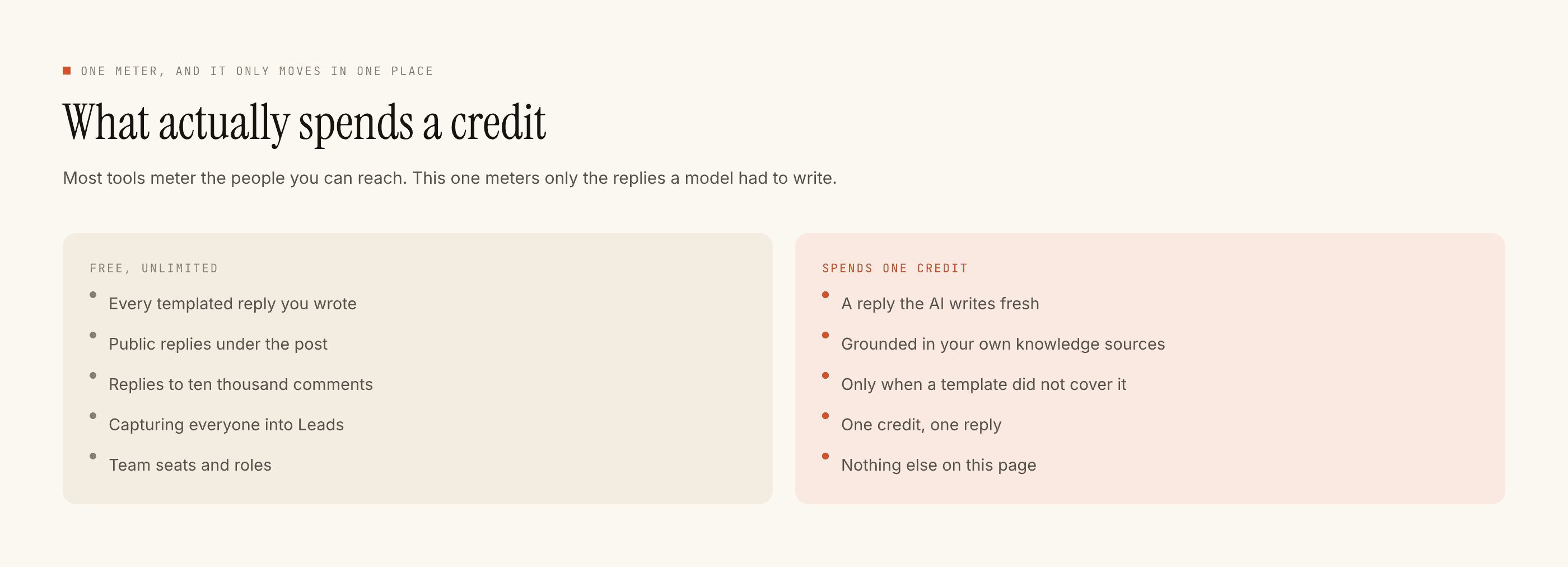
Templated replies are free and unlimited. A credit is spent only when the AI writes a new reply. Your highest-volume, lowest-value questions — the software ones, the "do you do print too" ones — are exactly the ones with a fixed answer, so they cost nothing forever. The free tier is 100 credits with no card and packs start at ₹499, and a designer whose templates cover the repeat questions will mostly spend credits on the genuinely unusual brief, which is the message that deserved a written reply anyway.
Things it will not do, and one you should not want
It cannot check whether you are free next week. There is no calendar, no scheduling and no availability of any kind, so "can you deliver by Friday" gets an honest "let me check" rather than a promise.
It cannot send a file. A link to your portfolio or your rate card, yes — that is text. The PDF is not.
And it cannot write a proposal, which is the one people ask for and the one you should be relieved about. A brief you did not read is a proposal you will lose.
Keep the voice yours, because it is the product
The register of a designer's DMs is part of the work. A reply that reads like a support ticket from a company undoes what the grid was doing.
Generated replies are shaped by replies you actually wrote, which is the only version of this that survives a client reading it twice. And the moment you answer a thread by hand, the automation stands down for that conversation — no template landing thirty seconds after your real reply.
If you freelance across more than design, the freelancer post covers the general shape. For deciding which of these enquiries to call first, lead scoring is here, and if you want the enquiry to start from something better than a cold DM, lead magnets are here.