Playbooks · 6 min read
Brokerage Instagram: One Account, Nine Agents, No Routing
On this page
- The thing to settle before anybody opens the builder
- Name the automations so a stranger can read the list
- The Monday ritual, which is the actual product
- Two agent-scale problems the single-agent post does not have
- The shared inbox, and who is allowed to type
- What to build first, if you are starting on Monday
- The unflattering list

The flat sells, the reel keeps running already makes the argument every property account needs: your inventory expires, your content does not, and an automation attached to a listing is a temporary structure that needs a demolition date.
I am not going to restate it. This post is the version for an agency rather than a person — nine agents, one Instagram handle, a shared inbox, and listings that belong to individual people who did not build the automation and will not remember to switch it off.
The thing to settle before anybody opens the builder
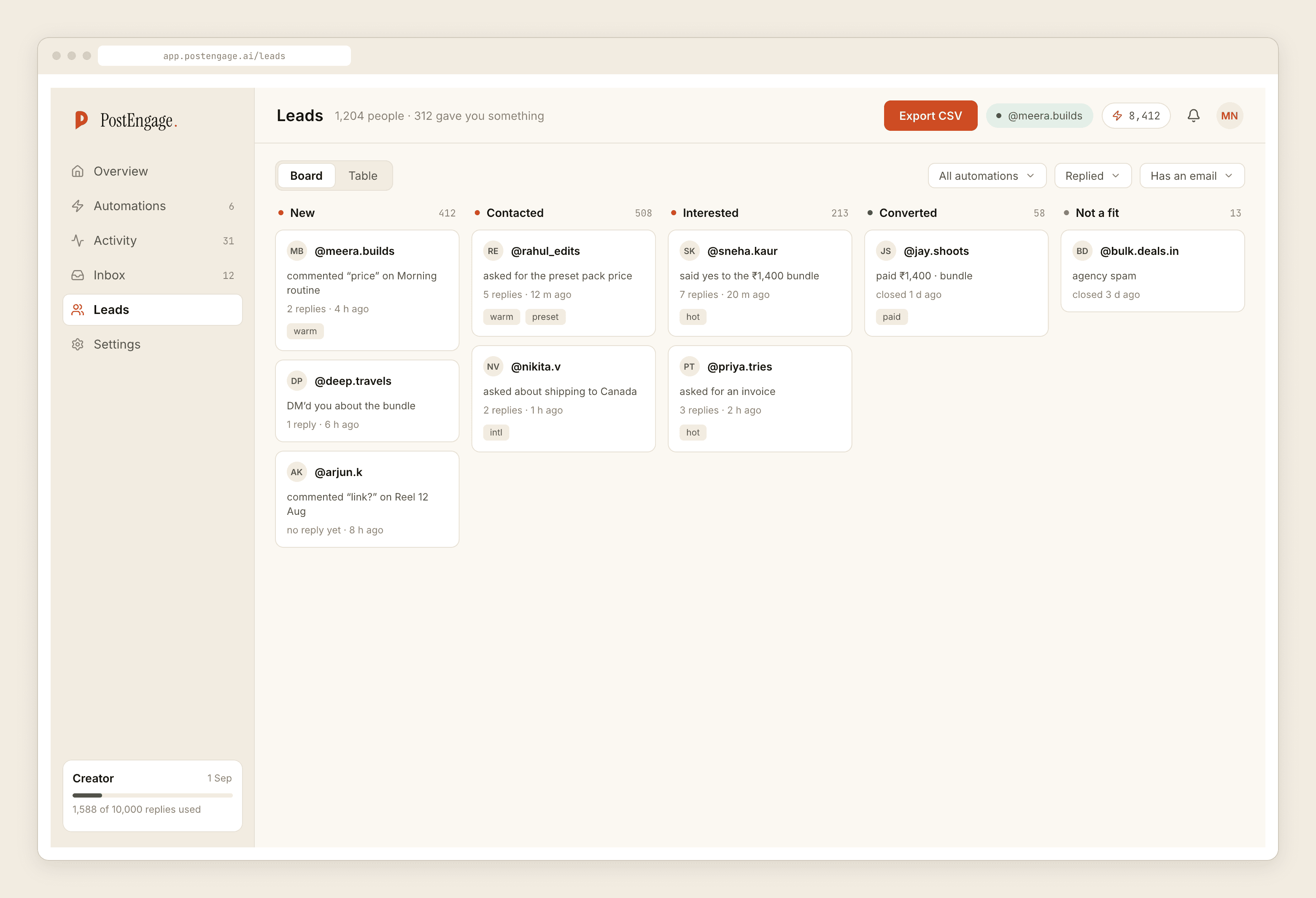
There is no lead routing here. None. No assignment rules, no round-robin, no territory logic, no per-agent inbox, no CRM sync. A captured lead is a handle, the words they typed, and which post caught them. It lands in one list that everybody with access can see.
That is the constraint the whole operating model has to be built around, and it is better to know it on day one than to discover it in week three when two agents have both replied to the same buyer.
The product will not decide whose lead this is. Something in your office has to, and it should be a rule rather than whoever checks their phone first.
The workable arrangement in most brokerages is that the source post decides. One automation per listing, the listing belongs to an agent, so the post that caught the lead names the owner. It is crude and it is unambiguous, which is the correct trade at this size.
Name the automations so a stranger can read the list
By month four a brokerage account has thirty automations and nobody remembers what half of them are attached to. The fix is a naming convention agreed on the first afternoon and never negotiated again.
Something like WHITEFIELD-3BHK-PRICE-RAHUL-DEC — locality, configuration, trigger word, owning agent, month created. Ugly, and readable by an office manager who has never seen the property.
The month in the name is the part that does the work. When somebody scans the list in March, anything from October is visibly a question, and the questions are the ones that send an old asking price to a cousin.
The Monday ritual, which is the actual product
Fifteen minutes, once a week, one named person. Not the agents — they will not do it, and it is not a criticism of agents.
- Read the automation list top to bottom. Anything attached to a property that is sold, off market, or under negotiation gets switched off or swapped to a graveyard reply.
- Read Activity, filtered to blocked. Window-closed rows on older posts are the platform working. A run of takeovers on one listing usually means an agent is answering faster than the automation, which is good and means that automation could be narrower.
- Export the leads to CSV and hand it out. There is no integration; this is the handoff. A file, once a week, split by source post.
- Ask which listings changed price. Then check whether a number is sitting inside a template for any of them.
Step four is the one that catches the expensive mistake. Keep figures out of templates wherever the reply survives without one — "sending you the full detail sheet" outlives a price revision, and revisions in property are routine.
Two agent-scale problems the single-agent post does not have
The buyer who comments on four listings. A serious buyer in one evening will comment on your Whitefield reel, your Sarjapur reel and two others. Those are four automations and four replies. Nothing account-wide recognises them as one person, so the reply count will look like four leads and the Leads list is where you find out it was one. Read the list, not the counter.
The agent who leaves. Their listings stay live, their automations stay live, and their name is in the private reply template saying they will call. Add "switch off their automations" to whatever exit checklist you already have, next to taking back the SIM.
The shared inbox, and who is allowed to type
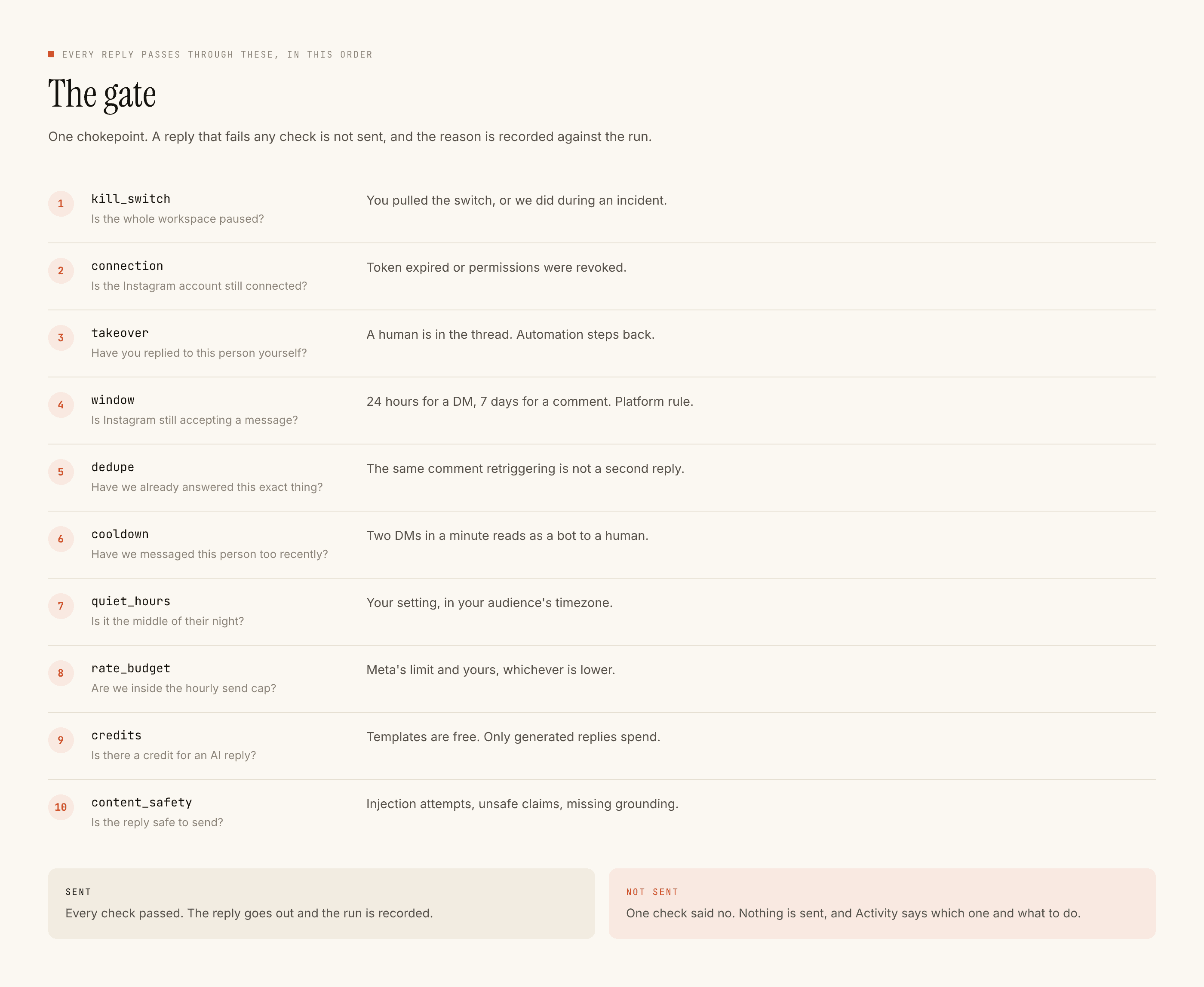
Takeover stands the automation down in a thread the moment a human replies by hand. In a brokerage that is a feature and a hazard at once, because the human who replied might be the wrong human.
The rule worth writing down: whoever replies first owns that conversation until they hand it over deliberately. Not "whoever is free". Half the awkward moments in a shared property inbox are two agents pitching the same buyer forty minutes apart, and the automation is not what caused it.
What to build first, if you are starting on Monday
One listing. The one an agent is actively pushing this week.
Trigger PRICE scoped under Advanced to that single post. Negative keywords for the words that mean an existing client or a problem — possession, registry, agreement, delay, refund, broker. Public reply of four words with no number and no availability claim, because the seller reads it too. Private reply with the detail sheet, one qualifying question about where the person is based, and the agent's name. Capture on.
Then watch it for a week before the second one exists. The paced setup guide is the right order and it does not get faster because there are nine of you.
The unflattering list
No CRM sync, no lead assignment, no round-robin, no per-agent reporting, no attribution, no analytics product. No calendar and no site-visit booking. No WhatsApp. No way to message anybody who has not messaged the account first, which rules out DMing your followers about a new launch entirely.
Official Graph API only: a comment stays answerable for seven days, a DM thread for twenty-four hours, and only the buyer's next message restarts that second clock.
Templated replies are free and unlimited, and a credit is spent only when the AI writes a new reply. Free tier is 100 credits with no card, packs from ₹499. At brokerage volumes the listing traffic is one repeated question, which templates absorb at no cost however far a walkthrough travels — the credits go on the genuinely odd message about a loan situation or a school two streets away.
What no tool will tell you is whether an automated message counts as an advertisement in your jurisdiction, or what a listing must disclose. That varies by regulator and it is a question for whoever advises the agency.
If you want the mechanics of the flow itself, the comment-to-DM walkthrough covers it, and what the checks refuse and why is worth reading before the first Monday review.