Playbooks · 5 min read
Instagram Automation in 2027: What We Will Not Predict

We do not know what Instagram will look like in 2027. Neither does anyone else writing a post with that year in the title, including the ones with a chart in them.
What can be written honestly is a different document. Some parts of how automation works on Instagram are not fashion — they follow from how Meta has chosen to build permissioned messaging, and from what a messaging platform has to do to stay usable. Those parts are worth planning around because they are expensive to change. Everything else is guessing, and guessing is not a service we are going to sell you.
So this post is in two columns. What is structural. And, for each of the things people want, the specific change that would have to happen first — stated as a condition, not as a timeline.
The structural part
Consent is the shape of the whole API. Every send on the official Graph API traces back to something a person did: they commented, they replied to a story, they sent a message. Meta did not build a permission for messaging a stranger and then restrict it. There is no such permission to loosen. This is not a rate limit that scales with your plan; it is what the product is.
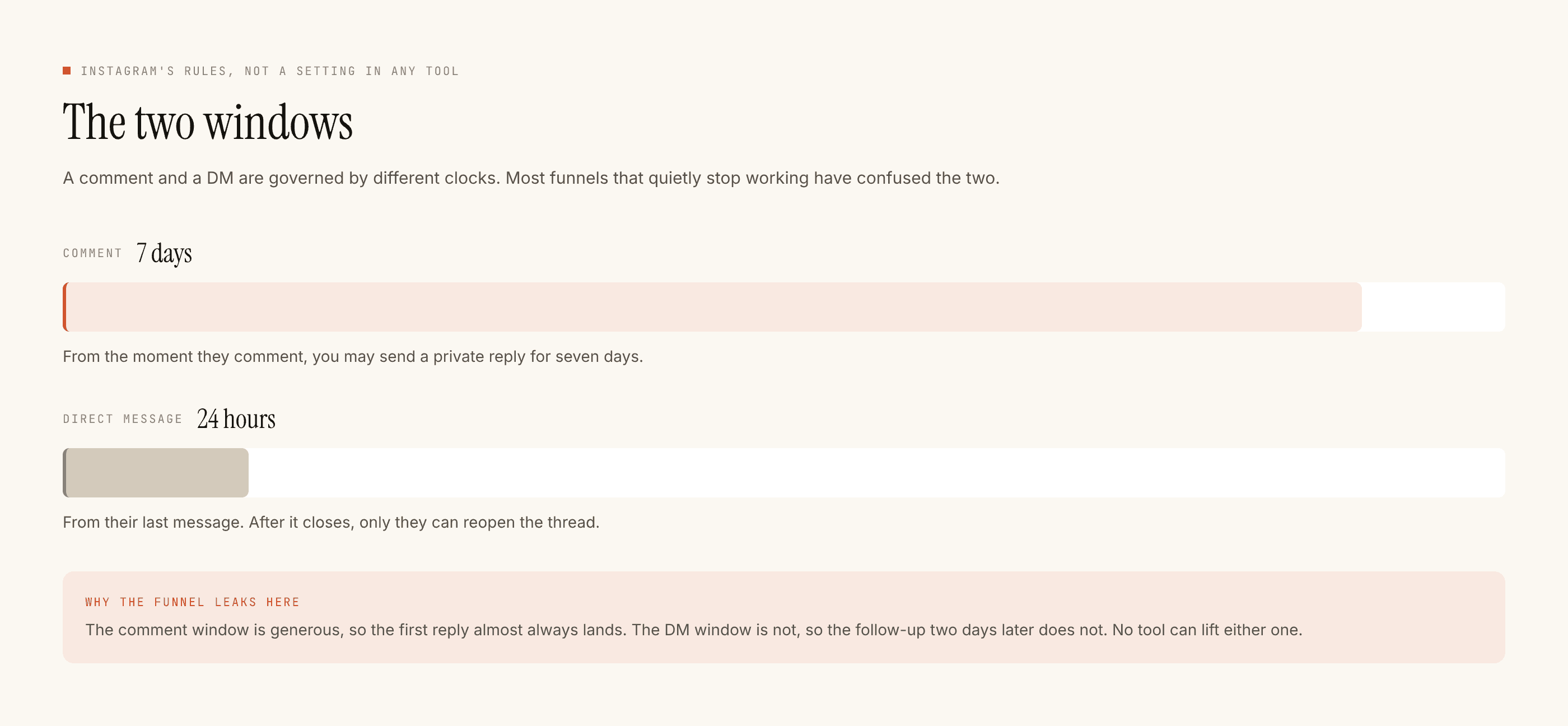
Because consent is the shape, there are clocks. A comment on your own post can be replied to for seven days. A DM can be answered within twenty-four hours of that person's most recent message to you, and only their message restarts that clock. Those two numbers are the mechanism that stops consent from being permanent, which is what makes it consent.
Generation costs money to run. Every fresh sentence a model writes has a real unit cost to whoever runs it. That does not go to zero, and it is why every serious tool in this category meters something. What differs between vendors is which thing gets metered — contacts, conversations, messages, or generated replies. Here it is generated replies: one credit, one reply, with templates free and unlimited at any volume.
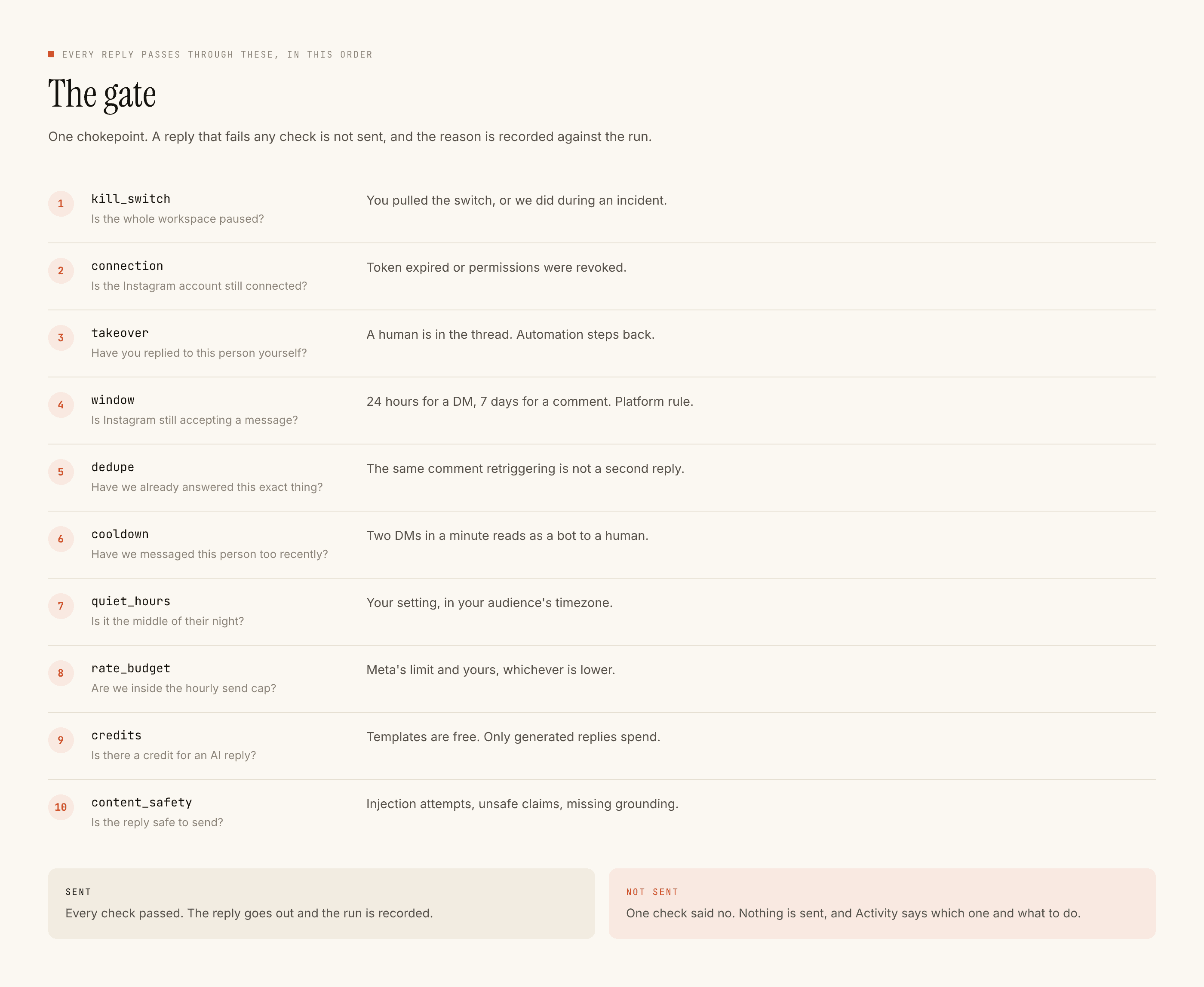
Someone has to be accountable for what got sent. Not a philosophical point. A business that sends automated messages will one day need to answer the question "what exactly did it say to this person", and if the system cannot answer, the business cannot either. Records outlive features.
The things that will still be true in 2027 are the boring ones: consent, clocks, cost, and a log.
What would have to change first
Here is the honest form of a forecast: a condition. Each of these is something people ask us for. None of them is on a roadmap, and we are not saying any of them will happen.
- Cold DMs on the official API. Meta would have to create a permission that does not currently exist, for a use case it has spent years designing against, and then decide the spam consequences are worth it. Until that happens, any product offering it is not using the official API.
- A longer reply window. The twenty-four hour clock would have to be relaxed by Meta, platform-wide. No integration can buy an exception, and no tier of any product includes one.
- AI that reliably handles the hard messages. The blocker is not model quality. It is that the hard messages — a refund, a complaint, a medical question, anything about someone's money — are exactly the ones where being confidently plausible is the failure mode rather than the goal.
- Automation that knows a customer across channels. Would require the channels to be joined, which requires either an integration we do not have or an identity that Instagram does not hand out.
- True attribution from a DM to a sale. Would require a tracked link, a conversion event, and a join between a person in your inbox and a payment in your bank. We have none of the three, and nothing on the official API supplies them.
The safe bets are not exciting
If you want something to act on rather than to nod at, this is it.
Models will keep getting better at prose. That improves one component and touches none of the others. A better writer still does not receive a webhook, hold a token, know a window closed, or remember what it already sent.
Enforcement of what is not the official API will get less forgiving over time, not more, because the pressure runs one way. Software that logs into an account with a password is the part of this category that has a weather problem; an authorised integration holding an issued token does not. The staircase and where it leads is the post on that.
And the cost of a wrong automated reply keeps rising as more of them exist. When every brand sends a smooth generated sentence, the smooth generated sentence stops being a signal of care and starts being a signal of its absence.
What to build now that survives either way
Four things, and none of them depend on which way the platform moves.
Templates in your own register. They are free, unlimited, and they are the thing you would have to rewrite last if everything else changed. Also the only asset here that is genuinely yours.
Keyword lists that match how your audience types. price, rate, kitne ka, dam kya hai. Matching folds case and punctuation, so you do not need every capitalisation — but it does not fold Indic vowel signs, so दाम and दम are two different words and both belong on the list if you receive both.
A short list of things you will never automate. Write it down. It is a judgement, and it does not become obsolete.
The habit of reading Activity. What was sent and what was refused, weekly. A system nobody reads is not a system.
If you would rather have the near-term version of this argument — what people are claiming about AI on Instagram right now and how to check a claim — that is the companion post. And the mechanics under all of it are in the API overview.