Comparison · 5 min read
WhatsApp Marketing Conversation Pricing (2026)

Most of what a business spends on WhatsApp is not a decision. Orders get placed, so dispatch messages go out. Customers ask questions, so somebody answers. That spend tracks the business.
Marketing conversations are different. Nobody asked for them. You choose to open every one, you choose how many, and you choose who receives them. That makes this the only category on the channel you can genuinely budget — and the only one where the money can disappear without producing anything.
What makes a conversation a marketing one
Not your intent. The content.
A promotion, an offer, a launch announcement, a re-engagement nudge, a "we miss you" — these are marketing. So is a shipping update with a coupon at the bottom, which is the single most common way a business ends up paying marketing rates on a message it budgeted as operational.
The categories that exist, and how each is charged, are Meta's and Meta revises them. Check the current category definitions and rates for your market in Meta's own documentation before you build a spreadsheet on top of them. This post has no numbers in it on purpose.
You do not get to choose the category. You choose the words, and the words choose the category.
The denominator that ruins budgets
The number every marketing dashboard wants to show you is cost per message sent. It is the least useful figure available.
Sends are an input. You control them completely, which means you can always make the number look better by sending more to a worse list. A campaign that reached a large audience cheaply and produced nothing has an excellent cost per send and was a waste of money.
The denominators worth using instead, in ascending order of honesty:
- Cost per reply. Somebody wrote back. On a channel where a conversation is the unit, a reply is the first evidence that you bought a conversation rather than a notification.
- Cost per qualified conversation. They wrote back about the thing, not to ask you to stop. This needs a human or a system to read the replies, which is why most teams skip it.
- Cost per order attributable to the send. Hard, requires your own order data, and worth doing on at least one campaign per quarter so you know roughly what the others are worth.
If you can only maintain one, make it cost per reply. It is cheap to count, it is hard to game, and it collapses the moment you start messaging people who did not want to hear from you.
The cost that is not on the invoice
Here is the part that separates this channel from email, and it is the reason "just send more, it is cheap" is bad advice even when the rate genuinely is low.
A marketing message to somebody who did not want it costs you the conversation charge, and then it costs you again: a block, possibly a report, and a small downward push on the health of the number the rest of your business depends on. The dispatch notifications, the order queries, the appointment reminders — they all ride on the same number.
The four levers that actually move marketing spend
List quality. The most powerful and the least glamorous. A smaller list of people who asked to hear from you will out-earn a larger bought one on every denominator above, and it will not damage the number.
Frequency. Almost every business that has trouble here is sending too often, and almost none of them believe it. If you cannot name what the last three campaigns were for, the next one is probably filler.
Segmentation, in the crude sense. Not personas. Just: do not send the first-order discount to somebody who ordered last week, and do not send the restock alert to somebody who bought the thing. Two or three obvious splits capture most of the available gain.
The message itself. A marketing conversation that ends in a reply has bought you a window in which you can be genuinely helpful. One that ends in a click has bought you a page view. Write for the reply.
A sane budgeting routine
Decide, once a quarter, how many marketing conversations you intend to open — as an absolute number, not a rate. Divide it across the campaigns you can actually name and justify. Look up the current rate for your market and category in Meta's documentation, add your vendor's meter separately, and you have a ceiling.
Then hold the ceiling. The value of an absolute number is that it forces the question "is this campaign worth more than the one I would give up", which is the only question that reliably kills bad sends.
What this looks like on the channel we run
PostEngage does not ship WhatsApp. On Instagram, where it does run, there is no outbound marketing to budget at all — the product replies to people who commented or messaged first, inside Meta's windows, and there is no broadcast and no nurture sequence to send. That is a limitation, not a virtue, and it happens to remove this entire category of decision.
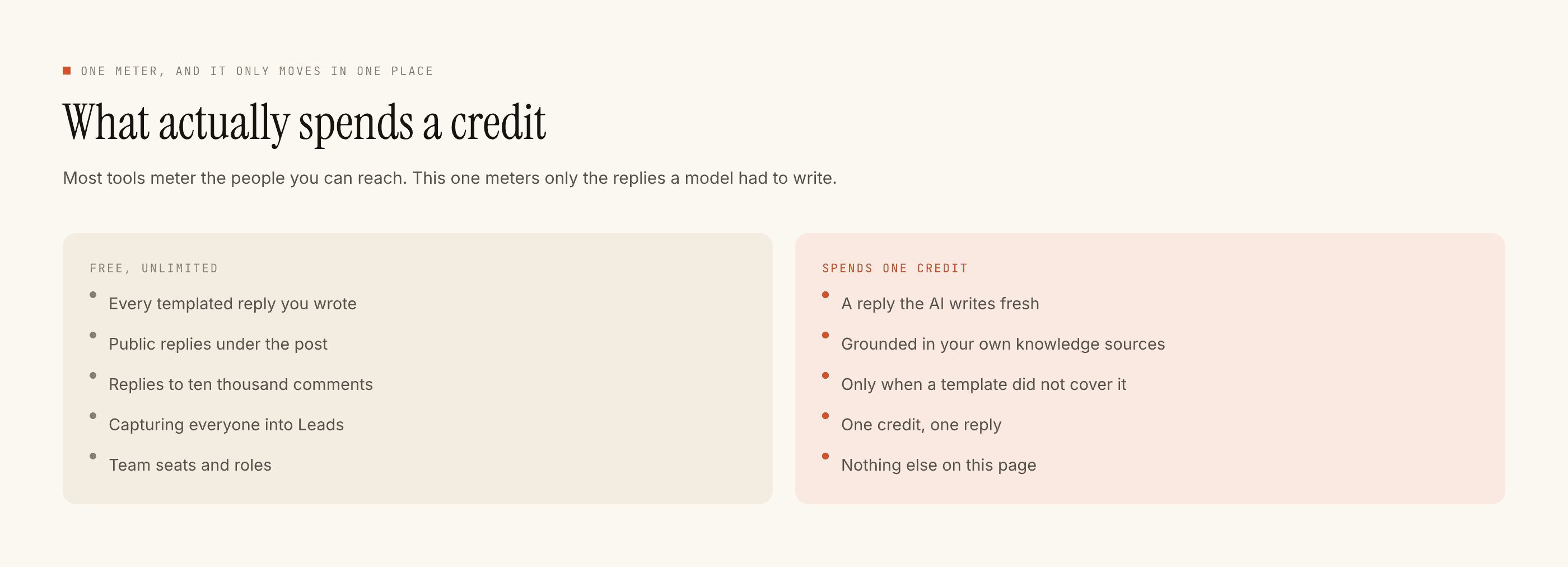
Our meter is a credit: templated replies are free and unlimited, a credit is spent only when the model writes something new, the free tier is 100 credits with no card, and packs start at ₹499.
If you want the model rather than the budgeting, the pricing structure post covers it. If you want the account-health side of sending to a cold list, the restrictions post is blunt about it. And if you are writing the actual message, this one is about earning a reply.