Playbooks · 5 min read
Real Estate on WhatsApp: The Price Is Not Yours to Send

Property enquiries arrive at the times people think about property: late at night, on a Sunday, and in the twenty minutes after somebody scrolls past a listing. An agent who replies at 11:40pm gets the viewing. An agent who replies on Tuesday gets told the flat is taken.
That is the honest case for automating a property inbox, and it is a good one. It is also where most of the argument for automation ends, because nearly everything a buyer actually asks is something a machine should not answer.
The listing is already stale
Every other vertical worries about templates ageing. In property the inventory ages, which is worse.
A flat goes under offer on Thursday. The listing stays live on three portals, the photos stay in a folder, and the automation keeps sending the same brochure to people asking about it on Saturday. You are now booking viewings for something that is sold, and the first thing the buyer learns about you is that you did not know.
There is no clever fix. There is a discipline: any automation that names a specific property is a temporary automation, tied to that property, switched off the day it goes under offer, and owned by whoever updates the status. If nobody owns that, do not build property-specific automations at all — build the generic ones and let a person send the details.
A brochure sent automatically for a flat that sold on Thursday is not efficiency. It is a public record of your admin.
Never a price, never a valuation
Two different refusals that get lumped together.
The asking price looks safe — it is a number you set. It is not safe, because in practice it moves. Sellers revise, offers change the position, and "the price" is often a range with a negotiation attached. A template quoting a firm figure sets an anchor the seller did not agree to. Send the brochure or the portal link, where the number lives in one place and updates in one place.
A valuation is a straight refusal. "What is my flat worth?" "Kitne mein bik jayega?" "Should I sell now or wait?" These arrive constantly, usually from an owner who is deciding something significant. A generated number will be confident and will be based on nothing — no visit, no comparables you verified, no knowledge of the floor, the facing, the society or the condition. It is a figure somebody may act on.
Hard stop on valuation, worth, market value, kitne ka, should I sell, resale value, rate kya chal raha hai. A person, after seeing the property.
The same goes for anything involving a loan, eligibility, stamp duty, tax or registration cost. Those are regulated matters that vary by state and by the buyer's own situation, and we are in no position to tell you what applies — that belongs with a qualified professional, not a chat template.
What a property enquiry reveals about a person
This is the part of the vertical nobody plans for, and it is specific to property.
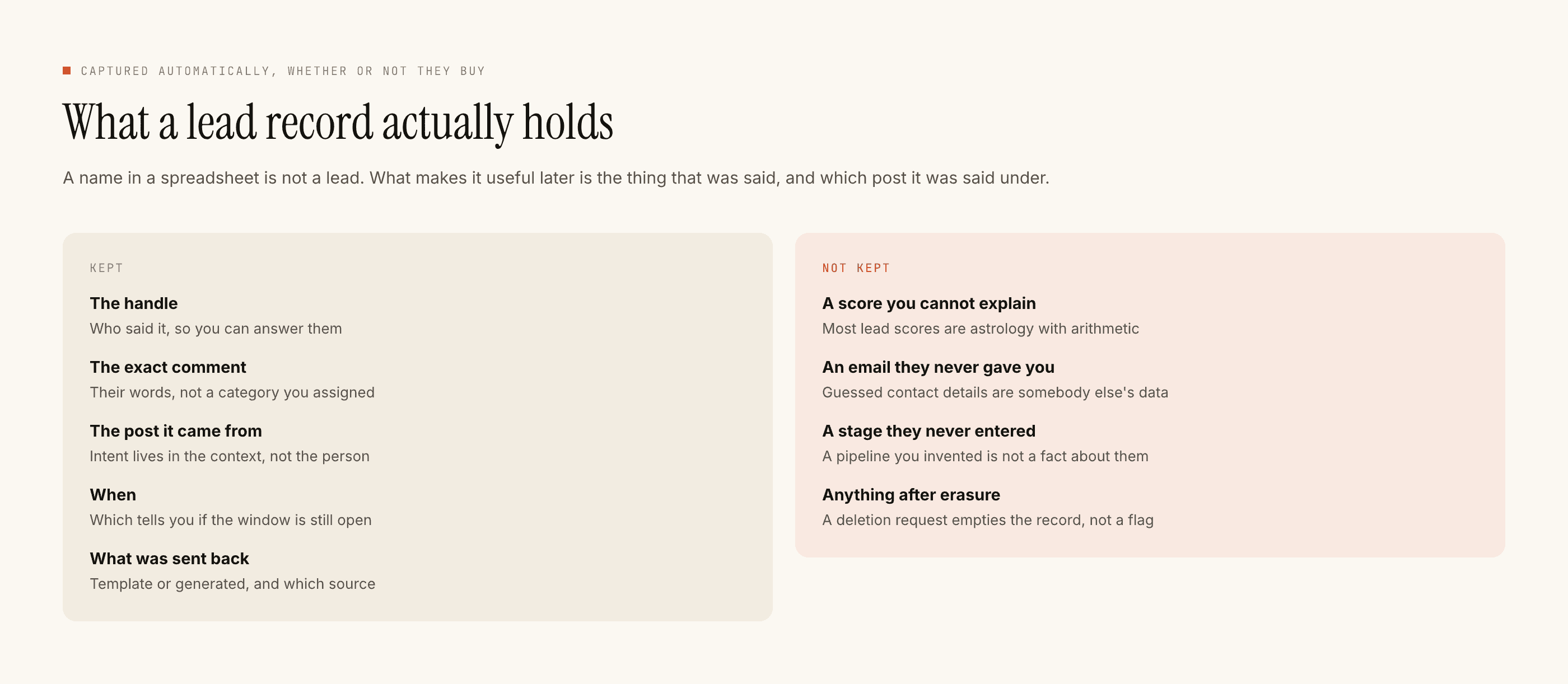
To qualify a buyer you end up holding an unusually intimate profile: what they can spend, whether they have a loan sanctioned, how many people will live there, whether there are children or elderly parents, sometimes what community they want to live near. A phone number plus that combination is a genuinely sensitive record.
- Ask for less than you could. Budget range and location are enough to route an enquiry. Household composition can wait for a conversation.
- Never automate collection of identity documents. PAN, Aadhaar and salary slips have a place in a transaction, and none of it is a chat with a bot.
- Decide who on the team can read a thread. Agencies churn staff; a shared inbox with no access notion is an export waiting to happen.
- Know how you would delete it. If a buyer asks you to remove their details, the answer should be a procedure, not a search through three phones.
India's data protection framework applies to a business holding personal data, and what it requires of your agency depends on facts no blog post knows. We are not lawyers and this is not legal advice — the overview of the channel in India sets out the shape, and your own advice fills in the rest.
What is worth automating
After all that, a real list remains, and it covers most of the midnight volume.
Automate
Person
Site visits deserve a note. Confirming a slot means committing an agent's Saturday, and the diary is in somebody's head or somebody's calendar. Collect the preference — day, part of day, how many people — and let a human confirm. A buyer who arrives at a locked site office because a bot said 4pm is a lost sale with a story attached.
What we run today
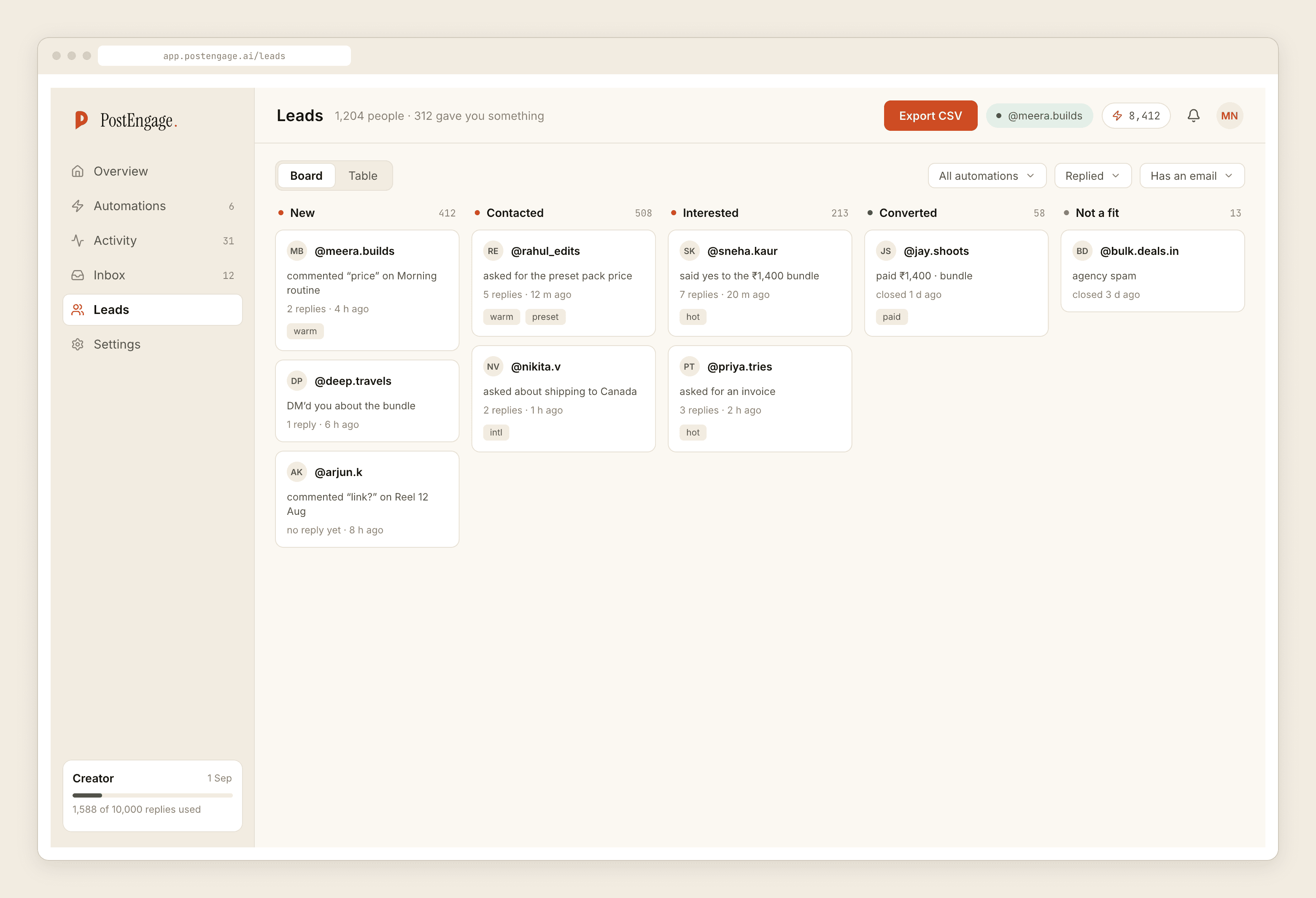
PostEngage answers Instagram comments and DMs through the official Graph API, and that is the entire product. There is no WhatsApp in it. This post describes the channel because agents search for exactly this, and the useful version is the honest one.
On the channel we do run: a comment stays answerable for seven days, a DM thread for twenty-four hours, restarted only by the buyer's own next message. Templated replies are free and unlimited; a credit is spent only when the AI writes new text. Free tier is 100 credits with no card, packs from ₹499.
Continue with Instagram lead capture for agents and what governs this channel in India.