Playbooks · 5 min read
SaaS on WhatsApp: Support With No Ticket and No Record

Indian B2B has a habit that surprises founders who learned software from American playbooks: the buyer wants to talk to you on the same app they use for everything else. The demo gets scheduled in a chat, the renewal is discussed in a chat, and at some point a customer's ops lead sends a screenshot of an error at 10pm with "urgent" under it.
You can refuse that and lose deals, or accept it and discover what it does to a support process. Most teams do the second thing without thinking about it, which is where the trouble is.
The thread has no ticket, no queue and no record
This is the part that breaks, and it breaks quietly.
A support system exists to do things a chat cannot. It gives an issue an identifier both sides can refer to. It has a state — open, waiting, resolved. It has a queue, so nothing is lost when the person who saw it goes on leave. It records what was promised, when, and by whom. And it produces the history you need when a customer says at renewal that this has been broken since March.
A message thread has none of that. It has recency. Whatever was said last is at the bottom, and everything else is scrollback in a chat that also contains a Diwali greeting and somebody's travel plans.
A conversation is not a record. At renewal, only one of them can be produced.
The workable pattern is not to pick one. It is to treat messaging as an intake surface rather than a support system: the customer writes where it is convenient, an acknowledgement goes back with a real reference number, and the actual work happens where it can be tracked. The automation's contribution is creating that reference and making sure a human sees the thread, not answering the question.
The number belongs to a person, not to the account
The second structural problem, and the one that costs money later.
Your customer is a company. The number in the thread is an individual's personal phone. When that person changes jobs — and in Indian B2B they do, frequently — the history, the context, and often the relationship leave with them. Their replacement starts from zero, and your account manager has nothing to hand over except a chat they cannot access.
It goes the other way too. Your own team's threads live on their phones. An engineer who has been quietly answering a customer's questions for a year takes that customer's expectations with them when they resign.
- Run it from a company number, never a personal one. Both for continuity and because a personal number is not something you can revoke.
- Decide what is kept and where. If a commitment is made in a thread, it belongs in the account record, not only in the thread.
- Handle offboarding explicitly. Somebody leaving your customer's team should trigger a check on which threads are now orphaned.
- Never let a support thread become the contract. Scope, pricing and commitments belong in writing, in the place your contract says they belong.
What must not be automated in B2B
Three things, and they are different from consumer verticals.
Roadmap answers. "Does it support X?" and "when will you have Y?" are the most-asked B2B questions and the ones an AI reply handles worst. A generated answer will be confident about a feature that does not exist, or commit to a timeline nobody agreed. In a chat with a customer evaluating you, that is a promise. Route feature and timeline questions to a person, always.
Pricing and contract terms. Enterprise pricing is negotiated, tiers change, and a template quoting a figure sets an anchor before your sales team has said anything. Send the public pricing page if you have one, and nothing else.
Anything about their data. Where it is stored, who can see it, whether you are compliant with something. Those are questions with real answers that belong to your security and legal people, and an automated approximation is a document you will be shown later.
Trials, and the thing that actually helps
The genuinely useful automation for a SaaS company here is narrow and unglamorous: the onboarding nudge that removes a blocker.
Somebody signed up and has not connected anything. Somebody hit an error during setup. Somebody's trial ends on Friday. Those are events in your own system, they are about a relationship the person entered into, and a short, specific, non-salesy message about them is welcome.
Two cautions. A trial-expiry note is a service message; the same note with a discount attached is a promotion, and on Meta's platform that is a different category with different consent behind it — the specifics are Meta's, they change, and their documentation is the place to check them rather than an article. And keep timezones honest: your customers in Kochi and your customers in Singapore should not get the same 9am.
The support expectation you are setting
One last thing worth deciding deliberately rather than by drift.
A messaging channel implies availability. B2B customers translate that into an expectation of response time, and then into a complaint when it is not met. If you are going to be on this channel, publish the hours in the greeting, honour them, and route genuine production incidents to whatever on-call process you already have. An automated "we will get back to you shortly" at 11pm during an outage is the worst message in this entire post.
Screenshots deserve a note too, because B2B support runs on them. Nothing in this class of tool reads images, so a screenshot of a stack trace is an empty message to an automation. Media routes to a person, immediately.
What we run today
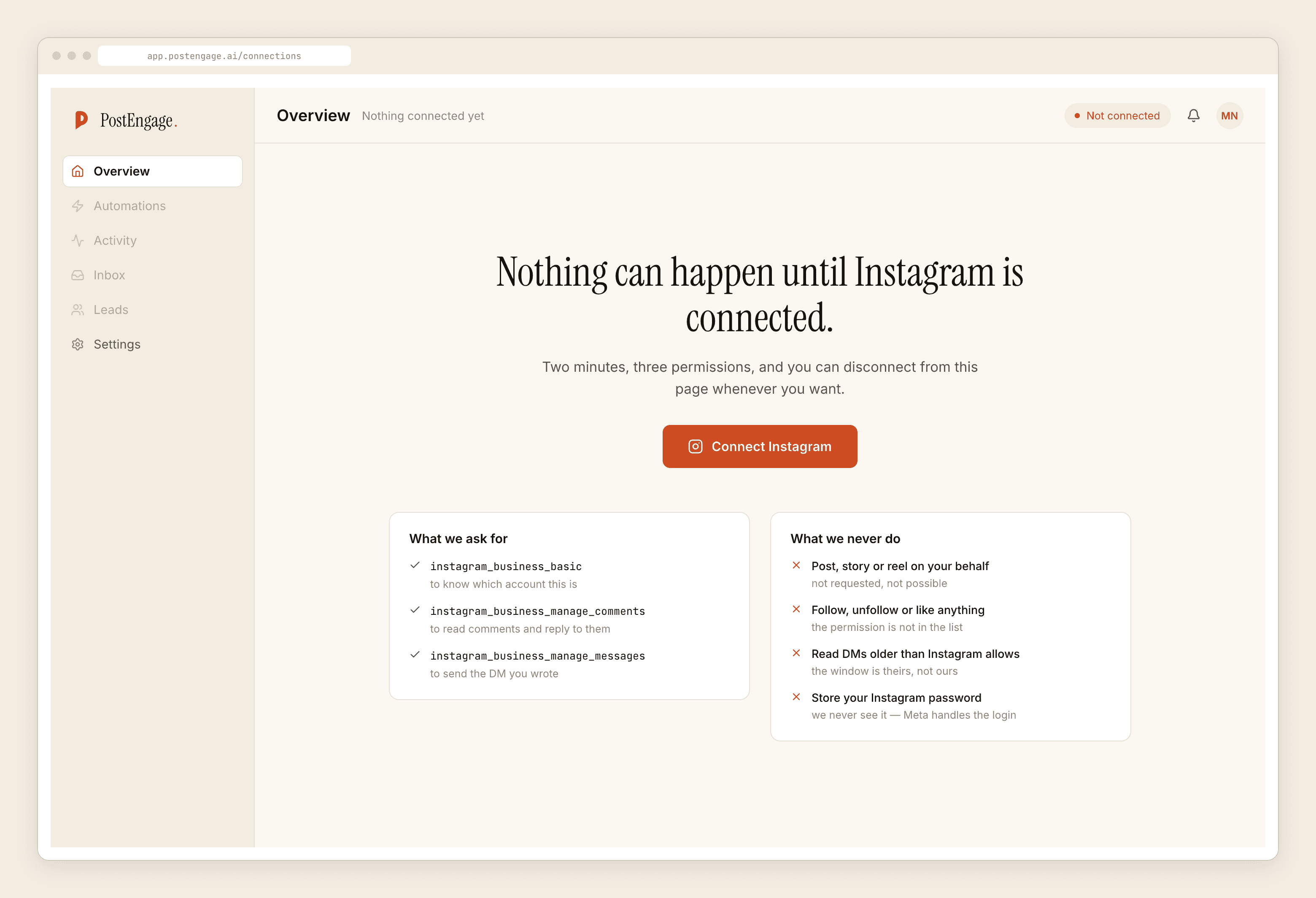
PostEngage answers Instagram comments and DMs on the official Graph API, and that is the whole product. There is no WhatsApp in it, on any plan or behind any flag. This post covers the channel because SaaS teams search for it and deserve an accurate picture rather than a pitch.
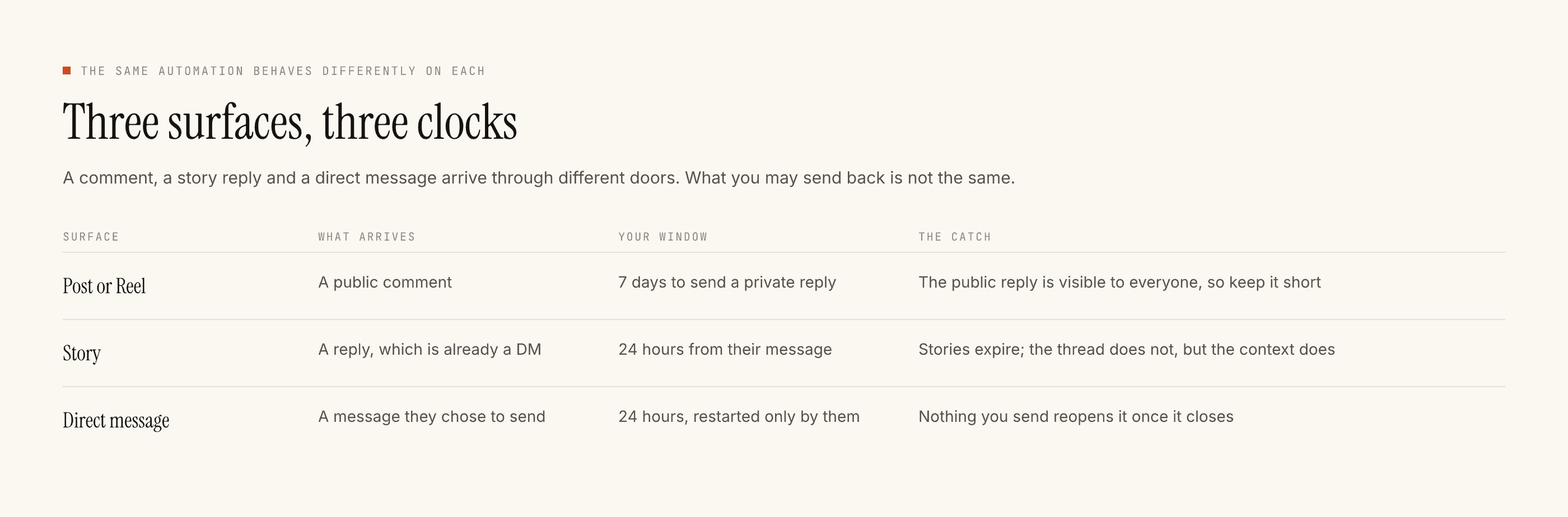
On the channel we do run: a comment stays answerable for seven days, a DM thread for twenty-four hours, restarted only by their own next message. Templated replies are free and unlimited, a credit is spent only when the AI writes new text, the free tier is 100 credits with no card, and packs start at ₹499.
Related: Instagram for SaaS companies, B2B lead generation, and what governs this channel in India.