Playbooks · 5 min read
Pet Brands: Product Questions, Never Symptom Questions

A pet brand's inbox is a retail inbox with a hazard in it.
The retail part is straightforward and high volume: sizes, weights, what is in the bag, whether you ship to Guwahati, whether the harness fits a beagle, when the flavour that sold out is back. Fixed answers, asked forever, free to automate.
The hazard is that a meaningful share of the questions that look like product questions are health questions, and your customer will act on the answer because it came from the brand that makes the food.
The question that must never get an automatic answer
"Will this help with my dog's itching?" "Meri billi ko loose motion ho raha hai, ye food theek rahega?" "He's been vomiting after meals — should I switch to your sensitive-stomach one?" "Is this safe for a dog with kidney issues?"
Read those again. Each one names a product, sits under a product post, and would match any sensible product trigger. Each one is also a description of a sick animal, and any answer — including a helpful, well-meaning, technically-about-your-product answer — is a health recommendation issued by software.
The correct behaviour is to stop. Not to hedge, not to add a disclaimer, not to recommend the sensitive-stomach variant with a footnote. Stop the reply and route it to a person, and have that person point at a vet.
The bag says what is in it. It does not say what a particular animal should eat, and neither does anything that replies from your account.
Feeding amounts are the same trap, quieter
"How much should I give a 12kg dog?" feels like the most factual question in the inbox. It is on the packet. Why not automate it.
Because the packet is a guideline for a healthy adult animal, and the person asking is frequently not describing one — the dog is a puppy, or elderly, or recovering, or on two other things at once, or the 12kg is a guess. A number sent by your account becomes the number they use, and a supplement is the worst possible place for that.
Answer it the way the packet does and no further: "the feeding chart is on the pack and on the product page, and your vet is the right person for an amount specific to your dog." Point, do not calculate.
The message that is a safety report
This is the one pet brands are least ready for, and it is the one where an automated reply does real damage.
"My cat threw up an hour after the new treats." "There was something hard in the bag." "The seal was broken when it arrived."
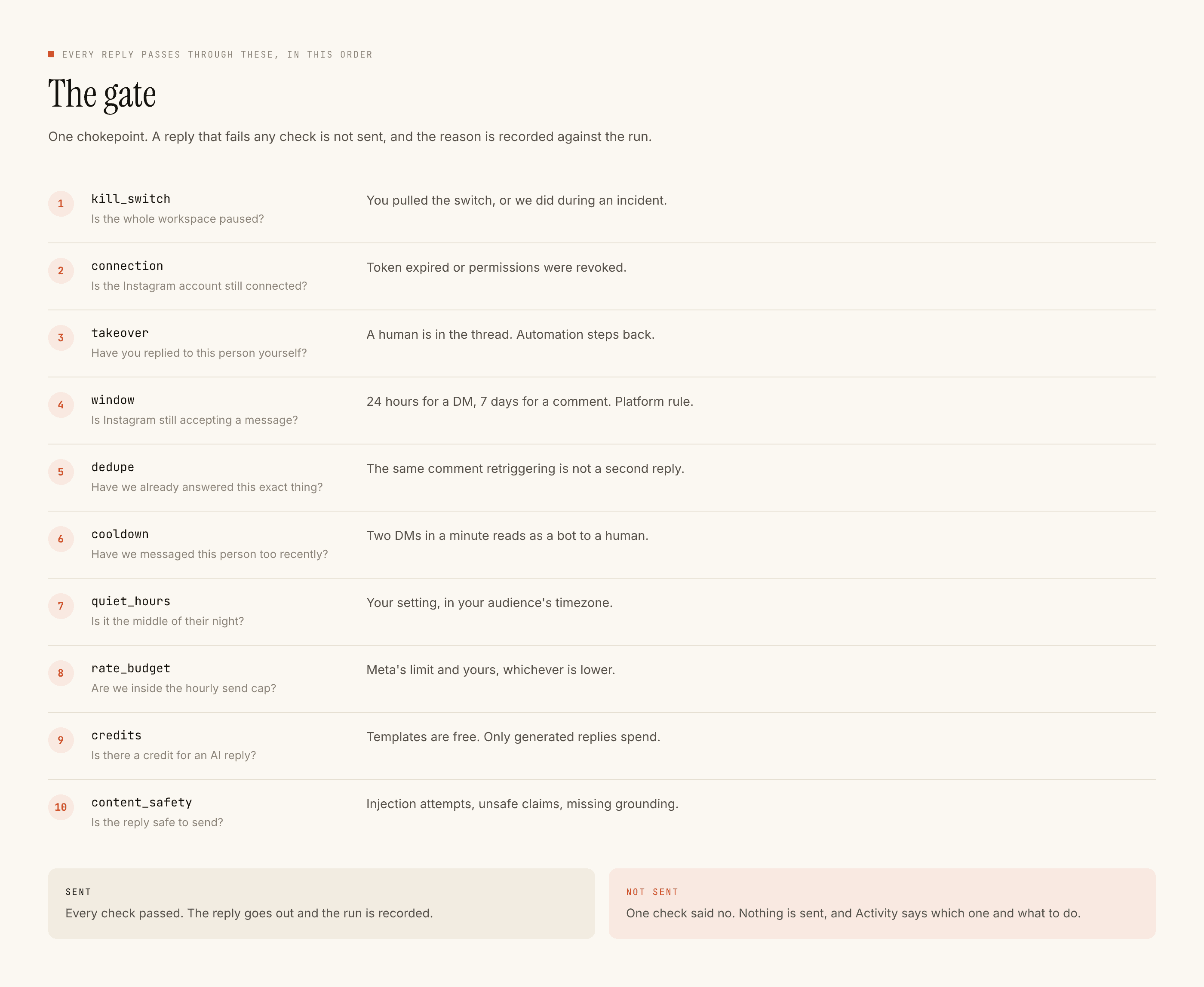
That is a product safety report, and it must reach a human immediately — not because a rule somewhere requires it, though rules on product complaints vary by jurisdiction and are worth knowing where you sell, but because the first automated sentence you send sets the tone for everything after it. "Thanks for reaching out! Which flavour did you buy? 🐾" underneath that message is the screenshot that travels.
Put complaint vocabulary on the stop list — sick, vomit, refund, expired, mould, smell, batch, recall, damaged, sealed, worst — and turn off the first-time-senders-only restriction for those, because a complaint usually comes from a repeat buyer.
What is genuinely worth automating, and where the stock problem is
With health carved out, the remaining volume is large and dull and perfect: ingredients, grain-free or not, life-stage, sizing charts, shipping timelines, whether you deliver to a pin code, subscription questions, which retailers stock you offline.
Two cautions specific to retail.
Stock. There is no inventory connection. The automation does not know the 3kg bag went out of stock this morning, and a template saying "yes, available" will keep saying it. Write "the current sizes are on the product page" instead — it is true on every day of the year.
Price. Same logic. A figure in a template is a public offer, still being quoted after a revision, months later, to people who will screenshot it. Send them to the page.
Cost, clocks, and what does not exist
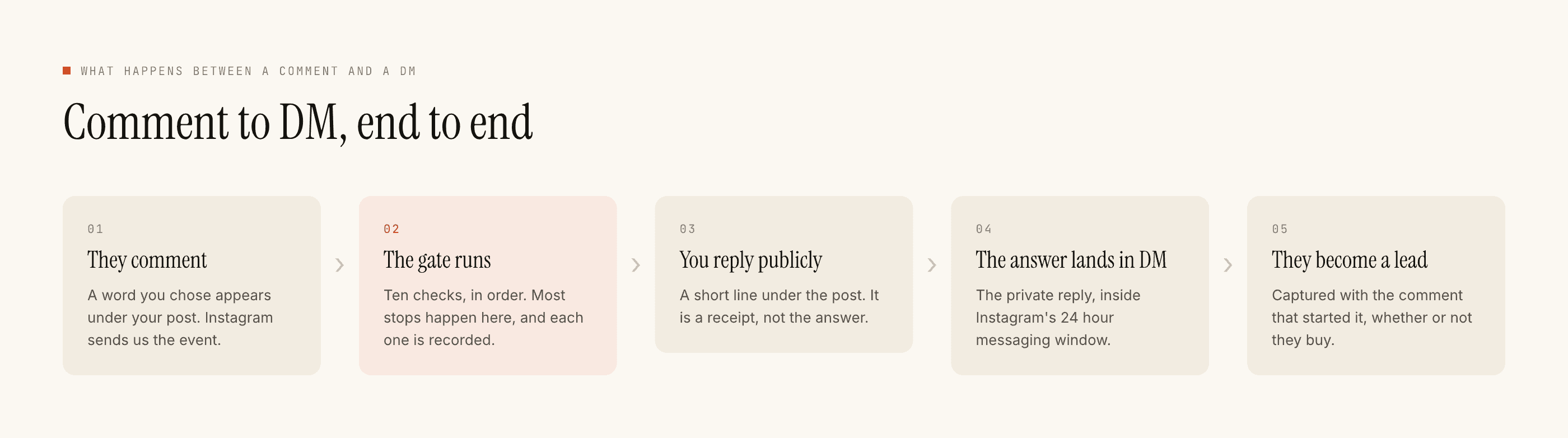
Templated replies are free and unlimited. A credit is spent only when the AI writes a new reply, one credit per reply. For a pet brand that means the sizing-and-shipping tail costs nothing however well a reel does, and credits go on the genuinely odd questions. Free tier is 100 credits, no card; packs start at ₹499.
Official Graph API only: seven days to answer a comment, twenty-four hours inside a DM thread, restarted only by their next message. There is no store integration, no order lookup, no payment link, no cart recovery, no product catalogue and no analytics. Leads export as a CSV and nothing syncs anywhere.
If you run a grooming, boarding or training business rather than a product line, the health boundary sits in a different place and is covered in its own post. For the ordering of everything else, the setup guide is the right sequence — but build the symptom list before the first automation, not after.