Playbooks · 5 min read
A Global Instagram Inbox Is a Rota Problem, Not a Setting

The configuration half of running an account across timezones is straightforward and already documented: quiet hours, the three clocks, and the timezone people forget to set. Set it in your audience's timezone rather than your own, and most of the obvious damage stops.
What that post cannot solve, and what nobody sells a setting for, is the part underneath. A twenty-four hour window does not pause overnight. It runs while you sleep, and if your audience is spread across the world it is running for somebody at all times.
The arithmetic that makes this uncomfortable
Somebody in London messages you at three in the morning your time. You see it at nine. A quarter of the window is gone before anybody in your business has read the message, and the person who sent it has had six hours to buy from somebody else.
Add quiet hours set for a different region and it gets worse: the reply that would have gone out automatically at three was held until eight, which is correct behaviour for your largest audience cluster and expensive for this particular person.
None of that is a fault. It is what happens when a clock that runs continuously meets a business that does not.
The window does not care which timezone you are in. It only cares when they wrote.
What templates are actually for in this situation
Speed is the usual argument for templating the four questions you get most. Across timezones the real argument is different and stronger: a template is the only thing in your business that is awake at three in the morning.
Which changes what a template has to contain. A message that will not be seen by a human for nine hours cannot be an opener. It has to be complete on its own — the price, the availability, the delivery answer, the payment method, and one closed question — because nothing is coming behind it until morning.
Where it stops being a settings problem
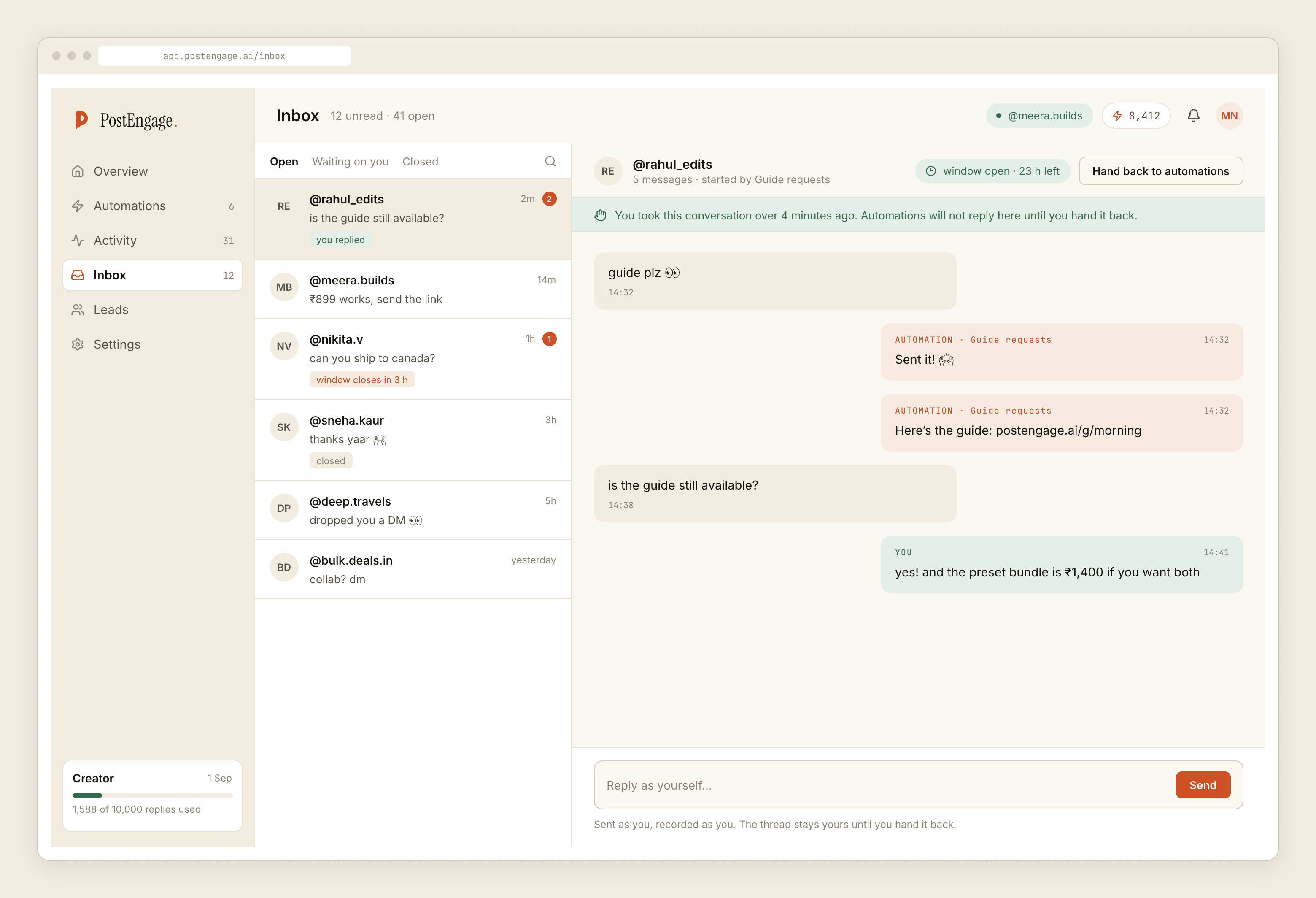
Takeover is the feature that makes automation safe: the moment a human replies by hand, automation stands down in that thread. It is exactly right and it does not scale across timezones, because a thread that needs a person needs a person who is awake.
So every escalation path in a global inbox terminates in the same question, which is a rota question rather than a product one:
- Who reads the inbox, and at what hours. If the honest answer is one person in one timezone, then a share of your conversations get a template and nothing else, and the template has to be written knowing that.
- What happens to a thread that needs a human at 2am. Either it waits — and the window may close on it — or somebody covers that shift. There is no third option and no setting produces one.
- Which regions get real-time human attention. Choosing not to cover a region is a legitimate decision. Pretending you cover it is what produces the bad experience.
- When to stop taking the conversation at all. Some businesses are better off answering during their own hours and saying so plainly in the reply, which sets an expectation instead of breaking one.
The refusals will tell you which hours you are losing
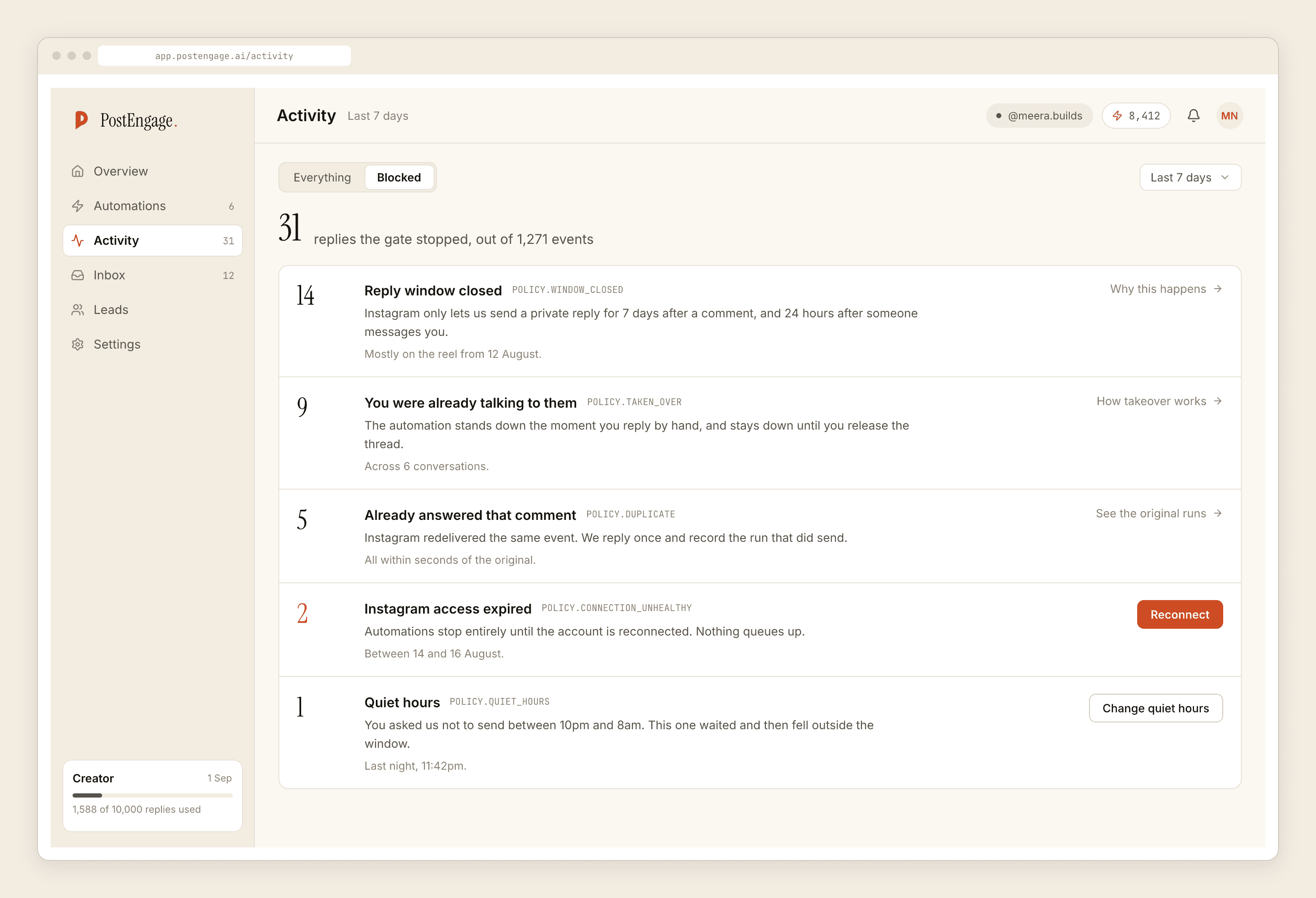
Activity records the reason a reply was not sent, and two of the reason codes are the diagnostic for this specific problem.
A pile of quiet_hours holds clustered at one end of the day means the setting is fighting a real audience cluster. A pile of window refusals on DM threads means messages are arriving and being answered after the clock ran out, which is the shape of a timezone problem rather than a keyword problem.
What we do not do about any of this
No routing by region or by language. No timezone detection. No scheduling, no send-later, no per-region quiet hours, no automatic handoff to whichever colleague is awake. Quiet hours are one window, in one timezone, for the account.
If that sounds thin, it is worth saying why rather than implying more is coming: every one of those features would be a way of deciding on your behalf which customers get a person, and that decision belongs to whoever is running the business.
The version that works for most accounts
Set quiet hours for your largest audience cluster and accept that they are wrong for the rest. Template the four commonest questions completely enough that a person who receives one at 3am has everything they need. Weight new automations toward comment triggers, where the window is a week. And decide, explicitly, which hours a human is genuinely covering — then write the reply that tells people so.
If the languages rather than the clocks are the problem, check whether you actually have a multilingual inbox first, because the two get bundled together and they are not the same job.