Tutorial · 5 min read
Drafting Instagram DM Templates With a General AI Model

A general chat assistant is genuinely useful here, and useful for a narrower job than most people attempt with one. It can help you draft the handful of templates that will answer most of your inbox. It cannot receive a comment, hold a permission on your account, know a reply window closed, or send anything — what sits between a good sentence and a sent reply is a separate post and worth reading if that distinction is new.
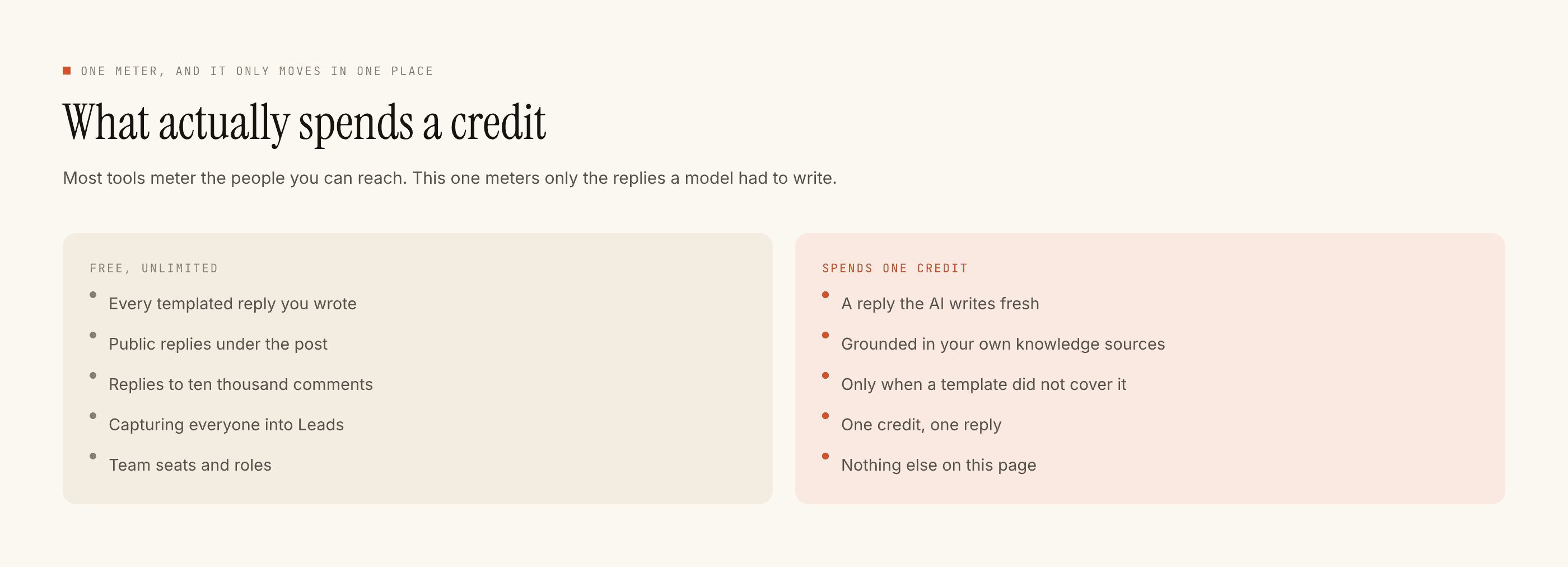
This post assumes you accept the split and want the drafting half done well. That half is worth an afternoon, because templated replies are free and unlimited at any volume. A credit is spent only when the AI writes something new — one credit, one reply — so every question a template covers is a question that never touches the meter again.
Start from your own sent replies, not from a blank prompt
The most common mistake is asking for "five Instagram DM scripts for a clothing brand". You will get five competent, generic messages in a register that belongs to nobody, and they will read as machinery the moment a real person opens one on a phone.
Do this instead.
- Collect twenty replies you actually sent. Scroll your own DMs and copy out the real ones, including the short ones.
haan available haicounts and is more informative than the polished ones. - Strip the personal details out before you paste anything. Names, phone numbers, order numbers, addresses, amounts. Replace them with placeholders.
- Ask it to describe your register back to you first. Before any drafting: what does this person sound like, how long are their replies, what do they never do. If the description is wrong, the drafts will be wrong, and this catches it in thirty seconds instead of after you have edited five messages.
- Then ask for drafts of the questions that repeat. Name them yourself — price, availability, delivery, the link, hours. You know which four or five they are; do not ask a model to guess your inbox.
- Edit every draft by hand. This step is not optional and it is where the value is. See below.
- Run Test on myself. The whole pipeline — match, the ten checks, generation, send — delivered to your own account. Read it on a phone as the recipient. If it is not something you would have typed, it is not finished.
What to edit back in
A model smooths writing towards a middle. The bits it smooths off are exactly the bits that made the reply sound like a person.
Length. Your real replies are shorter than the drafts. Usually much shorter. Cut until it looks like something typed with a thumb.
The greeting it added. You do not open every message with "Hi there!". Delete it.
The enthusiasm. "Absolutely!" and "Great question!" are not registers, they are tells.
The completeness. A draft answers the question and then adds a helpful sentence nobody asked for. Delete the second sentence.
Your actual words. If you say "bhej deti hoon" or "ping me", put it back in. Mixed Hindi and English is how a lot of Indian creators genuinely write, and a template that switches to formal English mid-inbox is more jarring than either language on its own.
The draft is a starting position. What makes it yours is everything you take out of it.
The job it is unusually good at: keyword lists
This is the underrated use, and it is better suited to a language model than the drafting is.
Ask it for every way somebody might type a question in your comments, in English, in Hindi, and in Roman-script Hinglish. For price alone you will get price, rate, cost, kitna, kitne ka, kitni hai, dam kya hai, mrp, price plz. That is a genuinely hard list to produce from your own head, because you already know what you meant.
Two rules when you paste the result in. Matching folds case and punctuation, so Price!! and price are already one word and you do not need capitalisation variants. It also folds Latin accents. It does not fold Indic vowel signs, so दाम and दम remain two separate words — if your audience types both, both go on the list.
Then do the same exercise for negative keywords, which nobody does and everybody needs. not interested, job, internship, collab, price drop, sale. The wrong reply landing under a complaint about your price is worse than no reply at all.
What never to ask it for
Three things, and all three produce confident wrong answers.
Your own facts. Prices, delivery areas, timings, policies. A model will fill a gap with something plausible, and a plausible wrong price sent to two hundred people is not a copy problem.
Anything regulated or dated. Deadlines, rules, what a professional body permits. Take structure from a draft; take the wording from your own source.
Anything about a specific customer. Which brings us to the part worth being firm about.
Where the drafting stops and the product starts
Once the templates exist, the assistant is done. What happens next is a different kind of machinery: an event arriving, a connection holding a permission Meta issued, ten checks in fixed order, a record of what was sent and what was refused, and a voice profile built from replies you actually wrote rather than from a tone setting.
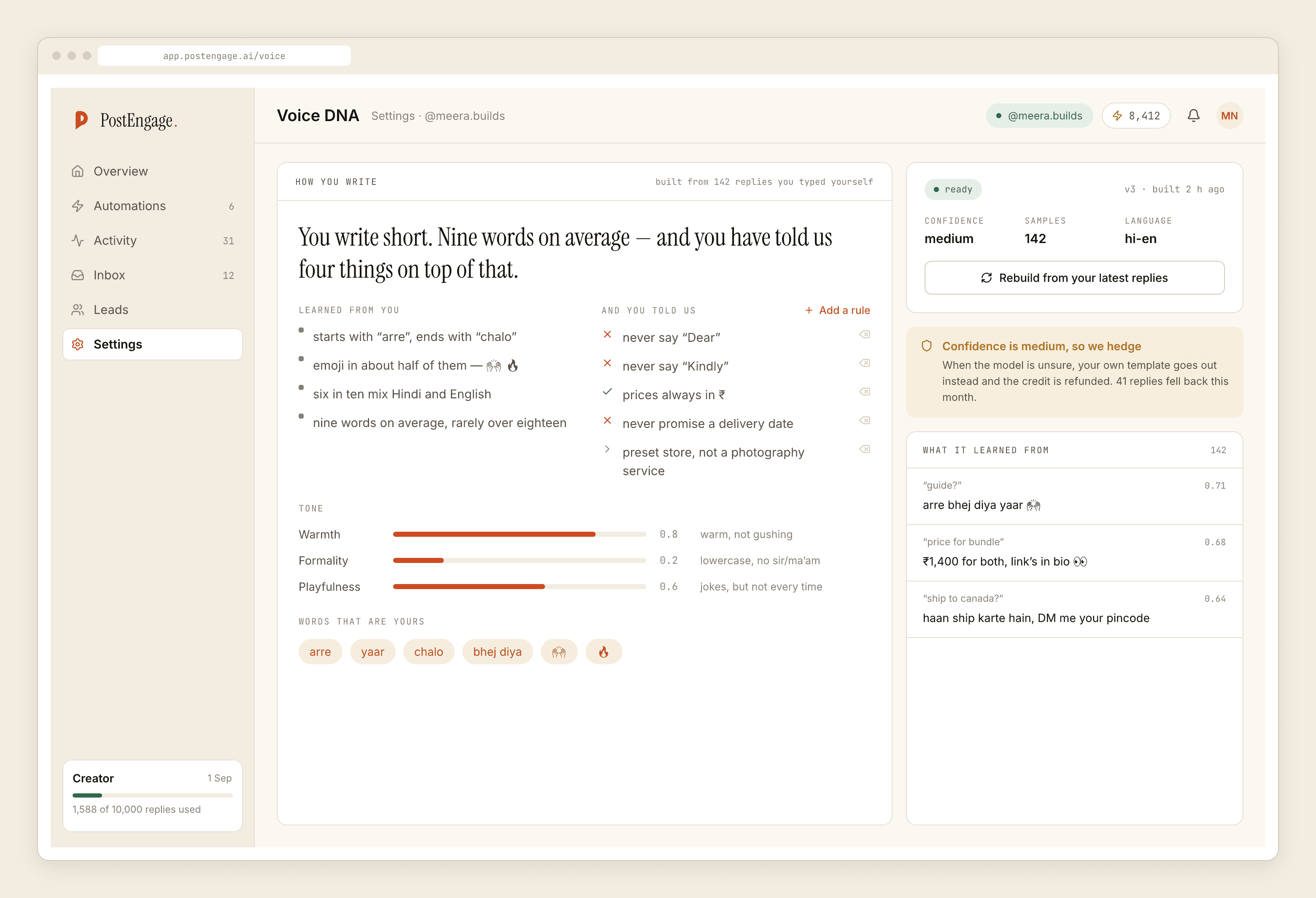
If you want the argument about what makes a template land rather than how to draft one, that post is here. And how a voice profile is built explains why an afternoon of your own writing is worth more than a longer prompt.