
The free plan is a hundred credits and no card. That number is meaningless on its own, because a credit is not a reply and a hundred credits is not a hundred messages. This is what it actually is, what it will cover for a week, and the point at which it stops being enough.
If you want the wider version of this question — how free tiers work across the whole category and what to test with one — that is a separate post. This one is only about ours.
One credit is one sentence the AI had to write
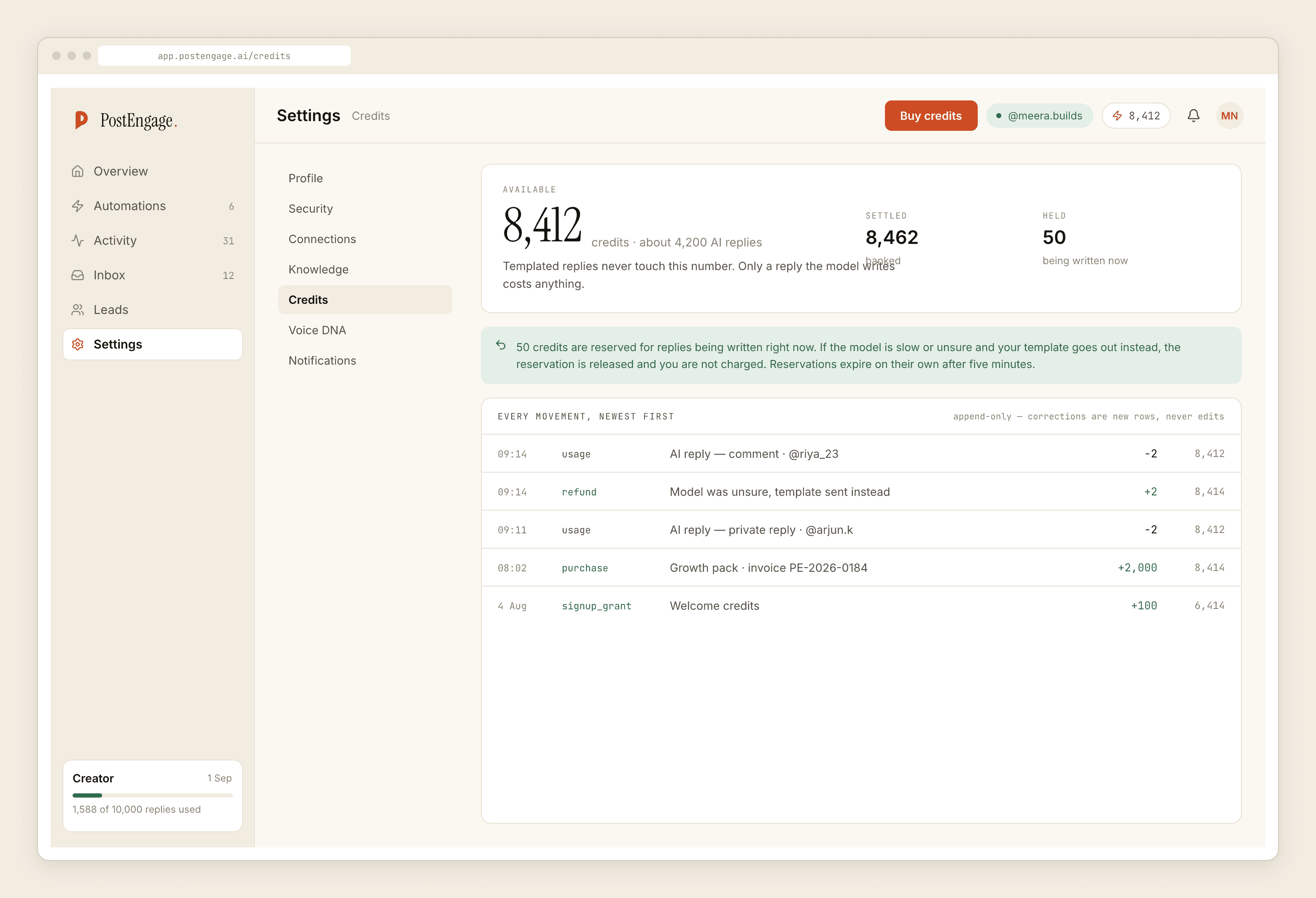
The rule is short. A reply you wrote yourself, sent as a template, costs nothing and never will, however many times it goes out. A credit is spent only when the model writes something new because nothing you wrote covered the question.
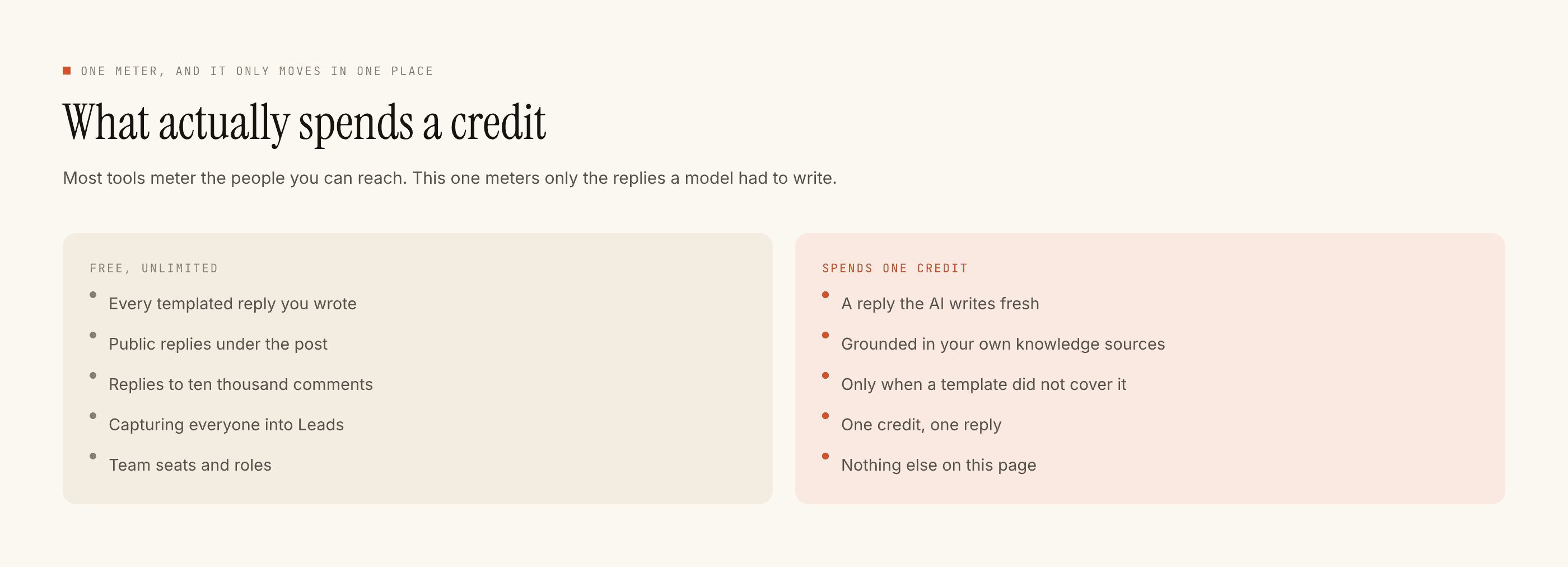
So the credit meter tracks how unusual your inbox is, not how big it is. A post that brings four hundred comments asking the same thing costs nothing. A post that brings forty comments all asking something different costs forty.
That is the opposite of how most people expect a meter to behave, and it is worth sitting with for a second, because it changes what you should do first.
What a real week looks like
Take a shop that posts three times a week and gets a few hundred comments across them. Most of those comments are one of four things: price, is it available, do you deliver here, send the link.
You write four templates. The keyword price catches "price?", "Price kya hai", "PRICE!!" and "price plz" — matching ignores case and punctuation, so you do not need variants. Those four templates absorb the overwhelming majority of the volume and the balance does not move.
What is left is the tail: the person asking whether it comes in a different size, the one asking if you ship to Guwahati, the one asking something you have genuinely never been asked. Those go to the model, and each one costs a credit.
The templates do the work. The credits handle the surprises. A hundred surprises is a reasonable week.
What is free permanently, not free for now
This list does not shrink when the credits run out.
- Templated public and private replies, unlimited. The comment reply and the DM you wrote yourself, at any volume, forever.
- Triggers and keywords. Post selection, any-of and all-of matching, and negative keywords so
not interestednever gets a sales pitch. - Capture to Leads. Everyone who triggered an automation, with what they said. The people are yours regardless of plan.
- All ten pre-send checks. Kill switch, connection, takeover, window, dedupe, cooldown, quiet hours, rate budget, credits, content safety. Safety is not a paid feature here and will not become one.
- Test on myself, and Activity. The full pipeline sent to your own account before going live, and a record of every reply that was blocked with the reason attached.
When the balance hits zero, generated replies stop and your template goes instead. credits is the ninth check for exactly that reason — running out is a downgrade in reply quality, not an outage. The automation keeps running, keeps capturing leads, and keeps answering the four questions it always answered.
What burns a hundred credits in two days
All three of these are avoidable, and all three are self-inflicted.
No templates. If you leave the reply fields empty and let the model handle everything, every single reply is a credit. It also produces worse replies, because there is less of your own writing for the draft to be built on.
A keyword so broad it catches everything. Matching on a single common word, or on no keyword at all, sends every comment on the post down the generated path — including "🔥🔥" and "first".
Treating the AI as the default rather than the exception. The design assumes most of your inbox repeats. If you use it the other way round, the arithmetic works against you and you should know that on day one rather than in week three.
When you will outgrow it
We would rather say this plainly than have you discover it during a launch. Four signals, and the last one means our pricing shape is wrong for you rather than too small.
That fourth case is real and we are not going to argue you out of it. Count two weeks of your own sent replies before assuming it describes you; most people who believe every reply is bespoke find that four answers cover the bulk of it. But if you count and it does not, the head-to-head against a bigger platform sets out where a wider product wins.
The numbers, in one place
A hundred credits, no card, no expiry pressure and no upgrade prompt in the middle of a send. Credit packs start at ₹499 when you want more. Templates stay free at any volume on any plan, including this one.
What we are not doing is the thing that makes free tiers feel generous and then expensive: we do not meter contacts. Someone who asked one question in March is not on a bill in December, because we are not holding them, we are just not sending them anything.
If you have not built the first automation yet, the three-minute setup uses nothing but the free parts, and it is deliberately small enough that you can read every reply it produced.