Compliance · 6 min read
Healthcare Marketing: The Reel Works, the Inbox Cannot

The reel about the procedure did well. Better than anything you have posted all year, and the comments are full of people describing what is wrong with them.
That is the healthcare marketing problem in one sentence: the better the content performs, the more your inbox fills with exactly the questions you are not able to answer automatically. Success and risk arrive through the same door, at the same time, in the same volume.
Most automation advice for this sector is written as though the inbox were a funnel. It is not. It is a queue of people who have decided something is wrong with them, and the automation's job is to be useful without ever pretending to be clinical.
Three sentences that never go out automatically
Write these on the wall before you build anything.
An answer to a described symptom. "That sounds like it could be…" is a clinical judgement produced by a text box. An AI writing a new reply will produce one smoothly and confidently, because the internet is full of confident health content written by people under no obligation to be right. The message does not have to be wrong to be a problem. It has to be automatic.
A claim about an outcome. How long results last, how many sittings it takes, whether it will work for them, whether it is painless. Each is a claim your establishment then owns, in writing, sent to a stranger whose case nobody has seen.
A price for a procedure. This one surprises people, so it gets its own section below.
A calm, confident, automated reply to a person describing their symptoms is the worst possible output of this entire category. Design so that it cannot happen, not so that it usually does not.
Why the price is different here
In most businesses a price in a template is a convenience. In healthcare it is two problems at once.
The first is that it is rarely one price. A procedure quote depends on what is actually needed, which nobody knows until somebody is examined. A figure sent before that is either a number you will revise upward — which reads as a bait — or a number you will have to honour on a case you would have quoted differently.
The second is that a price sent from a clinical account, unprompted, to a member of the public, starts to look like an advertisement rather than a reply. Whether that matters, and how much, depends entirely on where you are and what kind of establishment you are.
Design the campaign around what the reply is allowed to say
The fix is upstream. If the automated reply cannot answer, then the content must not invite an answer — it has to invite a next step.
A reel that ends with "comment your symptoms below" has built a machine for generating messages you cannot handle. A reel that ends with "comment INFO for our patient information sheet on this" has built one you can. Same content, same reach, and the second one produces a conversation the automation is genuinely able to run: send the sheet, offer the callback route, capture the enquiry, stop.
- Make the ask a document or a callback, never a question about them. The reply is a delivery, not a consultation.
- Keep the public half content-free. A warm public reply under a real name tells that person's followers they are your patient, even when it says nothing clinical. Say "sent you the details" and move everything else into the DM.
- Build the negative-keyword list before the positive one. Symptom vocabulary, medication names, pregnancy, and anything about a child. Those route to a human and never meet a template.
- Put a phone route where the automation cannot break it. Bio, pinned post, profile. Something a person answers, or a recorded instruction outside hours. It is the one part of this that must keep working when everything else is switched off.
Read the blocked list, because it is the compliance record
Ten checks run in a fixed order before any reply is sent, and a blocked reply is recorded with the reason it was blocked. In marketing terms that log is a nuisance. In this sector it is the useful artefact — a written record of what the system wanted to say and what stopped it.
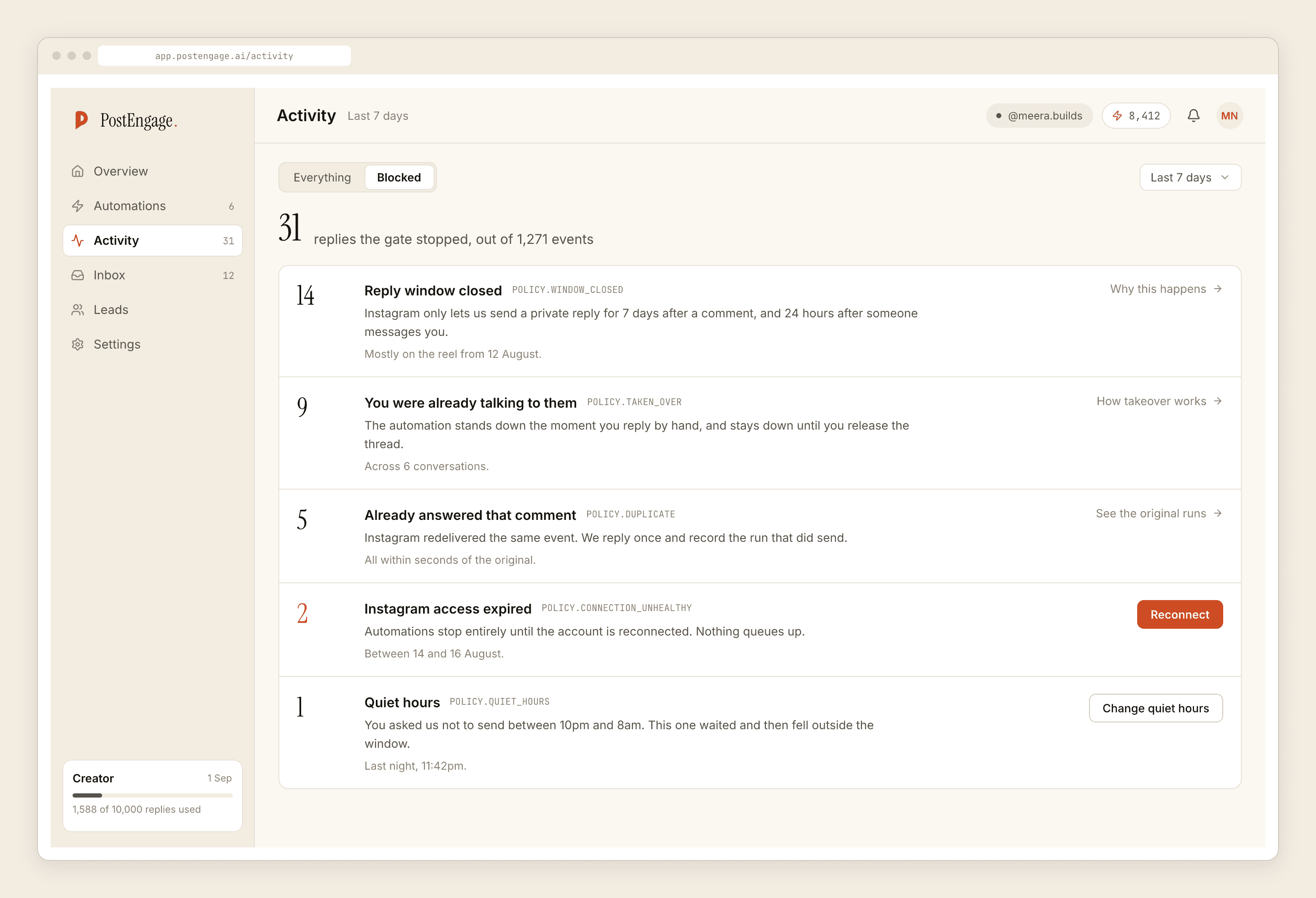
The rows worth acting on are not the window closures and duplicates. They are content-safety stops, which tell you a template or a generated reply drifted toward something clinical, and a rising takeover count, which usually means the front desk is rewriting the automation by hand because it is answering badly.
What you keep about a person, and what you should not
A captured lead is a handle, the post they came from, the words they typed, and a timestamp. That is already more than a marketing list usually holds, and in this sector the words they typed may be a description of their health.
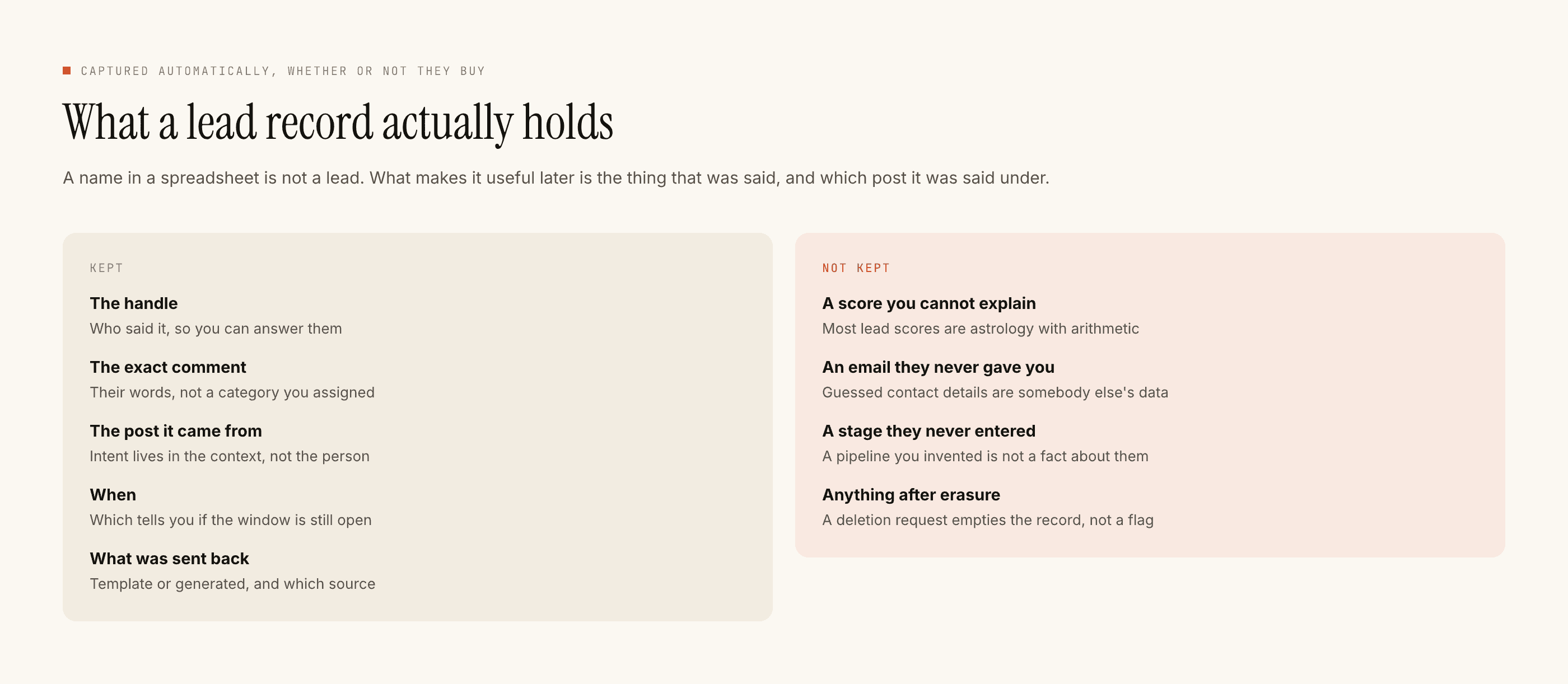
Two rules that cost nothing. Do not ask for clinical detail in an automated message — asking creates a record you then have to look after. And decide in advance who may export the CSV and where it goes, because leads leave as CSV and a CSV is very easy to email to somebody.
The clinic-side version of this — who signs off the wording, who can change it, who reads the log — is a separate post about ownership, and it is the one to read next if more than one person touches the account.
Cost, and the honest limits
Templated replies are free and unlimited. A credit is spent only when the AI writes a new reply, one credit per reply. An account built the way this post describes runs almost entirely on templates, because the entire point is that the wording is fixed and identical for everyone. Free tier is 100 credits, no card; packs start at ₹499. If your credit use is climbing, that is a signal the automation is answering things it should be routing.
It has no calendar, so it cannot confirm or book an appointment. No CRM sync. No WhatsApp. It cannot message anybody who has not messaged you first. Official Graph API only: seven days to reply to a comment, twenty-four hours inside a DM thread, restarted only when the person writes again.
And it cannot assess anyone's health. Everything above is arranged so it never gets the chance to try. What each of the ten checks does is worth reading before you go live rather than after.