Comparison · 5 min read
WhatsApp vs SMS in India: One Delivers, One Converses

PostEngage does not ship WhatsApp and does not send SMS. It runs Instagram comments and DMs, so nothing below is steering you towards a product of ours. It is an argument about two channels that Indian businesses routinely treat as substitutes when they are not.
They do different jobs
SMS is a delivery mechanism. It puts a short piece of text on a phone. It works on a feature phone, works with no internet, works when the customer has never installed anything, and works to a number you have without any relationship attached. What it does not do is start a conversation — the reply, if there is one, goes nowhere useful.
WhatsApp is a conversation. It has a thread, a history, images, a read state and a person on the other end who expects to be able to answer. It also has Meta's rules, a window that governs what may be sent when, and a charge from Meta on certain categories of message.
SMS
SMS is a notification. WhatsApp is a relationship. Businesses buy the second and use it like the first.
The Indian regulatory texture
Both channels are regulated in India and both regimes involve registering what you send before you send it — but they are entirely separate systems run by entirely different bodies.
Commercial SMS goes through the telecom regulator's framework, with registered sender identities and registered content, administered through your operator or aggregator. Business messaging on WhatsApp goes through Meta's own approval process. Neither exempts you from the other, and neither is something a software vendor can shortcut.
Where each one is the obvious answer
SMS wins on reach that does not depend on anything. A one-time code. A delivery that is at the gate. A message to a customer base that includes people without smartphones, which in much of India is not a rounding error. If the message must arrive and the recipient does not need to reply, SMS is the honest choice and often the cheaper one.
WhatsApp wins when the message invites a response. An order that needs an address confirmed. A booking somebody might want to change. A photograph of a product. Anything where the useful outcome is a conversation rather than a notification.
The failure case is a business paying for the conversational channel and using it for one-way announcements. That is expensive on both meters and it trains customers to mute you, which is worse than the money.
The costs are not comparable per message
A per-message SMS rate and a WhatsApp conversation charge are not the same unit, so comparing the two numbers is arithmetic on different things.
SMS is charged per message, by your operator or aggregator, with its own registration overhead. WhatsApp is metered by Meta on certain conversation categories, with your software vendor charging separately on top. A per-unit comparison across those models tells you nothing useful.
The honest comparison is per outcome. Take one job — say, confirming an appointment — and price it end to end on each channel, including the messages that follow when somebody replies. On a job where nobody ever replies, SMS usually wins. On a job where a quarter of people reply, it usually does not, because those replies had to happen somewhere anyway. The two-meter problem on the WhatsApp side is worth reading before you build the spreadsheet.
Consent is not shared between them
The one that gets businesses into trouble.
A customer who gave a number for delivery updates has not agreed to marketing on either channel. Consent for SMS is not consent for WhatsApp. A list acquired from somewhere else is not consent for anything, on any channel, whatever the seller told you.
- Ask per channel and per purpose. Two questions, recorded separately, with the date and the wording you used.
- Make leaving easy on both. A stop instruction that works, honoured quickly, without a conversation.
- Keep the record exportable. The evidence of consent is the asset, not the phone number.
- Take your own legal advice. India's DPDP Act and the telecom rules are different regimes with different obligations, and what applies depends on facts about your business. We are not lawyers and this is not legal advice.
What proper opt-in looks like covers that in more detail than a section can.
What we run
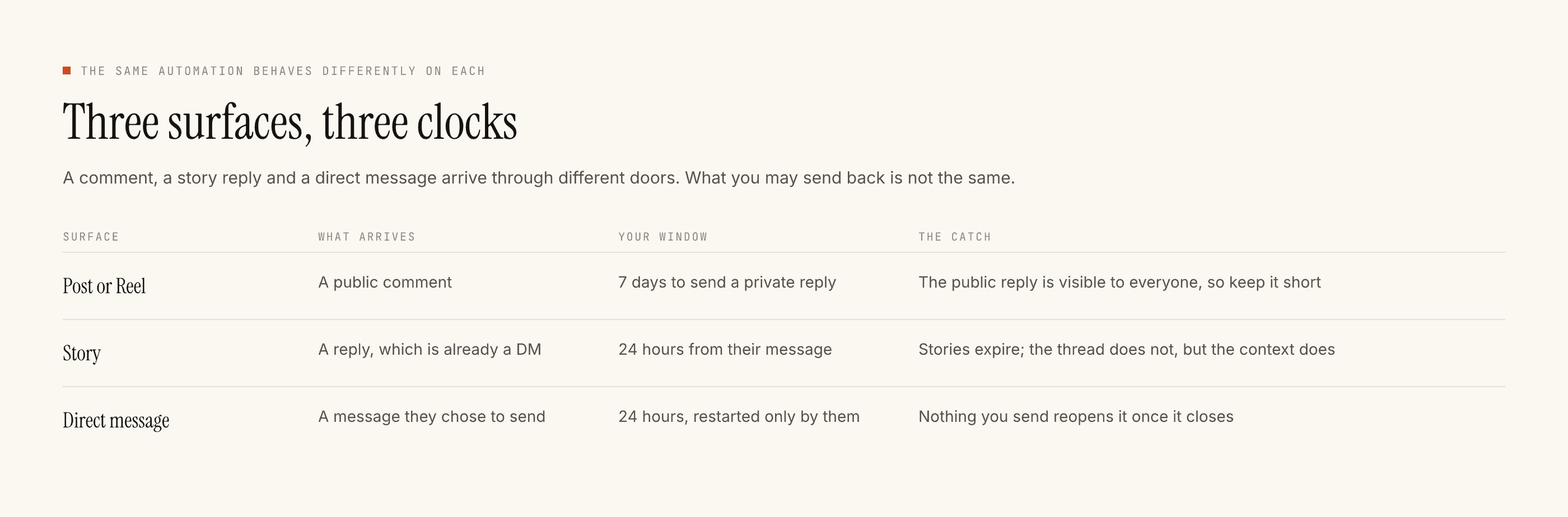
Instagram comments and DMs on the official Graph API: a seven-day comment window, a twenty-four-hour messaging window restarted only by the other person's message, ten named checks before every send and a recorded reason for every refusal. Templated replies free and unlimited, credits spent only on new writing, 100 free credits with no card, packs from ₹499.
If the channel you actually need is WhatsApp, the Indian specifics of running it are here.