Playbooks · 5 min read
Conversion on WhatsApp: What You Can See and What You Cannot

Start with the constraint that makes most conversion-optimisation advice unusable on a messaging channel: you cannot see almost any of it.
There is no funnel report, no view-through data, no attribution model, and — on the channel we do run, Instagram — no analytics product at all. A conversation is not instrumented the way a website is. Nobody records a scroll depth in a chat.
That is not a gap in tooling. A message thread genuinely does not produce the events a funnel dashboard is built from.
What is observable
Four things, and they are more useful than they sound.
- They replied. The single most informative event available. On a messaging channel a reply is not a vanity metric — it is the thing that keeps the conversation legally sendable, and it is the only signal the other person volunteered.
- What they typed. Their exact words, which tell you what they thought they were asking. This is the raw material for every improvement you will make.
- What you sent back. Which template fired, or that a person wrote it.
- What was refused, and why. Whether a send never happened, and which check stopped it.
Notice that none of these is a rate. They are counts and strings, and the honest version of this work is arithmetic on counts rather than a dashboard.
The one lever that actually moves
The wording of the single reply that follows their first message.
Everything else in a conventional funnel — traffic, targeting, landing page, retargeting — either does not exist here or belongs to a different tool. What remains is one message, and it either earns an answer or ends the conversation.
Ends it
Earns an answer
A message with nothing to answer has ended the conversation, however polite it was.
Why the usual A/B test does not apply
Two reasons, and both are worth knowing before you set up something elaborate.
Volume. Most businesses on this channel have inbox volumes in the tens or low hundreds per week. That is far too little to separate a real difference from noise, which means a split test tells you a story rather than a fact.
No holdout. You cannot withhold an answer from half your customers to establish a baseline. The control group is people you did not serve, and running it would be worse than not knowing.
What you can do is a before and after: change one template, leave everything else alone, and compare a month to the month before. That is a crude comparison, not a controlled test, and the distinction matters — a seasonal shift or one viral post will move your numbers more than your copy did.
Read their words, not your metrics
The highest-return activity available here is not analysis. It is reading fifty real messages as strings.
Doing that reliably surfaces two things no dashboard would have told you. The
first is that people ask in vocabulary you never use — the question you call
"pricing enquiry" arrives as kitna, rate?, or a photograph with ? under
it. The second is that a meaningful share of what you assumed were sales
questions are actually logistics: where are you, do you deliver here, are you
open now.
Both change what you write next, and neither is visible in a rate.
The counts worth keeping
A spreadsheet, once a fortnight, five columns. No product required.
- Messages received.
- Messages that got any reply.
- Replies that got a reply back.
- Conversations a person took over.
- Sends refused, and the commonest reason.
The ratio worth watching is the third divided by the second: of the people you answered, how many carried on. That is the closest available proxy for whether your first reply is doing its job, and it responds to copy changes in a way nothing else on the list does.
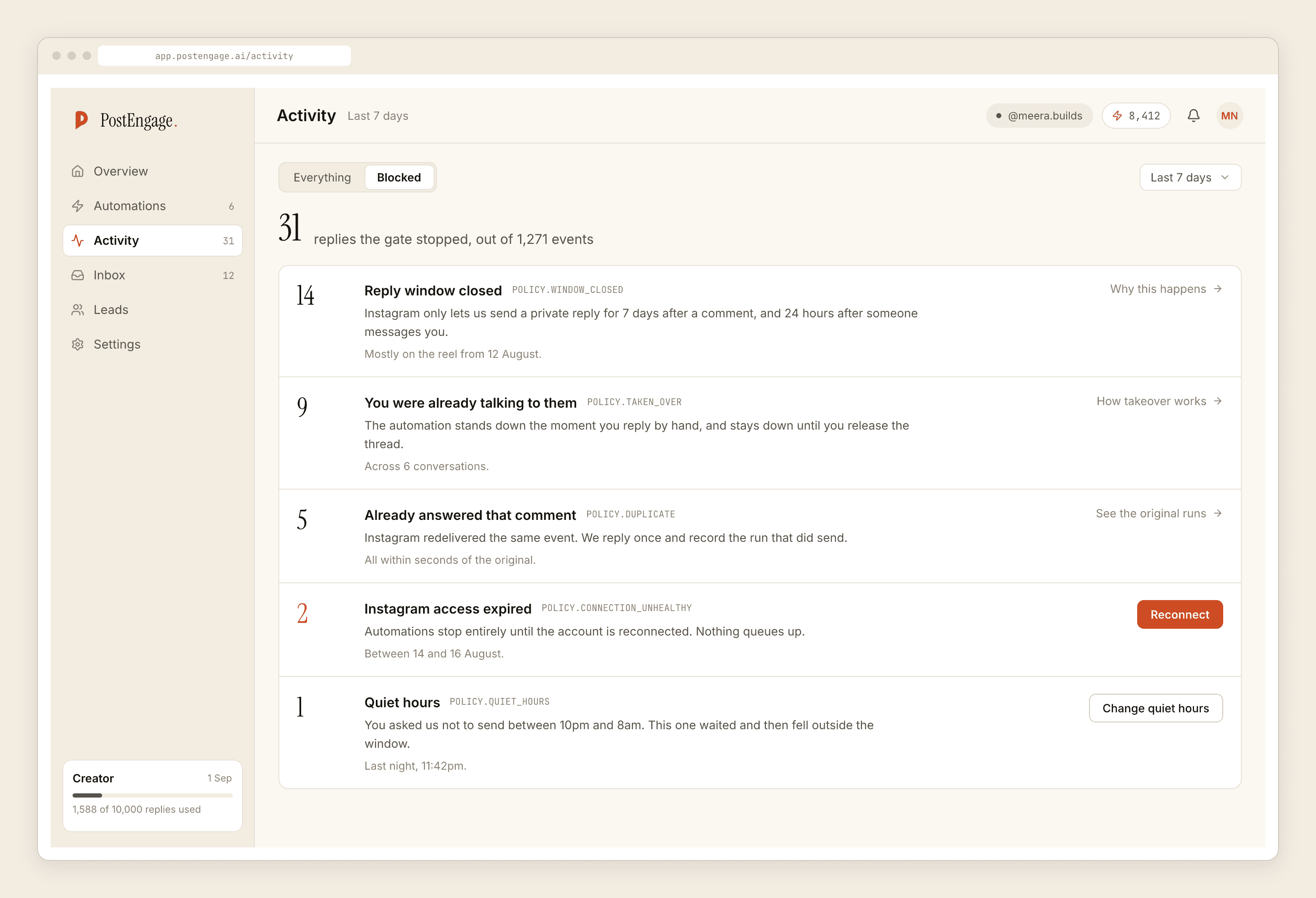
The failure this reveals most often
Not bad copy. Timing.
A large count of refusals for a closed window means the conversations were not lost to persuasion — they expired while somebody meant to get to them. That is an operational problem with an operational fix, and no amount of rewriting the message addresses it.
Check that before you optimise anything, because it is both the commonest cause and the cheapest to correct.
Where we actually are
PostEngage answers Instagram comments and DMs. There is no WhatsApp in the product, and no analytics or attribution on any channel — the counts above are things you tally yourself.
For the Instagram version of this argument, the conversion post is here. For the craft of the reply itself, which is the actual lever, that is here.