
"Free forever" is a real thing in this category and also a marketing phrase, and the two are hard to tell apart on a pricing page. The useful question is not whether a plan is free today. It is what happens on the day the tool starts working.
The three ways a free tier ends
Contact caps. The plan is free up to a number of unique people who have messaged you. That number is usually between 500 and 1,000, which sounds generous until you remember it counts everyone forever, not everyone this month. One Reel that travels can spend a year of headroom in a weekend.
Feature gates. Everything works except the one thing you needed. Keyword triggers are free, but only one keyword. Comment replies are free, but only on the most recent post. The automation runs, but the reply carries the vendor's name at the bottom.
Volume that scales with success. The plan is free until a message count, and the message count is not under your control. Your audience decides it.
All three are legitimate business models. The problem is that each one bills you precisely when the tool is finally earning its keep, which is the worst possible moment to be shopping for a replacement.
Per-contact pricing is the one to watch
Most of this category prices on contacts: the number of distinct people your automation has ever spoken to. It is worth doing the arithmetic once, because the shape surprises people.
Say you run a small store and you get roughly 400 comments a month that deserve a reply. In month one you are at 400 contacts and comfortably inside a free tier. By month four you are at 1,600 and paying. By month twelve you are at 4,800, most of whom bought nothing, several of whom asked one question in March and never returned, and all of whom are still on the invoice.
The bill grows with reach. Revenue grows with conversion. Those are different numbers, and per-contact pricing quietly assumes they are the same one.
The alternative is pricing on replies actually sent. A dormant contact costs nothing because nothing is being sent to them, and the bill tracks the work rather than the audience.
What a genuinely free tier can do
Enough to answer the only question that matters, which is whether the replies sound like you.
- Connect one Instagram account through Meta's official consent flow.
- Reply to comments on your posts, filtered by keyword or not.
- Reply to DMs inside the standard 24 hour window.
- Enough replies to cover a normal week, so you see the tool handle a real posting cycle rather than a demo.
What a free tier cannot reasonably include is unlimited volume. Every reply costs the vendor an API call and, if there is a model involved, tokens. A tool promising unlimited free sends is either about to change its pricing or is not sending through the official API. The second one is the expensive kind of free, and we wrote about why that bill comes due.
The arithmetic nobody runs before signing up
The trap is not the price on the page. It is that the two meters grow at different speeds against the same account.
A contact meter grows with reach. Every person who comments once, on one reel that travelled further than usual, is a contact you now hold and pay for next month, whether or not they ever speak to you again. A reply meter grows with conversations, which is a much smaller number, because most people who comment want one answer and then go away.
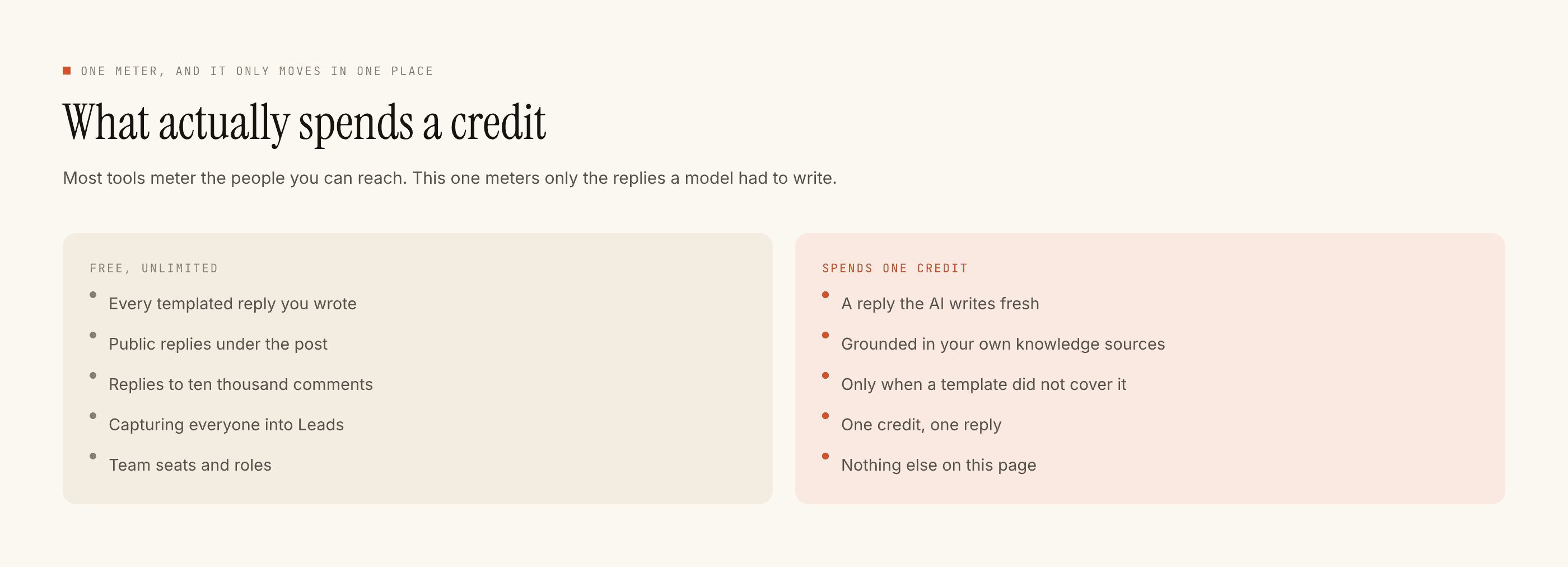
The practical consequence is that a good month is punished under one model and not the other. A post that does unusually well adds contacts you keep paying for; it adds replies you paid for once. If you post rarely and sell to a small list, the difference barely shows. If you post often, it compounds.
What "free forever" usually means in practice
Three honest versions of it exist, and they are not the same offer.
Free as a trial in disguise
Free as a real floor
The test is that second sentence. If you cannot say what stays free once the trial framing is removed, the plan is a trial.
Questions to ask a pricing page
What exactly is metered? Contacts, conversations, messages and automations are four different units and vendors are not consistent about which they use.
Do contacts ever expire? Some plans roll off inactive contacts after 90 days. Some never do. It is a footnote that changes the total by a multiple.
What happens at the cap? Sending stops, or sending continues and you get an invoice. Both are defensible. Only one of them is safe to discover in production.
Is there branding on the message? A promotional footer on every reply is the free plan's actual price, and your audience pays it.
Can you export and leave? Your reply templates and your list of who said what should be yours. If there is no export, the free plan is a deposit.
Where we land
We charge for replies sent, not contacts held, and the free tier is 100 replies with no card. That is roughly a week for a small account, which is deliberately enough to find out whether the drafts sound like you and not enough to run a business on.
We would rather you spent that week on the harder question. Every tool in this category can send a message. The gap between them is whether the message is one you would have written, and whether the tool has the sense to send nothing when it is unsure.