Playbooks · 5 min read
Hotels on WhatsApp: Rates and Rooms Are Not Templatable

A hotel's messaging number is answering two people at once. One is deciding whether to come. The other is in room 402 right now and would like more towels.
They need opposite things. The first needs information the hotel cannot safely automate. The second needs speed, and is the reason this channel is worth having at all.
The guest who is already in the house
Most articles about hotels and messaging are about capturing bookings. The better case is the one that starts after check-in.
A guest upstairs does not want to ring reception, wait, explain, and be transferred. They want to type "2 extra pillows, 402" and go back to what they were doing. That request is unambiguous, it is about a stay that already exists, the room number identifies them, and it can be routed to housekeeping without anybody composing a sentence.
The list of these is longer than most properties realise:
- Housekeeping requests. Towels, pillows, a kettle, a toothbrush, a room made up now rather than at eleven.
- Simple information. Wi-Fi password, breakfast timings, pool hours, whether the gym is open, how far the airport is.
- Acknowledgement with a real time. Not "we will get right on that", but that it has gone to housekeeping and roughly when. A guest who knows it is fifteen minutes does not message again at minute four.
- The handover, when it stops being simple. "The AC is not cooling" is a maintenance job with a person attached, not a ticket a template closes.
Never automate a rate, and never automate availability
Now the other guest, and the two things that must not be sent by machine.
Availability lives in a system the automation cannot see, and it changes while the message is being typed. A reply saying a room is free is a reservation the property has not made. The classic failure is not even a full hotel — it is a room that was free for two of the three nights asked about, and a confident yes that nobody checked.
Rates are worse, because they are not a single number. A hotel's price for a date depends on the channel, the season, the length of stay, the occupancy on the day, whatever the revenue system is doing that hour, and what the same room is showing for on an aggregator. Whatever figure a template holds will be stale, and a guest holding a screenshot of it at the front desk is a conversation nobody enjoys.
A quoted rate is a promise the property has to honour or explain. Neither should be decided by a template.
What is honest is the shape without the number: what is included, whether breakfast is part of it, what the cancellation policy says, when check-in and check-out are, whether the tariff changes in season. Then a person, or your booking engine, supplies the price.
The late checkout problem, which is a good example of the whole thing
A guest asks for a late checkout. It feels like a small favour and exactly the kind of yes an automation could hand out.
It is not. Whether 2pm is possible depends on who is arriving into that room, how many are arriving, and whether housekeeping can turn the floor in time. That information exists in the arrivals list, an hour from now, in somebody's head. A machine that says yes has committed a room the property may need.
The same logic covers early check-in, room upgrades, connecting rooms, a cot, and a view. All of them look like small yeses. All of them are inventory.
The complaint that arrives at 1am
Hospitality's hardest message: a guest who is awake, unhappy, and typing.
An automated reply under that is uniquely damaging because the guest is in the building. A cheerful "thanks for your message, our team will assist you shortly!" at 1am reads as a hotel that has gone to bed. Route complaint vocabulary — noise, dirty, smell, broken, refund, manager, paisa wapas — straight to whoever is on night duty, and switch off any first-time-sender filtering for it, because complaints come from repeat guests as often as new ones.
The same applies to anything sent as a photograph. Nothing here reads images, so a picture of a stained sheet is an empty message with a very unhappy person behind it.
Groups, weddings and the enquiry that is really a project
A banquet or wedding enquiry looks like a booking question and is not one. It involves dates, headcount, menus, decor, room blocks and a negotiation. Nothing about it is templatable beyond acknowledging it, capturing the date and the rough size, and getting it to the sales desk fast. The value of automation here is entirely in the handover, not the answer.
The platform, and what we run
The WhatsApp Business Platform needs a Meta Business account, verification, and templates Meta reviews. Categories, approvals and pricing are Meta's, vary by country and change; take the current specifics from their documentation, not from an article.
PostEngage answers Instagram comments and DMs on the official Graph API. That is the entire product — there is no WhatsApp in it, on any plan. This post covers the channel because hotels search for it and the honest description is more useful than a pitch.
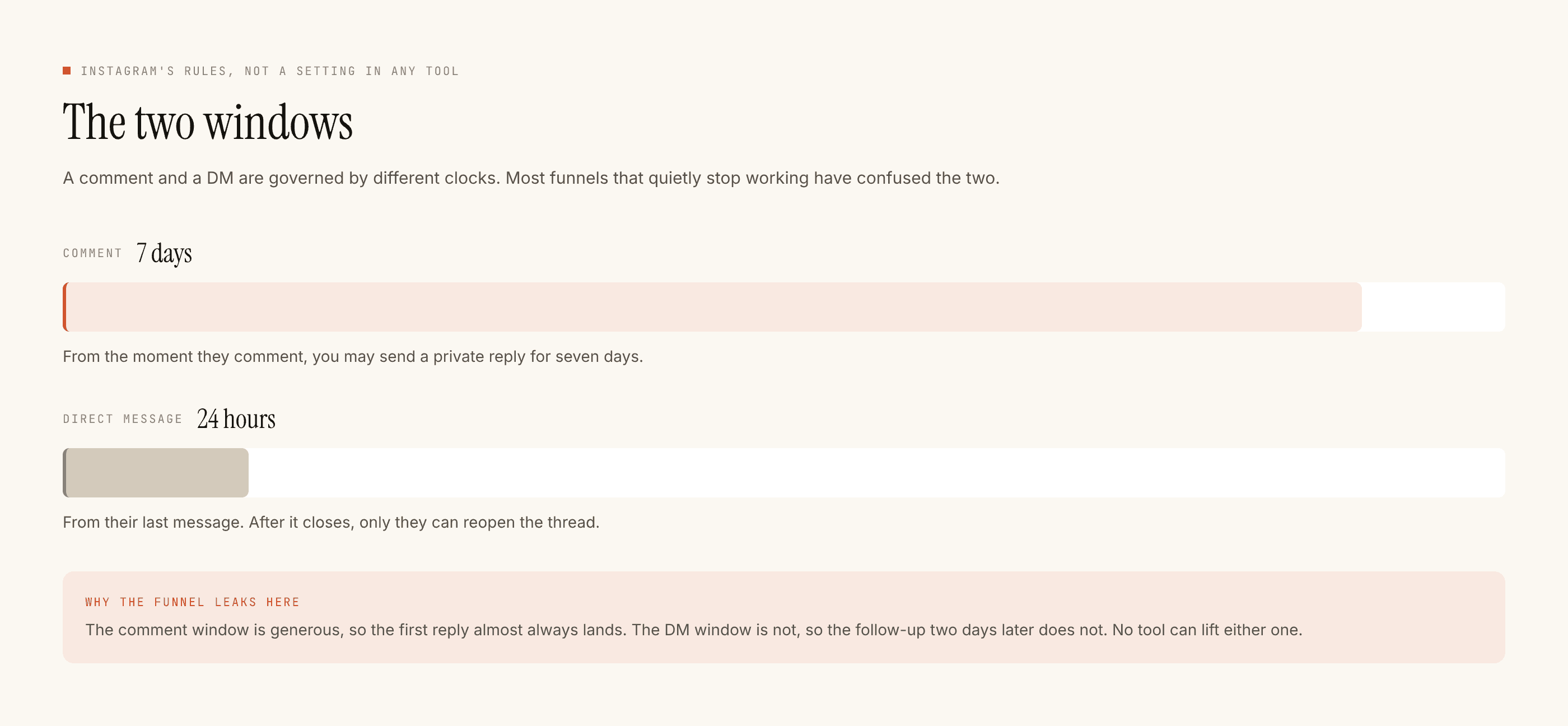
For the channel we do run: seven days to answer a comment, twenty-four hours in a DM thread, restarted only by the guest's own next message. Templated replies are free and unlimited; a credit is spent only when the AI writes new text. Free tier is 100 credits, no card, and packs start at ₹499.
Related reading: travel agencies, which has the same never-quote problem with fares attached, appointment booking done honestly, and what governs this channel in India.