Playbooks · 5 min read
Instagram Before Product-Market Fit: DMs as Research

The advice given to early SaaS founders about Instagram is nearly always funnel advice: post, capture, nurture, convert. It assumes you know who the customer is and what the offer is. Before product-market fit you know neither, and running a funnel over that uncertainty just makes you confident about the wrong thing faster.
There is a better use for the channel at this stage, and it is unglamorous. Instagram is one of the few places where strangers will type a sentence at you unprompted. That sentence is research. The signup is a side effect.
Start with the constraint that decides whether any of this is worth your time: nobody can message a stranger. Not us, not anyone on the official API. The conversation only exists if they comment or DM first. So this is not an outbound channel and no amount of tooling makes it one. If your plan was cold DMs to a scraped list, this post has nothing for you and neither does the product.
What the automation is for at this stage
Not closing. Catching.
You will not be at your phone when someone comments at 11pm on a reel you posted three days ago, and the twenty-four hour DM window means that if you get to it on Thursday, you cannot reach them at all. The automation's entire job pre-launch is to keep the conversation alive long enough for you to have it personally.
- Acknowledge, in your own words. One sentence that sounds like a person typed it, because at this stage the person typing it genuinely is you and there are not many of these yet.
- Ask one question. The best one before product-market fit is almost always some version of "what are you using for this right now?". It costs the reader nothing and it tells you the actual competitor, which is usually a spreadsheet.
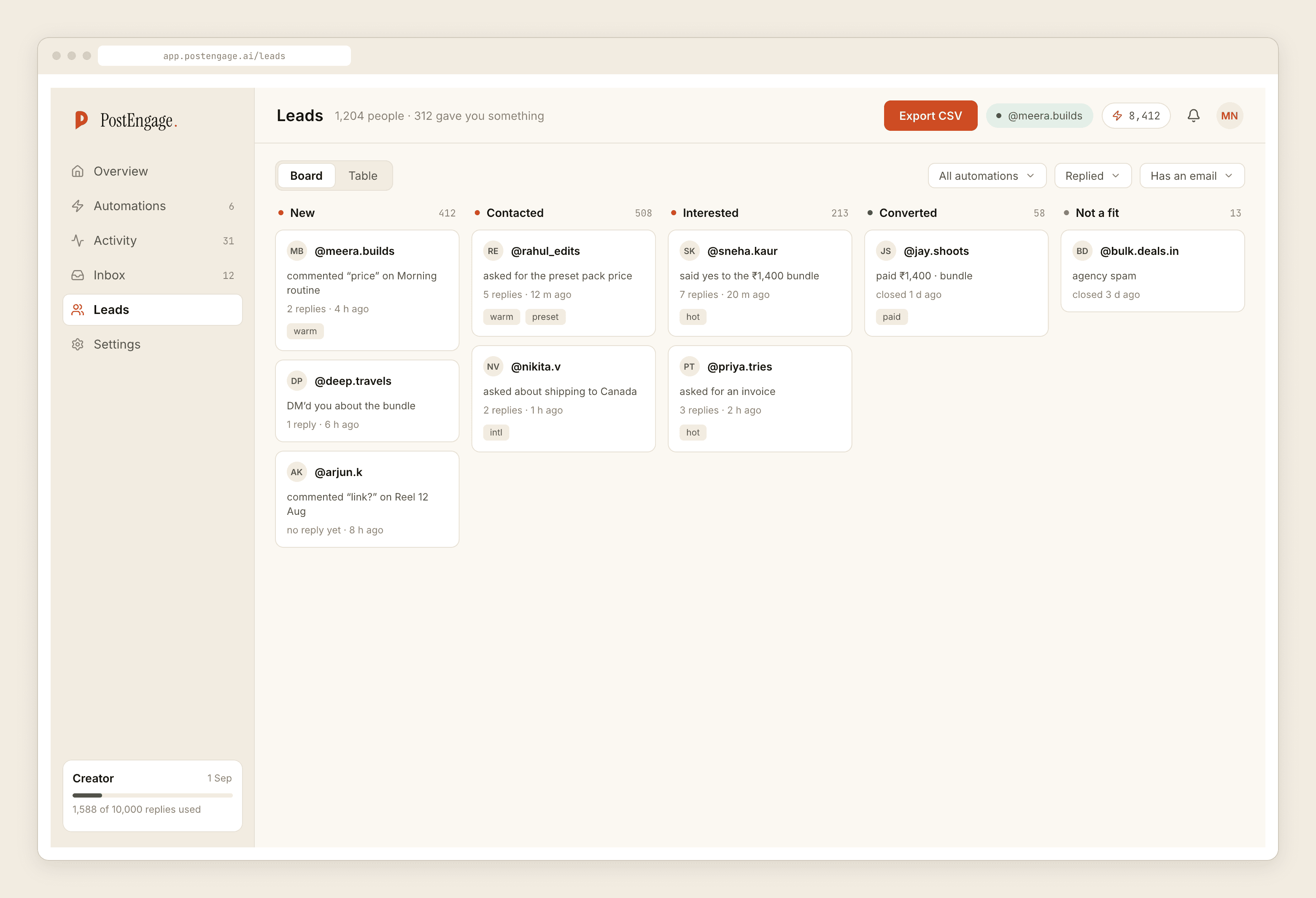
- Capture to Leads. Leave it on. At forty conversations the list is a research artefact, not a pipeline.
- Then stop. Do not automate the second message. The second message is where you learn something, and handing it to a model at this stage is throwing away the only signal the channel produces.
Read the leads as transcripts, not as a list
A lead record holds who asked, what they asked, which post and which keyword brought them in. Most teams look at the count. The count is the least interesting column you have.
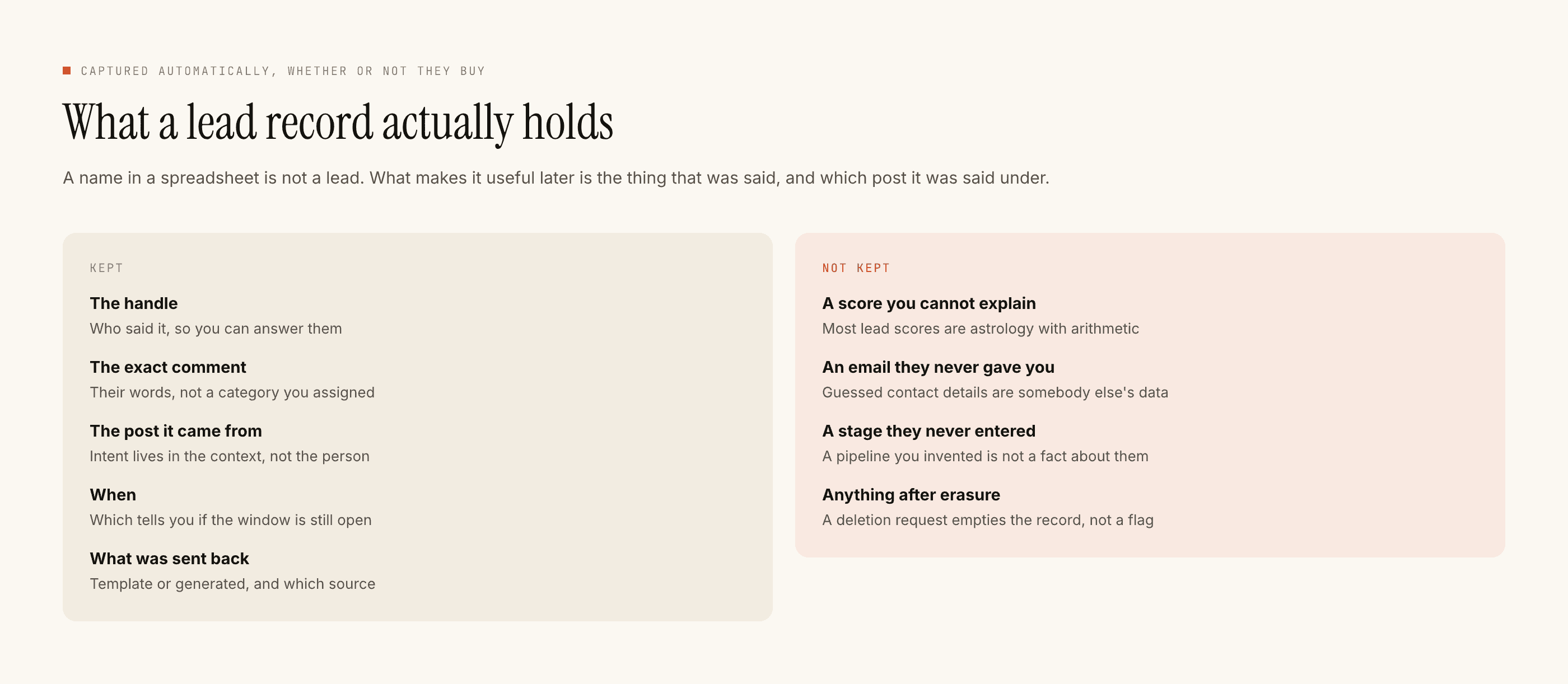
Two things fall out of reading them properly.
The first is vocabulary. You will discover the words people actually use for the thing you built, and they are rarely the words on your landing page. If your homepage says "workflow orchestration" and every DM says "automatic reminders", the DMs are right.
The second is the shape of the misunderstanding. Pre-PMF, a large share of enquiries are from people who want a nearby product that you do not make. That is not noise. Three people asking the same wrong question in one week is a stronger signal than any of your positive replies, because it tells you what your content is actually promising.
Forty DMs you read carefully will change your roadmap. Four hundred you never read will change your billing.
What this costs you, honestly
Templated replies are free and unlimited. A credit moves only when the model writes something new. The free tier is a hundred credits with no card, and packs start at ₹499 when you need more.
At the volume an early-stage account produces, this is close to a rounding error, and you may never pay us at all. That is a fine outcome and it is why the free tier exists in the shape it does — a hundred credits is sized to answer a question about whether the thing works, not to run a business on. What the free plan does and does not cover is written plainly elsewhere.
There is a real cost, though, and it is not money. The voice profile is built from replies you actually wrote. A brand-new account has no reply history, so the first drafts read flat and generic, which is the exact failure the feature exists to prevent. Pre-launch you are the cold start. Either paste in a body of your own writing or accept templates for a while, and templates cost nothing anyway.
What not to build yet
No sequences. There are none in the product, and more importantly there should not be any in your plan. A nurture sequence assumes you know what to nurture people towards.
No lead scoring. Scoring works when you have closed enough deals to know what a good one looks like. You have not.
No qualification gauntlet. Three questions before a human replies is how you turn a curious stranger into someone who closes the app. Ask one.
And no dashboards. You will be tempted to instrument this because instrumenting things is comfortable and reading forty conversations is not. There is no analytics product here anyway, which for once is the right constraint at the right time.
The transition point
You will know it when the same question arrives for the tenth time and you find yourself annoyed at having to answer it. That is the signal that a real template should exist, and it is also roughly the signal that some part of your positioning has stabilised.
At that point the advice changes completely, because the inbox stops being strangers and starts being users. What to do with an inbox that is mostly your own customers is the next post, not this one. And when a signup link genuinely belongs in the reply, getting one into a DM thread has its own mechanics worth knowing.