Lead generation · 5 min read
Travel Enquiries on Instagram: What Not to Automate

A travel agency's Instagram is unusually good at producing enquiries and unusually bad at converting them, and both facts have the same cause. The content is a photograph of somewhere beautiful, so the comment section fills with people at every stage of intent from idle daydream to a family with dates locked. The agency treats them all the same because it cannot tell them apart in the two seconds it takes to reply.
Automation is genuinely useful for that sorting problem. It is also, in this industry more than most, capable of doing real damage in a single sentence, so the boundaries come first.
Two things that must never be automated
A price or an availability quote. Fares change through the day, hotel inventory changes faster, and a package that costs one figure on Tuesday costs another on Thursday. A number sent from your account is read as an offer. When the customer comes back on Saturday with a screenshot of your DM and the price has moved, you either honour it or you have an argument, and you will lose that argument publicly in your own comment section.
A visa or entry requirement. This one is worse, because being wrong costs the customer the trip rather than the difference in price. Requirements vary by nationality, by purpose of travel, by length of stay, by which passport someone actually holds versus which country they live in, and they change with no notice. An automation cannot know which of those apply to a stranger who typed one word under a reel.
The honest reply on visas is one sentence that points at authority and states nothing: "entry rules depend on your passport and change often, so please check the destination's official government site, and I'll help with everything else." That is useful, it is never wrong, and it takes the liability off your account.
What the automation is actually for
Sorting. There are four facts that decide whether an enquiry is worth a human hour, and none of them are sensitive:
- Rough dates, or at least the month. A person with a month is a different prospect from a person with a mood.
- Departure city. It changes the entire package and it is the fact agencies most often forget to ask before quoting.
- Number of travellers, and whether any are children. This changes everything downstream and costs nothing to ask.
- A way to continue the conversation. Email or phone. This is the one that matters most, for reasons that are structural rather than commercial.
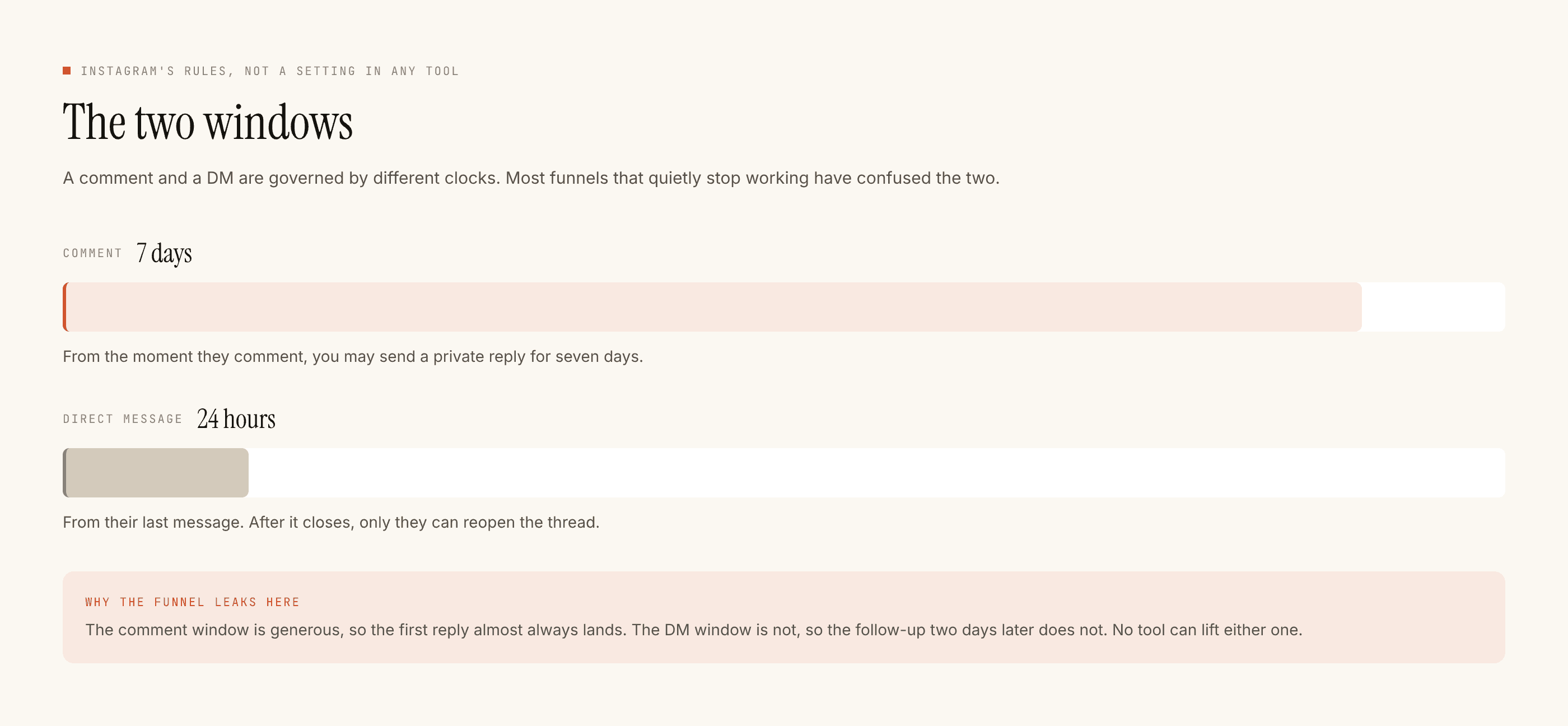
The window problem, which is severe for travel
A comment can be answered for seven days. A DM can be sent within twenty-four hours of that person's last message, and only their own next message restarts the clock. Nobody on the official API can message a stranger.
Now hold that against how travel is actually bought. Someone sees a Kashmir reel in March, thinks about it for six weeks, discusses it with a spouse, checks their leave, and comes back ready in May. Every mechanism you would want for that — the follow-up in week two, the reminder when fares drop, the seasonal nudge — sits outside the window. There are no sequences here, no broadcasts and no scheduled messages, and there is no way to build them within the platform's rules regardless of tool.
You get one conversation. Everything about the automation should be arranged so that conversation ends somewhere you can reach them again.
So the design is: reply fast, ask the four things, get an email or a number into Leads, and continue on WhatsApp or the phone the way your agency already does. Not through us — we do not do WhatsApp, it is not built and it is not shipped. Through whatever your team already uses.
What the leads list gives you and what it does not
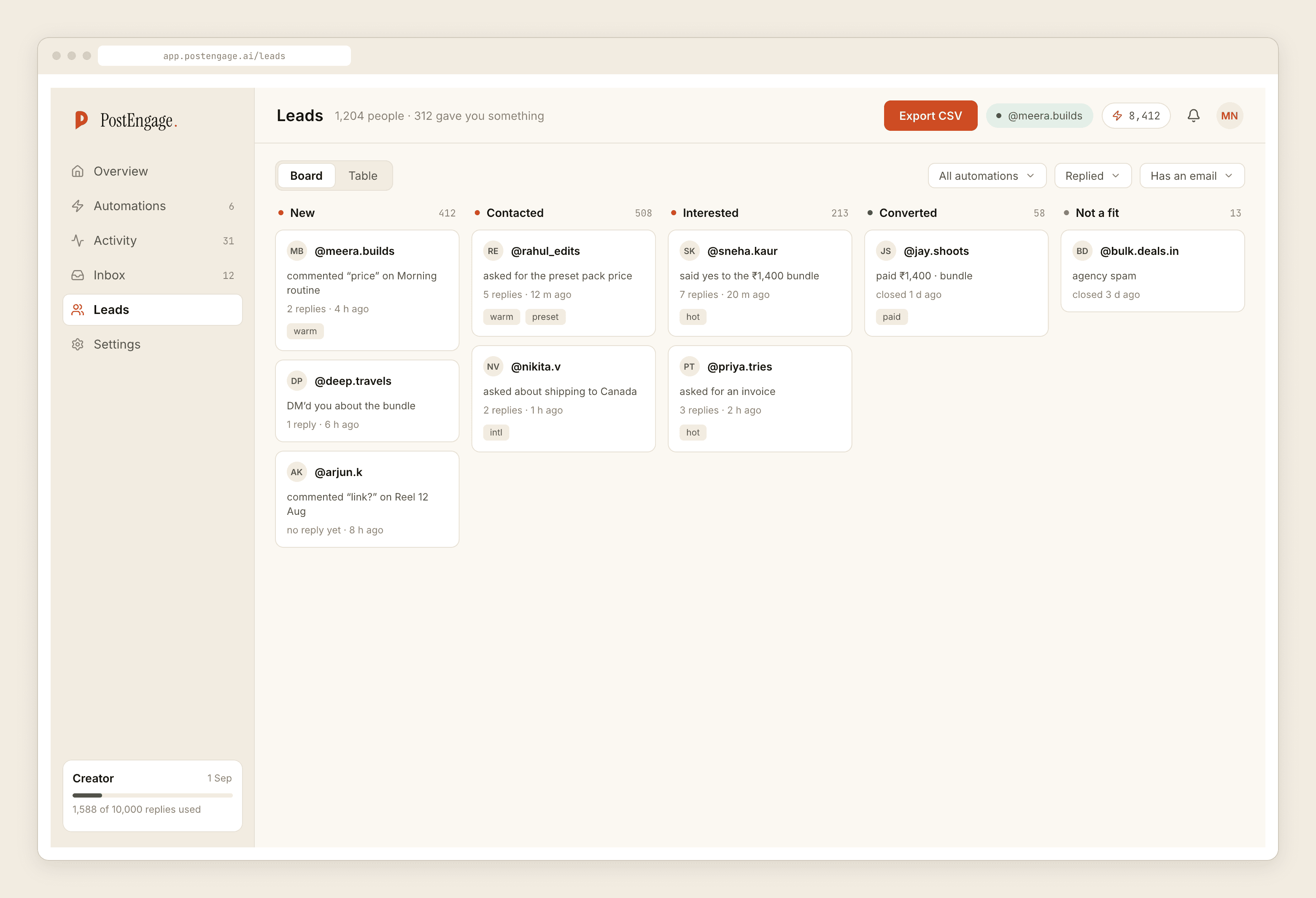
Leads export as CSV. There is no CRM sync, no connector into your booking system, no automatic assignment to a consultant. Somebody exports the file and somebody works it, and if that person does not exist, the automation is producing a list nobody reads, which is worse than not capturing at all because it feels like progress.
The column worth building a routine around is the source post. An enquiry from a Ladakh reel and an enquiry from a honeymoon carousel want different consultants and different first calls, and you have that information for free before anyone picks up the phone.
A configuration that behaves
One automation per destination post. Trigger on the words people type — details, price, itinerary, kitne ka. Negative keywords on anything that means a quote or a rule: visa, refund, cancel, cheapest. Those should stand the automation down and leave the thread for a person.
Public reply as a short receipt. Private reply that acknowledges, asks for dates and departure city, and offers to send the details properly by email or phone. No number, no seat, no rule.
Quiet hours in your customers' timezone, and takeover left alone to do its job — the moment a consultant replies by hand the automation stands down, which is exactly what should happen the second a real conversation starts.
Then read the blocked activity weekly. For a travel account the negative-keyword rows are the important ones: each is a person who asked something the automation correctly refused, and each is waiting on you.
For deciding which of those enquiries deserves a call first, what makes a lead hot and how scoring behaves in practice both apply directly. The closest sibling industry, where the same long consideration cycle and the same never-quote rule apply, is property.