Playbooks · 5 min read
Your Instagram DMs Are a Support Queue You Did Not Staff

A software company sets up Instagram for the top of the funnel. Product clips, a feature announcement, a founder talking about a problem, a customer story.
Then read the DMs. Most of them are not from prospects. They are from people who already pay you and cannot log in.
That mismatch is the whole thing worth planning for. Instagram is a support surface for any software business with consumer-adjacent users, and it is one nobody has staffed, because on the org chart it belongs to marketing and the tickets do not appear in the ticketing system.
Who actually writes to a software account
Arrives constantly
Arrives rarely, matters enormously
The left column is high volume and low stakes. The right is the reverse. Automation is worth roughly the ratio of volume to stakes, which puts it firmly on the left and nowhere near the right.
Four answers that never come out of a template
Anything about a specific account. "Your subscription renewed on the 3rd", "your data is still there", "we can see the error". Nothing here reads your database. There is no account lookup, no billing integration, no CRM sync. An automated reply that sounds like it checked something has lied about the one thing customers care about.
Whether the product is down. Status is a fact that changes minute to minute and the automation is holding a template written last month. Point at the status page. It is the only answer that is correct on every day of its life.
A security or compliance answer. "Yes we're compliant", "your data is encrypted", "we don't share anything with third parties". Each of those is a statement your company makes in writing to somebody who may be evaluating you formally. It belongs to whoever owns those answers, and that is not a keyword rule.
A price for anything negotiated. Self-serve pricing on a public page is fine to link to. An enterprise number is not a fact — it is an outcome of a conversation — and a figure sent from your account becomes the anchor for every negotiation that follows.
An automated reply that sounds like it looked something up is worse than no reply, because the customer stops looking for help.
What the automation is actually for: getting them out of Instagram
Your support process already exists and it is somewhere else. A ticket system, an email address, an in-app widget. It has history, attachments, escalation and an actual SLA.
Instagram has none of that, and nothing here bridges the gap. Captured messages leave as a CSV. A CSV is not a queue, has no owner, no status field and no SLA, and treating it as one is how a support request sits for a week.
So the honest design is a doorway, not a desk:
- Acknowledge in one line and route in the second. "That one needs an account look-up — quickest route is support@ or the in-app chat, they can see your workspace." Fast, honest, and it does not pretend to have checked anything.
- Send the specific link, not the help centre homepage. A person with a login problem does not want your documentation index.
- Ask them not to send credentials. People will paste API keys, screenshots with tokens visible, and occasionally a password, because they are trying to be helpful. A template that says "please don't send keys or passwords here" is the most valuable thirty words on this list.
- Put job applications on the negative-keyword list.
hiring,job,intern,resume,CV,opening,apply. It is a large share of a software company's DMs and none of it wants a support template. Point at the careers page by hand or leave it for a person. - Capture the rest and name who reads the file. If nobody is named, it does not get read.
Trials: the automation sends a link and stops
The demand-generation case is real and it is smaller than the deck suggests.
Somebody watches a feature clip and comments TRY. The automation sends the signup link and captures the handle. That is the whole flow, and it works well, and it is free to run at any volume because it is a fixed template.
What it does not do is provision anything. There is no account creation, no trial extension, no seat assignment, no plan change, no way to tell whether the person who commented ever signed up. There is no attribution here and no analytics product, so the honest measurement is whatever your own signup funnel already records about referrers, not anything this produces.
The window is shorter than your SLA
Comments stay answerable for seven days, counted from each comment. A DM thread stays open for twenty-four hours from the customer's last message, restarted only when they write again. Official Graph API, and both are platform rules rather than settings.
Twenty-four hours is shorter than a lot of support SLAs and much shorter than a weekend. A customer who writes at 6pm on Friday and is answered on Monday morning is answered into a closed thread. A free templated acknowledgement at 6:01pm is not support — it is the thing that keeps support possible, by telling them where to go while the door is still open.
Cost and limits
Templated replies are free and unlimited, which suits this inbox exactly: the repetitive tail is a handful of fixed routing messages and it costs nothing however many users you have. A credit is spent only when the AI writes a new reply, one credit per reply. Free tier is 100 credits with no card; packs start at ₹499.
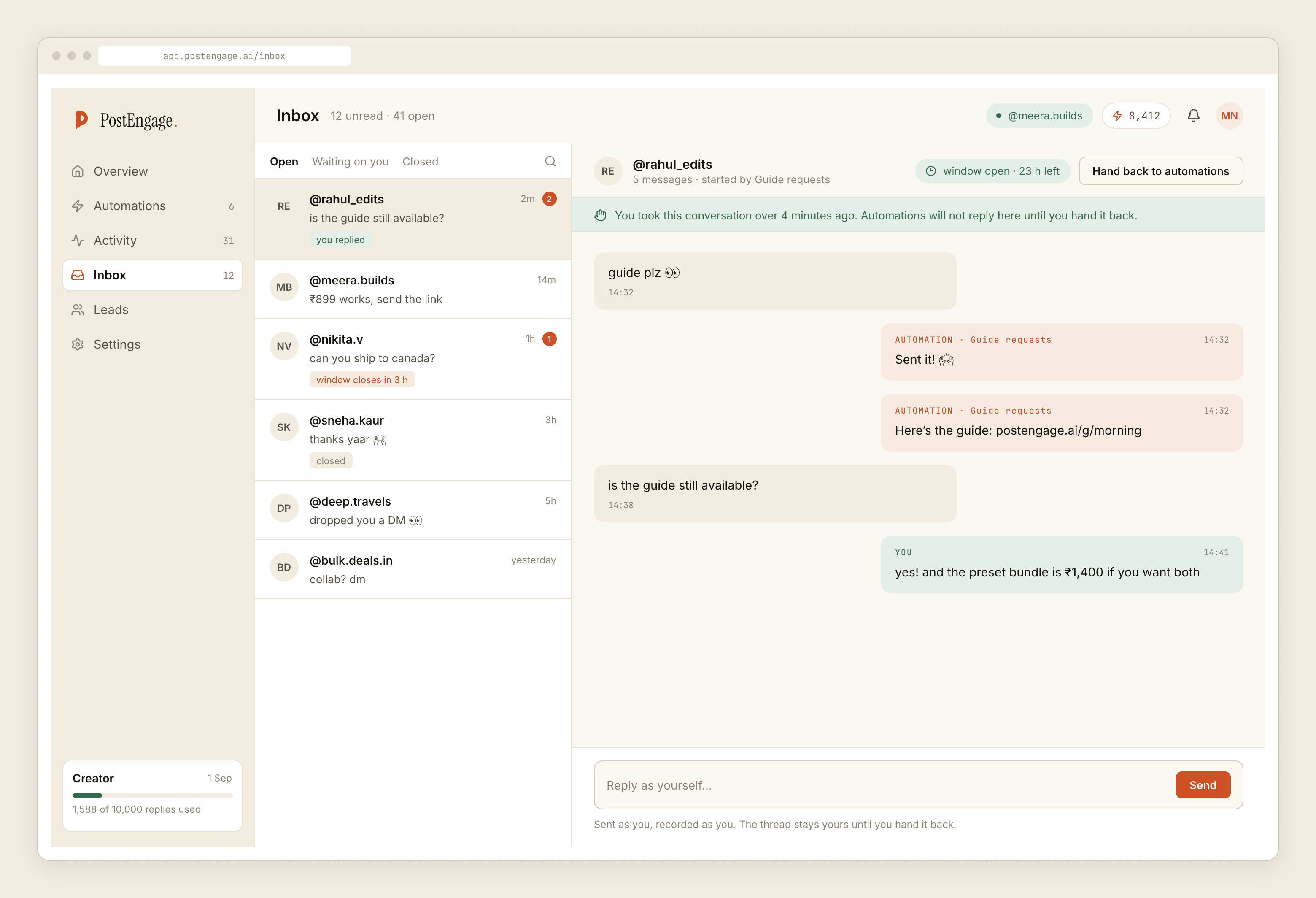
No CRM sync, no ticketing integration, no Zapier connector, no WhatsApp, no analytics, no ability to message anyone who has not written to you first. Takeover stands the automation down the moment a human replies by hand.
If your product is consumer subscription rather than B2B, the churn side of this is the closer fit, and running support on this channel generally covers the shape in more detail.