Playbooks · 4 min read
A Consulting Firm's Instagram Inbox Is Mostly Not Buyers

Read a week of a consulting firm's Instagram DMs and sort them by hand. The pile looks roughly like this: people asking whether you are hiring, final-year students asking for an internship or a project topic, agencies pitching you SEO, somebody who wants you to speak at their college fest, three messages about a post that had nothing to do with your services — and, somewhere in there, one message from a person with a budget and a problem.
Every automation guide written for this vertical assumes the last message is the whole inbox. It is not. It is the exception, and finding it is the job.
The value here is subtraction
For a restaurant, automation adds throughput — more orders answered, faster. For a firm that sells engagements, throughput is not the constraint. Nobody signs a six-figure scope because you replied in forty seconds.
What actually costs you is attention. Somebody senior opens the inbox, reads eleven messages that are not for them, and closes it. Do that for three weeks and the inbox becomes a place nobody checks, which is precisely when the one real enquiry arrives and sits for nine days.
So the thing to build is not a sales funnel. It is a sorting layer that answers the four kinds of message that are not enquiries — politely, immediately, correctly — so that what remains in front of a human is small enough to be read.
A consulting inbox does not need faster replies. It needs fewer messages arriving at a partner's attention.
The disqualifying fact is almost always in the first message
This is the useful property of the recruitment and student traffic: it announces itself. "I am a final year student at…", "sharing my resume", "internship opportunity", "are you hiring", "I do SEO for consulting firms", "we help agencies get clients".
Those are keyword-shaped, and keyword matching ignores case and punctuation, so you are writing the vocabulary rather than every variant of it. Each one gets a real answer — where careers are actually posted, that internships go through a specific address, that you do not take vendor pitches on Instagram — and then it is done. Nobody senior reads it.
That is not a trick. It is a better experience for the person writing, too. A student who gets the careers page in thirty seconds is served considerably better than one who gets silence for a fortnight because the message was triaged into nothing.
The brand risk is different here, and it is real
A firm's Instagram account carries partners' names. A cheerful, obviously-generated reply to a job applicant is a thing that gets screenshotted, and the screenshot travels among exactly the people you recruit from.
Two consequences. First, the recruitment reply is the one to write most carefully, not the least — it is the highest-volume message you send and the one most likely to be read as representative. Second, keep generated replies away from anything about hiring or fees; write those as templates, in your own words, and let the AI nowhere near them.
What a prospective client will do, and why it needs a human
Here is the pattern worth designing around. A genuine enquiry rarely starts with "what do you charge". It starts with a description of a situation — a founder explaining that their operations are a mess, a family business describing a succession problem, sometimes with names and numbers in it.
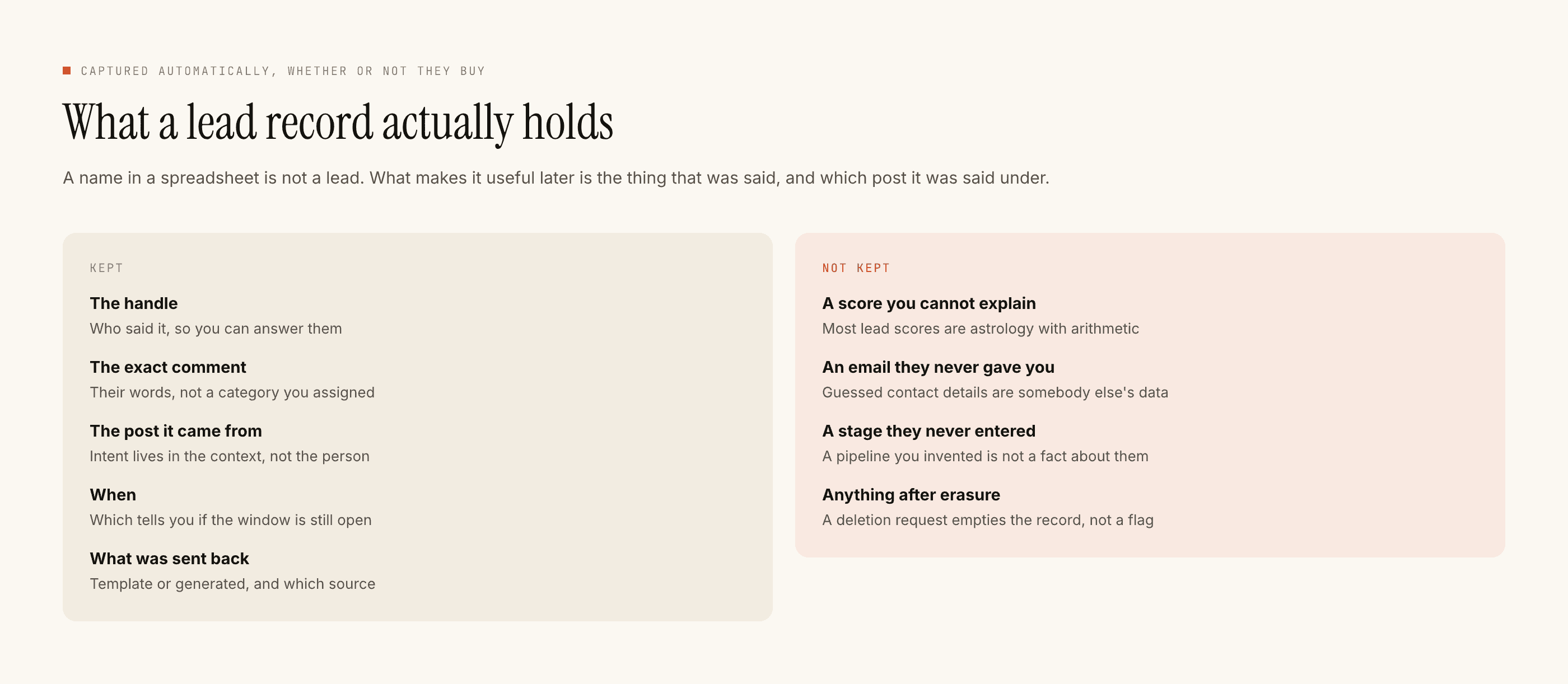
Two rules follow. Never write a template that invites detail — no "tell us all about your challenges and our AI will suggest an approach". You do not want that material arriving in an Instagram DM at all, and once it has, an automated reply to it is the wrong response by an order of magnitude.
And the moment a message contains a described situation rather than a query, it stops being automatable. There is no keyword for "this person is serious". There is only a human reading it, which is affordable precisely because the other eleven messages were handled already.
Cost, and where the leads end up
Templated replies are free and unlimited, and the sorting layer described above is entirely templates. A credit is spent only when the AI writes a new reply, one credit per reply. Free tier is 100 credits with no card; packs start at ₹499. Most firms building only the filter never touch a credit.
Captured enquiries land in Leads and leave as a CSV. There is no CRM sync, no Salesforce or HubSpot connector, no WhatsApp, no calendar or booking. Whoever owns business development imports the export and works it there.
The clocks are the platform's: seven days to reply to a comment, twenty-four hours to reply inside a DM thread, restarted only by their next message. For a firm, the seven days matters more than people expect — a comment left on Monday's post is still answerable on Friday, which is roughly the tempo at which senior people actually check things.
What this post deliberately does not cover
The build. Which automation to make first, what to put in each field, and what to check after a week is a separate and more practical document: the consulting build sheet covers it in order.
For the adjacent professional-services problem — an inbox where answering the question at all creates liability — what a lawyers' automation has to refuse is the sharper case, and the accountants' version is the one about routing rather than advising.