Compliance · 6 min read
Kids' Classes on Instagram: Do Not Collect the Child
On this page

You post the trial-class reel. Kids building something, a caption asking people to comment TRIAL, and by the next morning there are forty comments and a dozen DMs.
"6 saal ka beta hai, uske liye batch hai?"
"my daughter is in class 4, she is weak in maths"
"Is this for 11 year olds? He goes to DPS, timings clash ho jaate hain"
Every one of those messages contains a child. Not a customer — a specific, identifiable minor, described by their parent, along with their age, their ability, their school and where they are at four o'clock on a Tuesday.
That is the entire design problem for this category, and it arrives in the first hour.
Everything you capture is a record about somebody's child
A cleaning company captures a BHK. A florist captures a delivery area. You capture a seven-year-old.
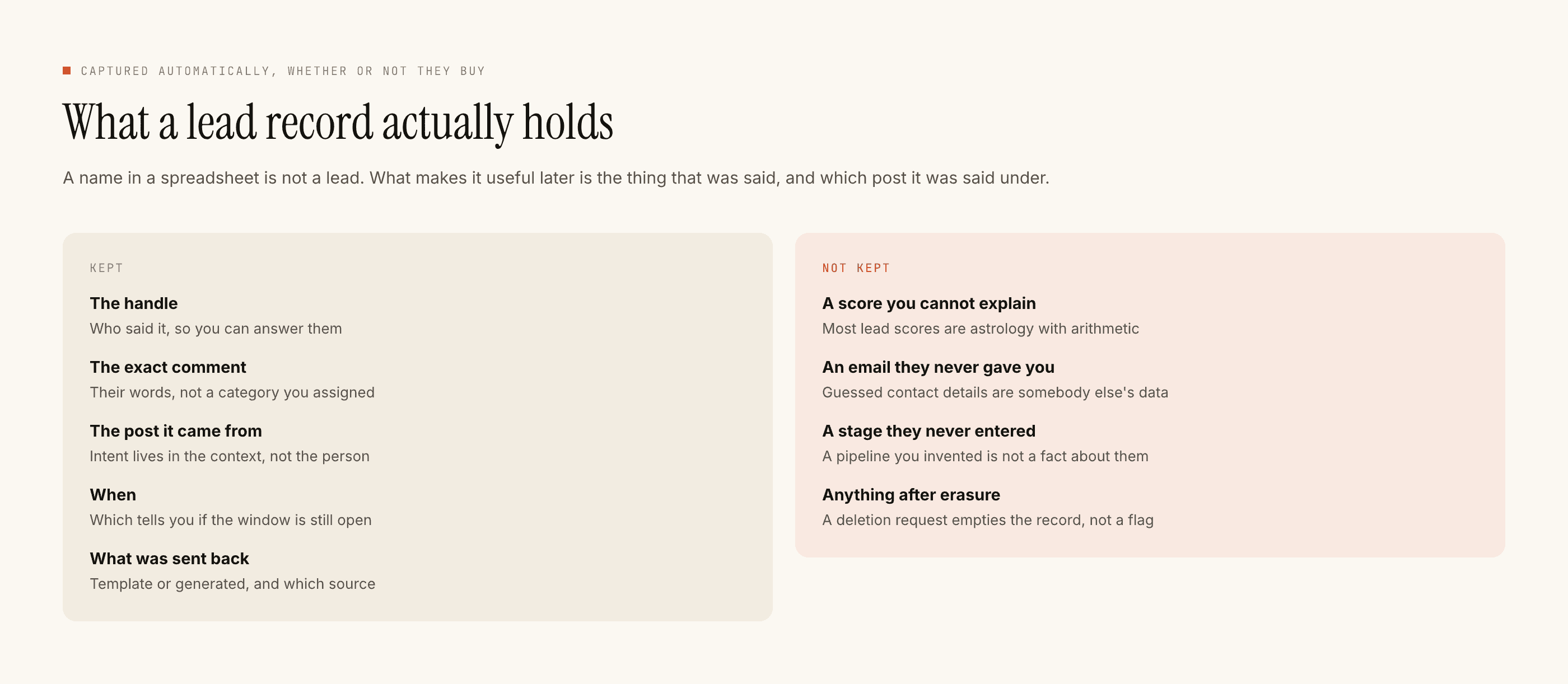
Once it is in a leads export it is a row containing a child's age, their weak subject and the parent's phone number, sitting in a marketing tool, exportable as CSV by anyone with access to the account, on somebody's laptop. Nothing about that is illegal by default and everything about it is worth avoiding, because the safest data is the data you never took.
So the rule for this category is not "handle it carefully". It is do not collect it at all.
The most protective thing an automation can do with a child's details is decline to write them down.
The forbidden question is the one you most want to ask
Here is why this category is genuinely hard rather than merely sensitive.
The natural qualifying question in children's education is age. Age determines the batch, the syllabus level, the price, and whether you can serve them at all. Every coaching website's enquiry form asks it first.
It is also the one field that turns a marketing lead into a record about a minor. Same for the class, the school name, the board, the child's name, their timings, a photo, a report card, and any description of how they are doing.
That last category deserves its own warning. Parents volunteer it unprompted — "she is very slow in reading", "he has attention issues" — because they are trying to help you help their child. A template that asks a follow-up question about it is soliciting an assessment of a minor over Instagram, and an automation that captures it into a lead record has stored it.
What to capture instead
- The parent, not the child. A name to greet them by and a number or email to call back on. That is a normal business contact.
- The programme they asked about. Which reel, which course, which trigger word matched. It tells you the age band without anybody stating an age.
- Area or city. Enough to say whether you have a centre near them or whether it would be online.
- Nothing else. No age field, no school field, no "tell us about your child" prompt. The person who calls back can ask, on a phone, and write it into whatever system you actually use for admissions.
Some of the people messaging you are children
Worth stating plainly, because it changes the tone of every template.
Teenagers DM coaching accounts themselves. So do younger kids using a parent's phone. Spoken English, coding, art, music, exam prep — a chunk of that inbox is not a parent at all, and there is no way to know.
That has two consequences. Nothing automated should ever ask a personal question, because you may be asking a twelve-year-old. And nothing automated should push — no urgency, no "batch filling fast", no discount countdown. Whatever you think of that language for adults, it should not be aimed at somebody who cannot tell you their age.
The public reply that says where a child will be
A comment automation posts publicly, tagged to the commenter, under your post. Read that sentence again with a children's account in mind.
"Hi Aarav's mom! Yes, the 5pm Saturday batch at our Koramangala centre has space — DM'd you the details."
That is a child's first name, a weekly time, and a physical address, published in a comment thread, attached to an account that is very likely the parent's real name and photo. Nobody wrote that maliciously. A template wrote it because the template was designed to be helpful.
Keep the public reply free of any detail — "sent you a DM" is the correct content — and keep centre names, timings and batch details in the private reply where only the person who wrote to you can see them.
Never automate an outcome
The other refusal list, shorter than the first. No automated reply should say what a child will achieve: marks, ranks, admissions, reading levels, "improvement in three months", "she will be fluent by summer".
Parents ask this directly and often, because it is the thing they are actually buying. It is also a promise about a person nobody at your centre has met, generated by software, in writing. Block the vocabulary — result, rank, marks, guarantee, admission, IIT, NEET, board exam, improve — and let a teacher answer it in a conversation.
The templates that rot
Batch timings, admission deadlines, summer camp dates. All true when written and all wrong within weeks, in a channel where nobody notices because the replies go out silently. Anything with a date in it belongs in a temporary automation you switch off by hand — there are no scheduled sends here and nothing expires itself.
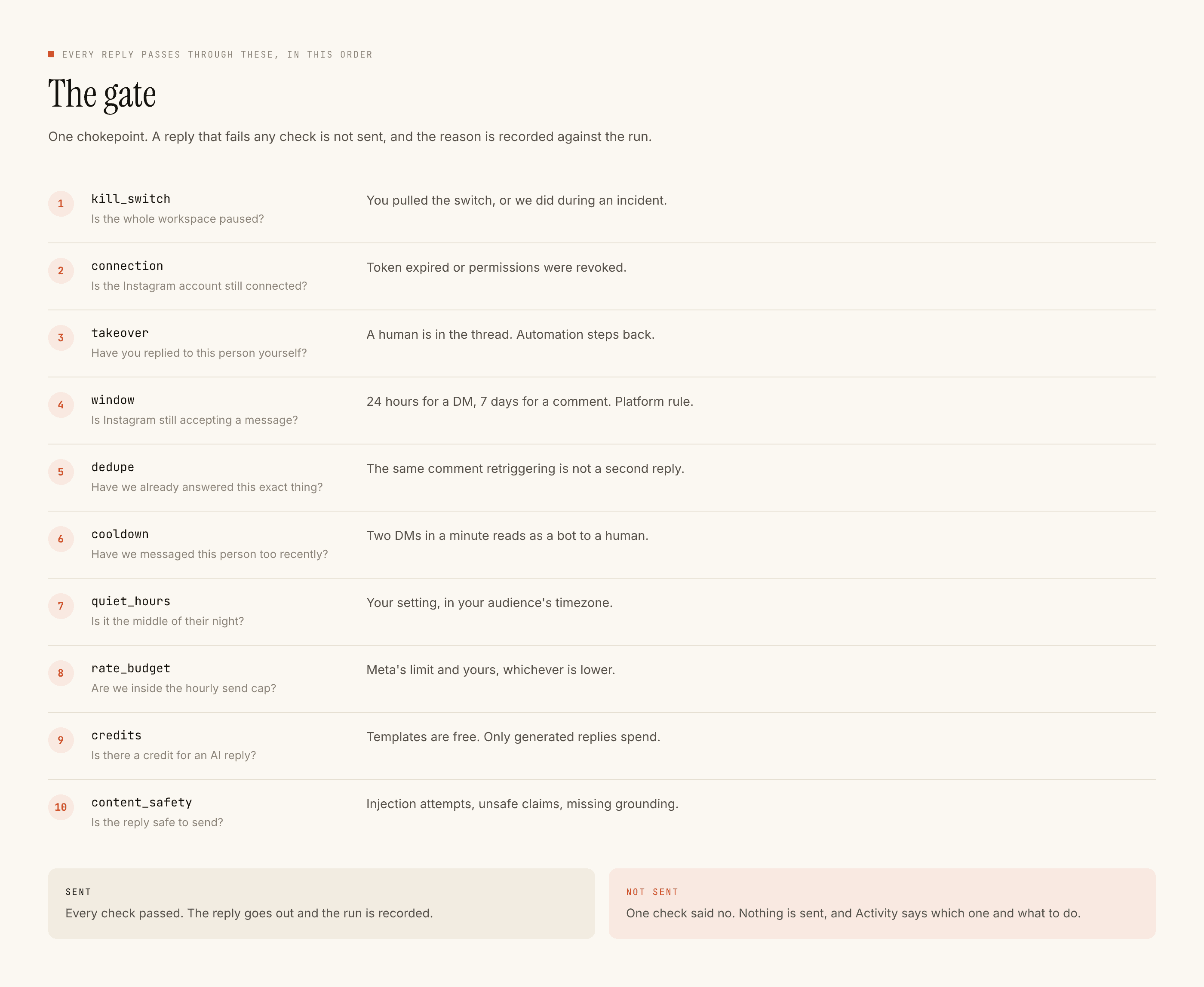
And takeover: the moment a person from your centre replies by hand, automation stands down in that thread for good, which is what you want the second a conversation becomes about a specific child.
What it will not do
No calendar and no booking, so nothing confirms a trial slot. No reminders, no scheduled sends, no fee collection, no CRM sync — leads leave as CSV. No WhatsApp, and it cannot message anyone who has not written first.
Official Graph API only: seven days to answer a comment, twenty-four hours inside a DM thread, restarted only when they message again.
Templated replies are free and unlimited; a credit is spent only when the AI writes a new reply. Free tier is 100 credits with no card, and packs start at ₹499.
The wider education sector post covers adult learners, where almost none of this applies. Language schools share the batch-timing problem, and what is and is not stored is the one to read before you turn capture on.