Lead generation · 5 min read
A Story View Is Not a Lead, and You Cannot Message It

You can open a story and see exactly who watched it. Names, handles, in order. It looks like a lead list and it is the most misleading screen on Instagram.
You cannot message those people. Neither can we, neither can any tool built on the official Instagram Graph API, and neither can any tool that claims otherwise without doing something to your account you would not agree to if it were described plainly. A view is not a message. No permission was created, so no conversation can be opened.
That is the whole of the bad news and it is worth stating flatly, because a lot of published advice implies the opposite and people buy software on the strength of it.
Why the viewer list is visible but unusable
The app shows you the list because it is your story and the counting happened on your account. The API governs messaging separately, and messaging permission comes from one place only: the person contacting you first.
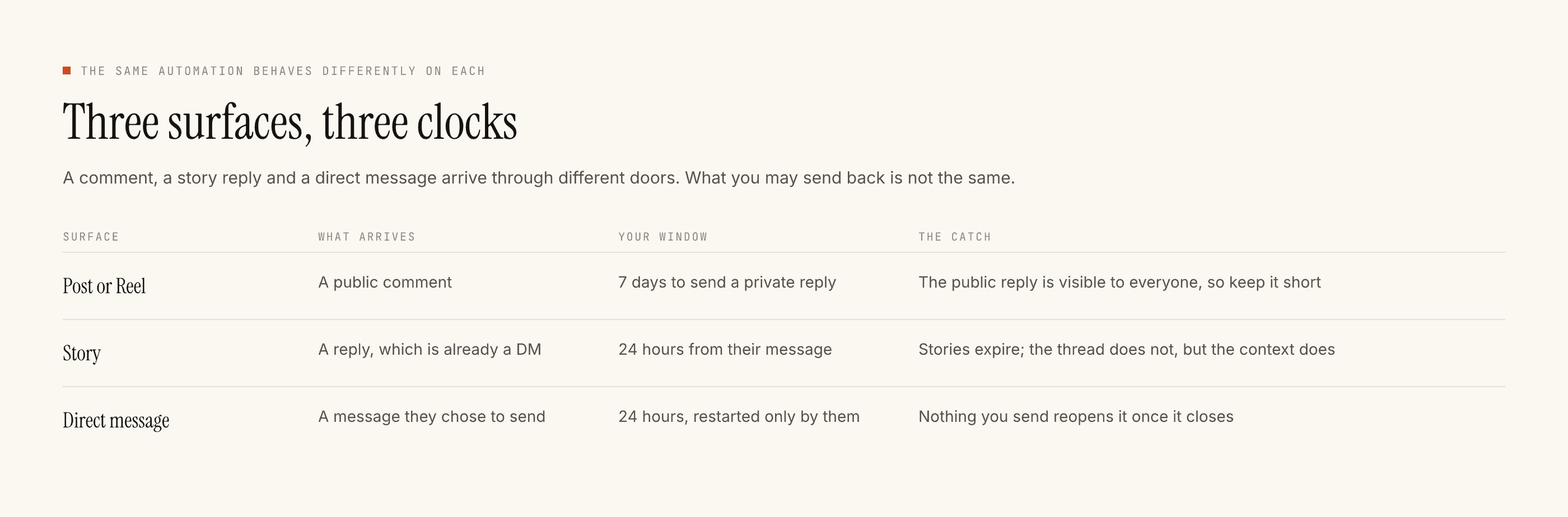
A comment gives you seven days to open a conversation. A direct message gives you twenty-four hours from their send. A view gives you nothing, in the same way a screenshot, a share, a poll vote and a link tap give you nothing — all of them are things a person did, and none of them are things a person sent.
What a viewer actually is
Someone who watched, felt something small, and did nothing. That is not a failure — it is the normal outcome for the overwhelming majority of any audience, on any platform, and it always has been.
The useful reframe is that views are the top of the thing, not the thing. A view means the frame was seen. Whether it produced anything depends entirely on whether the frame gave the viewer something to do that they could do with the hand already holding the phone.
What actually converts a viewer
There is one mechanism and it is not clever: give them something to type into, and make typing the easiest thing on the screen.
- One ask per frame. A frame that wants a reply, a swipe, a follow and a share gets none of them reliably. Cut until one remains.
- Use a question sticker when you can. It puts the input box in the middle of the frame instead of at the bottom edge, and because you wrote the question, the answers arrive pre-sorted. A sticker asking which city produces a list of cities.
- Ask something answerable without thinking. Blue ya black? gets replies. What are your thoughts on the new range? is homework and gets silence.
- Make the exchange concrete. People reply when a named thing comes back — the price list, the size chart, the slot times. "DM me for details" names nothing.
- Answer fast enough to be believed. A story reply is on a twenty-four hour clock that started when they sent it, and nothing you send extends it. Only their next message does.
The viewer list tells you how many people you reached. The inbox tells you how many you can speak to. Only one of those numbers is yours to use.
The lead that does exist
When somebody replies, that is a lead in the only sense that survives contact with the API: a person, a handle, something they said, and a window in which you may answer.
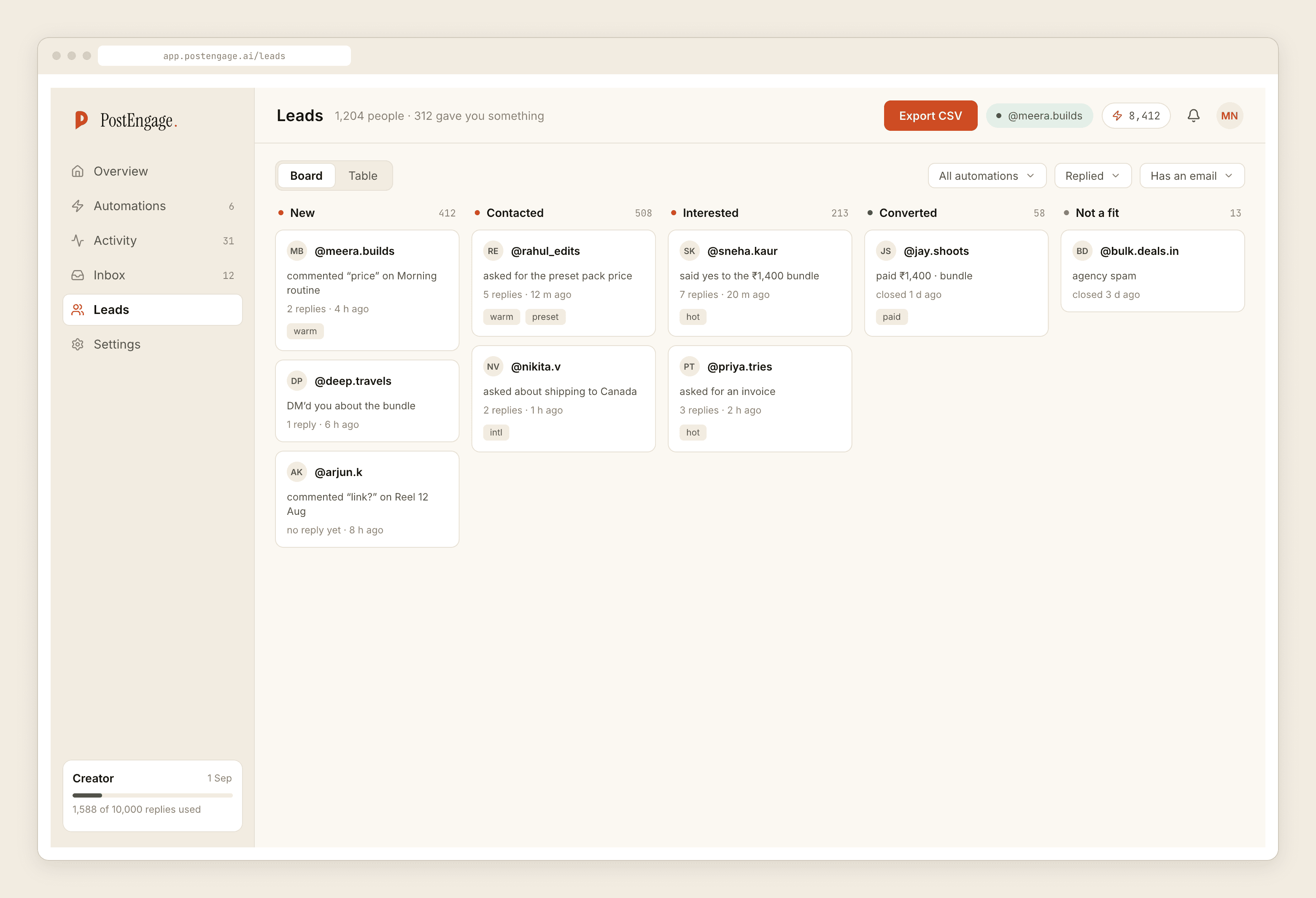
Capture-to-Leads records it, and the export is a CSV file. There are no one-click integrations into a CRM, no email sync, no automatic enrichment. A row, a file, your spreadsheet. That is a small promise and it is a true one.
The number that quietly matters more
If you want a metric to watch instead of views, watch the ratio of replies to frames posted — not as a benchmark to compare against anyone else, because no honest benchmark exists for your account, but against your own last month.
A week of stories with no ask produces almost no replies regardless of how many people watched. A week where every third frame carried one specific, typeable ask produces a noticeably different inbox. That comparison is available to you for free and it is more informative than any figure someone else publishes.
What we do not do here
No follower growth feature. No analytics product. No view tracking, no viewer scraping, no way to see who watched from inside our app, and no scheduling or publishing of stories. We do not post anything to your account.
What we do is answer the people who wrote to you, inside the window the platform allows, at a rate that does not put the account at risk, and record them if you want them recorded. On stories that means typed replies, emoji, and question sticker answers — the three things that actually arrive.
The frame to post tomorrow
One image, one sentence, one question sticker whose answer contains a word you can trigger on. A narrow keyword list. A templated acknowledgement, which is free and unlimited, followed by a human turn. Quiet hours set to your audience's evening rather than yours.
Then read what came in. The gap between four hundred views and eleven replies is not a software problem and no tool closes it — it closes when the frame asks for something worth typing. The surface reference is here if you want the complete list of what a story can and cannot produce, and the funnel version is here.