Compliance · 5 min read
Running Instagram Automation Makes You a Data Controller

There is a comfortable misreading of privacy law that goes: the tool holds the data, so the tool has the problem. It does not work that way. You chose to run an automation on your posts, you decided what it captures, you decide who on your team can read it, and you decide how long it stays. Under most privacy regimes that combination is what makes somebody the responsible party — the vendor is processing on your instructions.
This post is about the duties that land on your side of that line. What is actually stored, and how the export and erasure work, is a separate post; this one assumes you already know and asks what you now owe.
The moment the duty starts
Not when you sign up. When your first automation goes live on a post.
Before that, the messages people send you are just an inbox and you are a person answering it. After that, you are systematically processing incoming messages against rules you wrote, and — if capture-to-Leads is on — extracting contact details into a store you control for a purpose you had in mind. That is the shift. It is small in effort and large in category.
Answering DMs yourself
Running an automation
Consent is not a checkbox you can add to a comment
People sometimes ask where the consent tick-box goes in a comment-to-DM flow. There is nowhere to put one, and pretending otherwise is how bad policies get written.
What you have instead is context. Somebody commented a keyword on your post, in public, in order to get a thing. Replying to that is what they asked for. That is a defensible basis for the reply itself in most readings, and it is much weaker as a basis for what happens next.
So the line worth drawing is between the reply and the retention. Replying is the conversation they started. Keeping their email in a list and mailing them next quarter is a different purpose, and the person who typed the email address to get a price list did not obviously agree to that. If you intend to market to them later, say so in the message that collects the address. One clause is enough. "Bhej rahe hain — drop your email and we'll also send the monthly drop list" is honest, in the voice people actually use, and it costs you nothing.
Replying to a person who asked is one purpose. Building a mailing list out of them is a second one, and it needs its own sentence.
Notice, in the place people can see it
Your privacy policy should be able to survive the question "does this describe what your Instagram automation does?" Most cannot, because they were written for a website form.
Three additions cover most of it. That automated replies are sent to comments and messages on your Instagram account. That contact details a person provides in a message may be stored. That a third-party processor is involved in delivering those replies. Name the categories, not the internals.
If you operate in a jurisdiction with a notice-and-consent regime, this is also where the specifics of that regime bite, and where a template pulled off the internet will let you down.
Who on your team can read a DM
This is the duty most businesses actually fail, and it has nothing to do with law until it does.
A shared inbox means a customer's message is readable by everyone with the login. Add a freelancer for a launch, forget to remove them, and six months later a person who has no relationship with your business can read every DM your customers sent you. Nobody notices because nothing breaks.
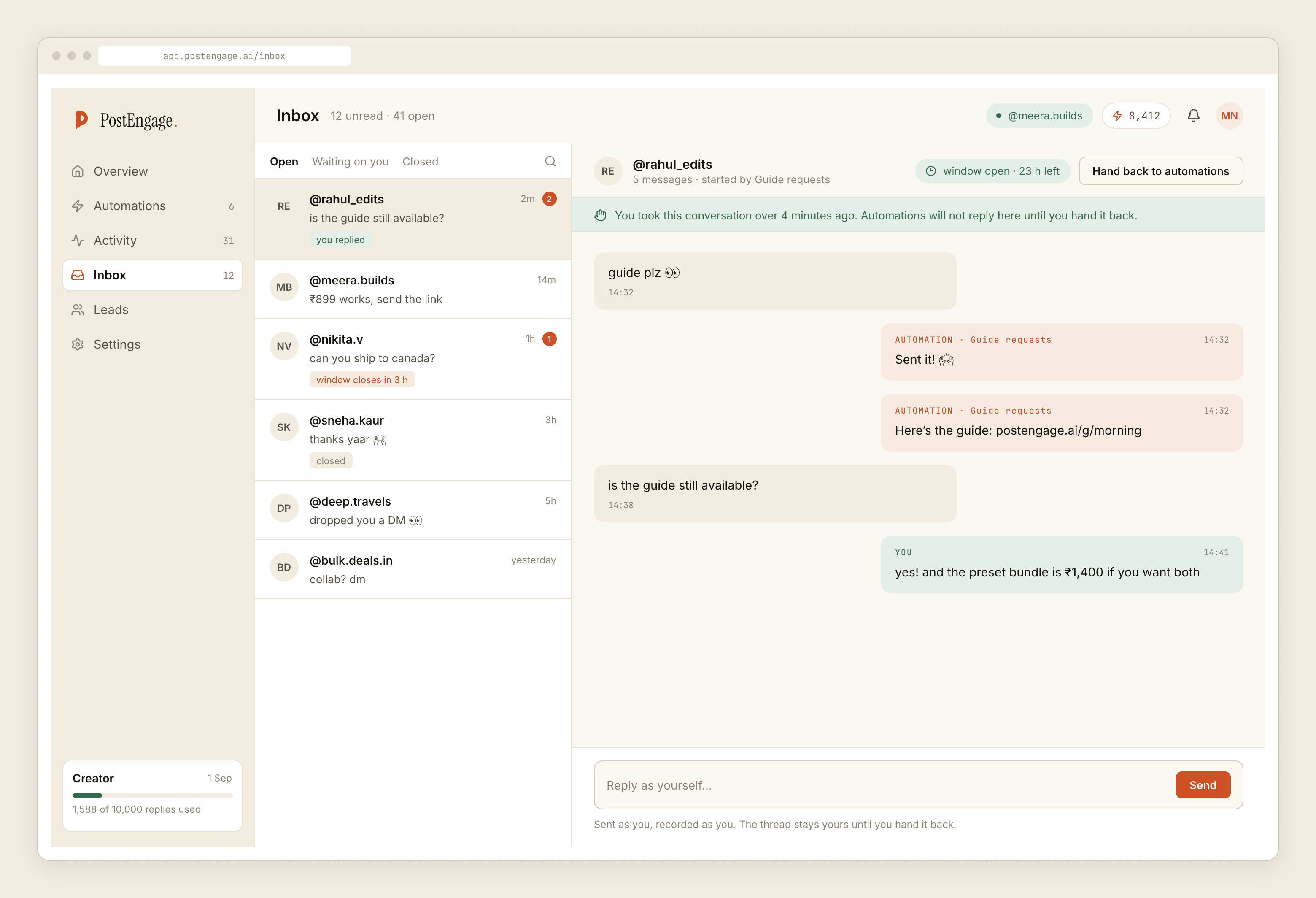
Minimum viable discipline: a list of who has access, a reason next to each name, and a habit of removing people the week they stop working with you. Takeover — automation standing down the moment a human replies by hand — means humans genuinely are in these threads, so treat access to them as access to customer records, because that is what it is.
Retention is a decision, so make it once
Automation makes retention accidental. Messages accumulate because nothing deletes them, and "we keep everything" becomes a policy by default rather than by choice.
Decide it deliberately instead, and write the decision down somewhere you will find it again:
- Leads. How long is a captured email useful to you? A lead from a launch two years ago is not a lead, it is a liability with a name.
- Threads. You need conversation history to answer "what did we tell this customer?" That is a real reason to keep it. It is not a reason to keep it forever.
- The refusal log. Activity records every blocked reply with its reason. This is your evidence that the automation behaved, and it is worth keeping longer than you think, for the same reason you keep invoices.
When somebody asks
Requests arrive as ordinary messages, not as formal letters with the right words in them. "Delete my number yaar" is a request. Treat it as one.
Have a route: someone owns these, the export exists, deletion of a lead record is a real action, and a person who says stop is not re-triggered by their next comment. Where the request touches data the vendor holds, forward it — but the person asking is your customer, and the answer comes from you.
What the vendor owes you back
Being the responsible party does not mean carrying it alone. From a processor you are entitled to expect an honest description of what is stored, an export you can actually download, an erasure path that covers everything rather than the obvious tables, and no surprise about where the data physically sits. If a vendor cannot describe those in specifics, you have found something out. The fifteen-minute audit covers how to ask.
The uncomfortable summary: the tool can make the duty easy to discharge, and it cannot take the duty off you.