Playbooks · 5 min read
Instagram DM Conversion Rate Benchmarks Are All Guesswork
On this page
- A rate needs three agreements, and benchmarks supply none of them
- Four denominators, one funnel, four honest answers
- Why we cannot even give you our own users' numbers
- The comparison that survives: your own previous month
- And the honest caveats on that comparison too
- What to do instead of hunting for the number

We do not publish conversion benchmarks, and it is not modesty. We have no attribution, no link tracking and no conversion events, so we could not compute one from our own users even if we wanted to. Any table we put on this page would be a table we made up.
That leaves a more useful question than "what is normal": why does the number in somebody else's benchmark table not mean what you think it means, and what should you compare against instead.
A rate needs three agreements, and benchmarks supply none of them
Before a percentage exists, three things have to be settled, and different people settle them differently without saying so.
- Who is in the population. Accounts of what size, in which country, selling what, at what price. A benchmark drawn from information products and a benchmark drawn from local service businesses are describing two unrelated behaviours under one heading.
- What counts as a conversion. A reply? A lead captured? A booked call? A payment? These are four different events with four different difficulties, and all four get called conversion.
- What the denominator is. This is the one that quietly does all the work, and it is almost never printed next to the number.
Four denominators, one funnel, four honest answers
Take a single comment-to-DM automation running for a week. It produced some number of conversations that ended in a sale. Now pick what to divide it by.
Divide by the people who saw the post and the rate is small. Divide by the people who commented your keyword and it is larger. Divide by the people who actually received the DM — the ones who got past window, dedupe, cooldown and the rest of the gate — and it is larger again. Divide by the people who replied to your DM at least once, and it is larger still, because you have quietly restricted the population to people who were already in a conversation.
Same week, same account, same sales. Four numbers, each of which can be called "Instagram DM conversion rate" without anyone lying.
The first denominator on that list is also one we would never see. Reach and impressions live in Instagram Insights. An automation tool receives events — a comment arrived, a message arrived — and never learns how many people scrolled past. So the most conservative version of the rate is not one anybody in this category can compute.
Why we cannot even give you our own users' numbers
Sometimes the request is smaller: never mind the industry, what do your customers see?
Same answer, for a structural reason rather than a policy one. There are three data stores in this product — Activity, Leads and the credit ledger — and none of them observes what happened after a person left the conversation. No purchase event, no order ID, no pixel, no callback from your payment provider. What one row in each store can and cannot tell you is documented in detail, and the short version is that the join between a conversation and a rupee does not exist here.
A vendor who does publish that number has either got a denominator from somewhere it should not have come from, or redefined the word to mean something much smaller than the reader assumes.
The comparison that survives: your own previous month
Your account last month is the only population that shares your audience, your price, your posting habits and your definition of a conversion. It is the comparison worth making, and it is available to anybody willing to keep a record, because nothing here keeps one for you.
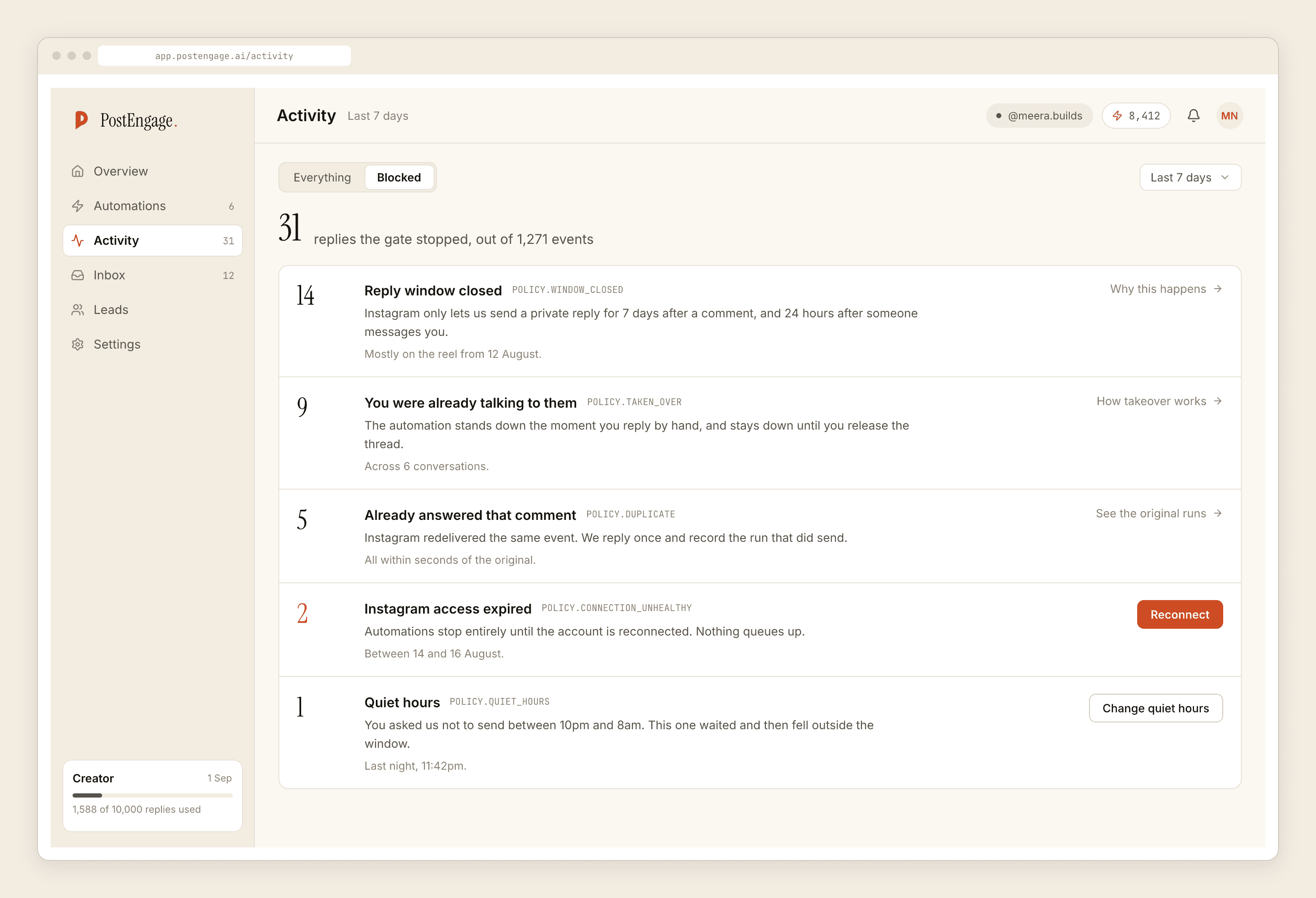
Compare counts, not rates. Leads captured. Replies sent. Threads you took over. The refusal reason that showed up most.
And the honest caveats on that comparison too
Even against yourself, a month is a noisy unit. Before you conclude anything from a movement, check whether any of these moved first.
How much you posted. Fewer posts, fewer comments, fewer conversations. This dominates almost every other effect.
Which posts aged out. Comments give you seven days from the comment. A campaign that ran hot in the first fortnight and then stopped attracting comments will show a decline that has nothing to do with your copy.
Whether one post travelled. A single Reel reaching strangers can produce more volume than the rest of the month combined, and strangers convert differently from your own followers. One good month built on one Reel is not a new baseline.
What you changed. If you rewrote a template on the ninth, you have two different experiments inside one month and no way to separate them. Changing one thing and reading the before and after is a real technique with real traps, and it is not the same as a test.
Against a benchmark you learn whether you resemble strangers. Against yourself you learn whether last month's change worked.
What to do instead of hunting for the number
Pick the one event you actually want and count it by hand. If the event is a booked call, count booked calls in your calendar. If it is a sale, count sales in your invoices and add "how did you hear about us" to your own checkout or intake form, which is imperfect, self-reported, and still the only real bridge between the inbox and the money.
Then hold that count next to your own count from the previous month, and next to the cost side, which is exact to the rupee because credits are metered one per generated reply and templated replies are free.
That gives you a defensible sentence — this many hands raised, this much spent, this many closed, and here is what changed. It is less satisfying than a benchmark and it has the advantage of being about you. If someone is asking you for the number in a report, the honest shape of that report is worth reading before you write it.