Voice DNA · 5 min read
Brand Voice on Instagram When Nobody Owns the Outbox

For a solo creator this is a solved problem. One person writes the replies, that person's replies are the voice, done. Everything written about AI and brand voice quietly assumes that setup.
A brand does not have it. A brand has a voice document written by an agency, captions written by a social lead, DMs answered by two people on rotation and occasionally by an intern during a launch, plus a legal position on what may be claimed. There is no single outbox. That is not a tooling problem, and no feature fixes it. It is a decision the brand has to make before any of this is worth switching on.
The eligibility rule forces the first decision
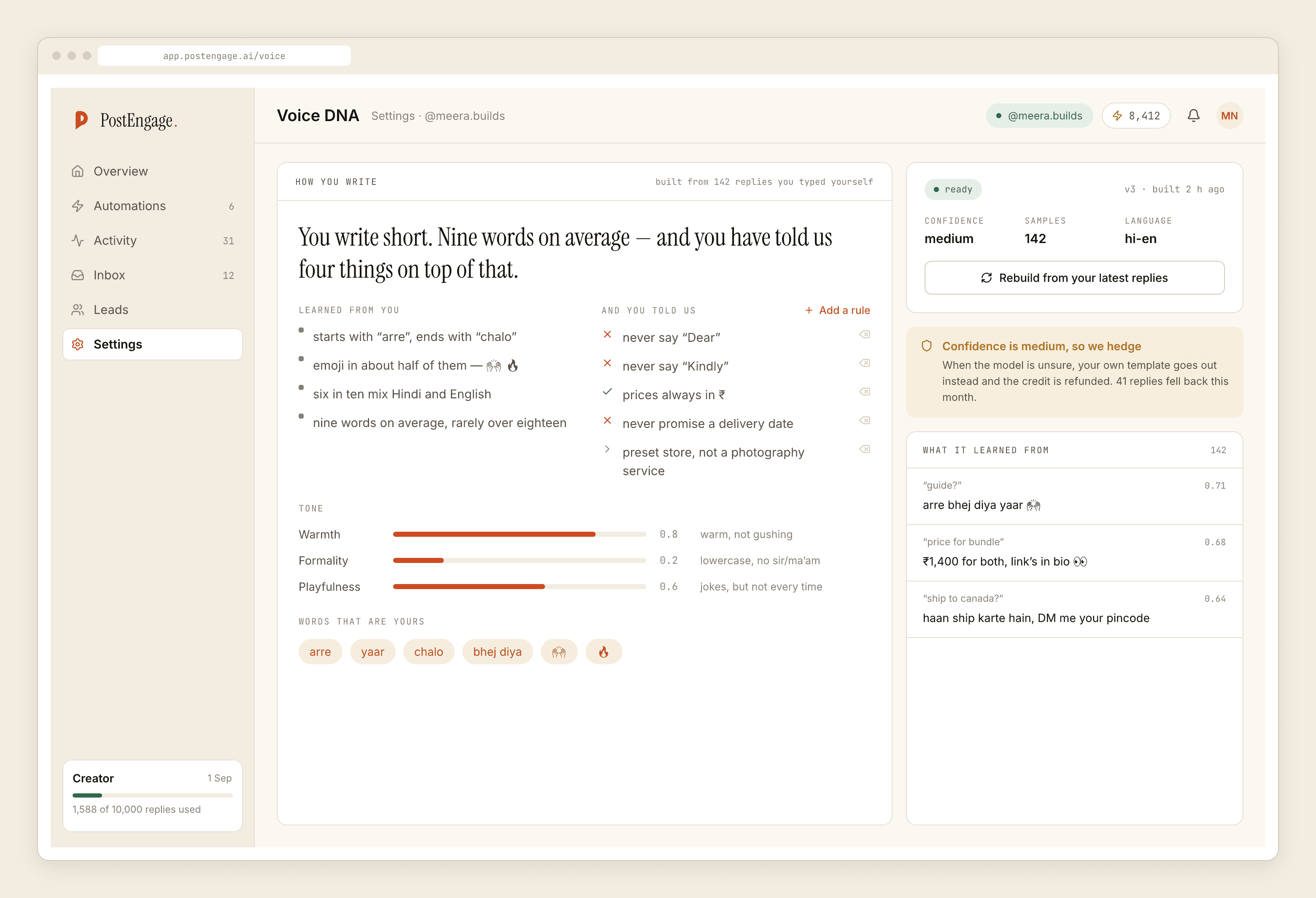
A voice profile is built from replies the account owner actually wrote. There is no version of it that ingests a brand book, because a brand book is a description and the input is evidence.
So somebody's replies have to be the reference, and the brand has to say whose.
What the brand book contains
What the DM outbox contains
The document on the left is not wrong. It is simply about a different artefact. It describes how the brand speaks when it is broadcasting, and a DM is not a broadcast — it is a reply to one person who asked one thing.
In practice the person whose replies should be the reference is whoever answers the most DMs and gets the fewest complaints. That is usually the community manager. It is almost never the person who commissioned the brand book, and this is the point where the conversation gets political, which is why it is better to have it deliberately than to discover it three weeks in.
Where brand approval goes wrong
Committees are good at approving adjectives and bad at approving replies. If you circulate "the AI will be warm and helpful", six people will agree and none of them will have learned anything.
Circulate ten real generated replies to ten real messages from last month instead. Disagreement appears immediately and it is specific — somebody objects to lowercase, somebody objects to the emoji, somebody objects that the reply promised a restock date. Those are resolvable. Adjectives are not.
The failure modes are different from a creator's
A creator's worst case is sounding slightly flat. A brand's worst cases are more expensive and they are not really about voice at all.
Claims. A generated reply that says "yes, this is safe during pregnancy" or "guaranteed delivery by Friday" is a liability regardless of how on-brand it sounds. This is not a tone setting. It is a category of question that should not reach the model.
Prices and offers. Brands change prices more often than creators, and campaign pricing has an end date. A profile knows nothing about your price list. If the number is not in something a person typed, do not let a reply contain a number.
Consistency across shifts. Two people answering the same inbox in visibly different registers is the thing customers actually notice, and automation makes it worse before it makes it better — now there is a third register.
Complaints during a launch. The volume spike is exactly when an automated reply under an angry comment does the most damage.
For a brand, the risk is not that the automated reply sounds wrong. It is that it sounds exactly right while saying something the company cannot stand behind.
Enforce constraints as structure, not as tone
The instinct is to write the constraints into the voice — "never promise delivery dates", "avoid medical claims". Instructions like that are aspirational. Structure is not.
- Move every fact into a template. Prices, shipping timelines, return policy, sizing. Templated replies are free and unlimited and a credit is spent only when the AI writes something new, so this is also the cheapest configuration available. The fact is then something a person typed and approved, not something inferred.
- Use negative keywords for the categories you will not touch. Refund, complaint, allergy, legal — whatever your regulated surface is. A message that matches those should produce no automated reply at all.
- Let takeover do the escalation. The moment a human replies to a thread by hand, automation stands down on that thread. No separate handoff process to maintain and nothing to remember during a launch.
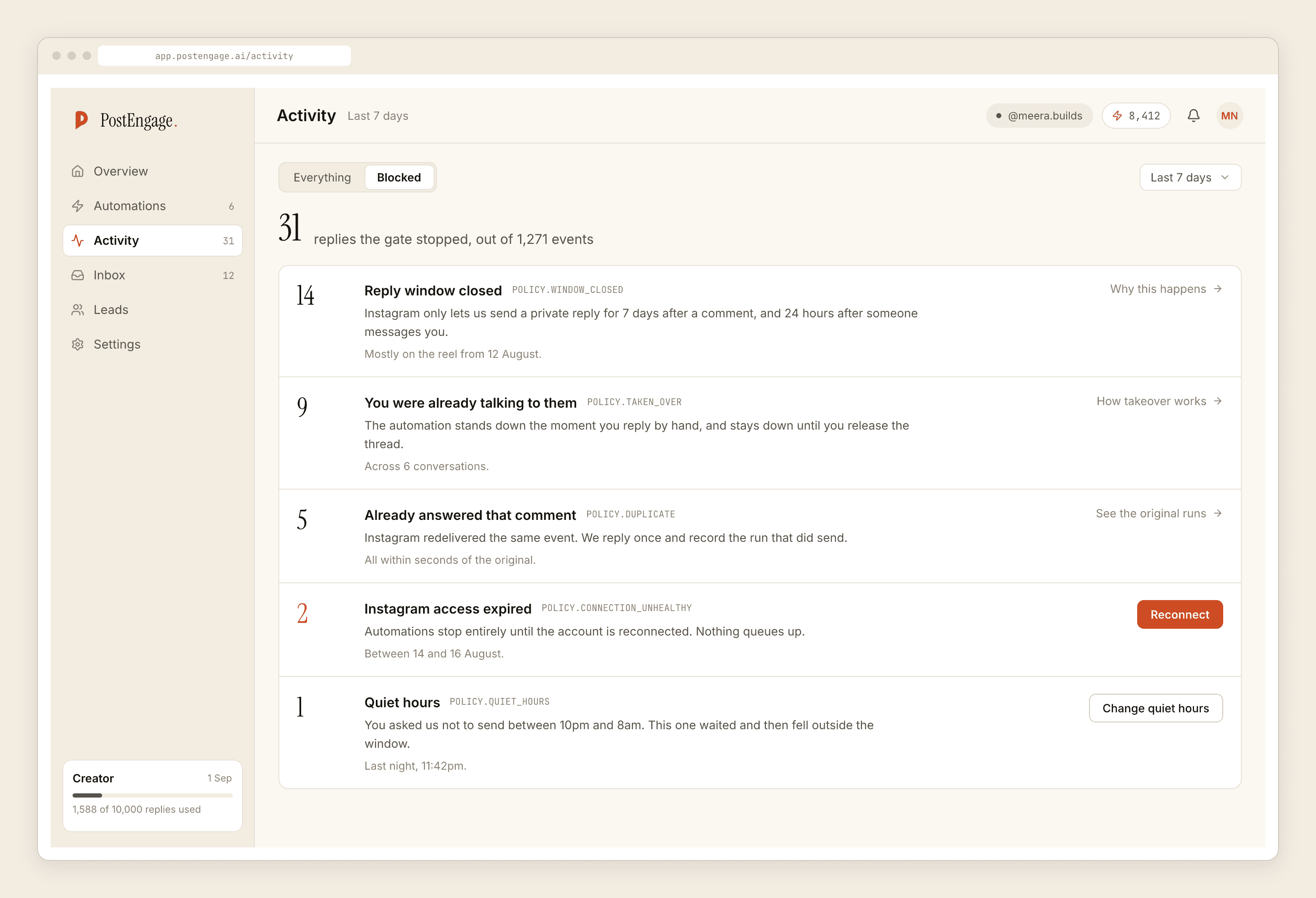
- Read the blocked list weekly. Ten checks run before any send in a fixed order, ending with
content_safety, and a blocked reply is recorded with its reason. For a brand this is the compliance artefact — it is the record of what the system refused to say on your behalf.
What to agree before switching anything on
Four decisions, and they are all organisational rather than technical.
Whose replies are the reference. What the brand may never assert in a DM without a human. Who reads the review queue, where low-confidence replies land instead of being sent. And who is allowed to change any of it — because a voice that four people can edit is four voices with extra steps.
Get those settled and the setup itself is unremarkable; the first-week guide is the same for a brand as for anybody else. Keeping the voice steady after launch — through staff changes, festive campaigns and gradual drift — is a separate discipline and has its own post. And if the underlying worry is account safety rather than tone, that question is answered here.